
Products















We are actively taking measures to improve product quality levels.
Applications








Why Hamamatsu?
Support


Our company





Investors





Japan (EN)
Select your region or country.
Initiatives
Candidates for Directors and Audit & Supervisory Board Members
The Articles of Incorporation stipulate that the term of directors is one year and the term of Audit & Supervisory Board Members is four years. Directors and Audit & Supervisory Board Members are elected when attending shareholders with a majority of voting rights approve their appointment at a general meeting of shareholders in which at least one third of the total voting rights of all shareholders are exercised by the attending shareholders.
Candidates for director are required to have deep knowledge of photonics, a desire to explore the frontiers of light and an entrepreneurial spirit with passion for a new industry. To put these qualities into practice, candidates should be capable of implementing bold reforms, backed by leadership and teamwork. Based on these criteria, the Company selects candidates while taking into consideration gender, expertise and other diversity in the composition of the Board of Directors, as stated in Article 13 of the Basic policy on corporate governance the skills matrix, and through a comprehensive assessment of their performance, achievements, character, ethics and other factors. Furthermore, in order to enhance fairness, transparency, and objectivity in the selection of candidates and to earn the trust of our shareholders, we consult in advance with the Nomination and Compensation Committee —a committee composed of a majority of Outside Directors—and The Nomination and Compensation Committee Regulation clearly stipulates that the Board of Directors shall respect the Committee’s reports.
Candidates for Audit & Supervisory Board Members are required to fulfill their duties from an independent and objective standpoint. Candidates should be individuals of outstanding character, insight and abilities, abundant experience, and high ethical standards. At least one Audit & Supervisory Board Member is appointed with appropriate knowledge of finance and accounting.
Outside Directors and Outside Audit & Supervisory Board Members
We strive to establish systems for providing and sharing the necessary information so that our outside directors and outside Audit & Supervisory Board Members can fully exercise their advisory and supervisory functions from an independent standpoint. In particular, with a view to enhancing the quality of deliberations at Board of Directors meetings, we focus on initiatives to provide outside directors and outside Audit & Supervisory Board Members with information on agenda items in advance and to promote their understanding of those items.
・Advance distribution of materials on matters for resolution
・Prior explanation of the agenda as necessary
・Reporting of views of internal Audit & Supervisory Board Members
・Ensuring appropriate access to necessary internal information, such as minutes of the Board of Executive meetings
Through these initiatives, we have established a system in which outside directors and outside Audit & Supervisory Board Members actively participate in the deliberations of the Board of Directors meetings based on their extensive expertise, thereby contributing to improved management transparency and objectivity, as well as strengthened corporate governance.
【Officer in charge of contact point for outside directors and outside Audit & Supervisory Board Members】
Hiroshige Takada (Executive Officer, Chief of Executive Office)
Compensation scheme for Directors
Compensation for Directors and Audit & Supervisory Board Members is as follows.
【Compensation data for Directors and Audit & Supervisory Board Members】
| Compensation of directors | Fixed Remuneration | 720 million yen or less per year (including an amount within 120 million yen per year for Outside Directors) | Determined at the December 22, 2023 ordinary general meeting of shareholders |
|---|---|---|---|
| Short-term performance-linked Remuneration | |||
| Restricted Stock Remuneration | 200 milliom yen or less per year (Excluding Outside Directors) |
Determined at the December 20, 2019 ordinary general meeting of shareholders |
|
| Compensation of Audit & Supervisory Board Members | Cash Remuneration | 10 million yen or less per month | Determined at the December 17, 2021 ordinary general meeting of shareholders |
【Remuneration Policy】
On the basis of the conviction that light has unlimited possibilities, the Company strives to pursue the unknown and unexplored. Based on new technologies and knowledge the Company creates new markets that contribute to a better society and a healthier planet.
Since these philosophies cannot be achieved in the short term, the Company requires its Directors to achieve results from a medium-to long-term perspective, not from a short-term perspective. Therefore, the Company considers that fixed remuneration is suitable as the base remuneration for Directors. In addition, the Company has introduced short-term performance-linked remuneration in consideration of the need to achieve stable performance improvement in each fiscal year in order to respond to shareholders' entrustment.
On the other hand, the Company has introduced stock-based remuneration (restricted stock remuneration) with the aim of contributing to the sustainable enhancement of corporate value from a long-term perspective, standing on the same standpoint as our shareholders.
As a result, the remuneration for Directors (excluding Outside Directors) consists of (1) fixed remuneration, (2) short-term performance-linked remuneration, and (3) stock-based remuneration. Since the Company places importance on a medium-to long-term perspective, the Company has structured the ratio of these remunerations to be generally 70:15:15*. In addition, the remuneration for Outside Directors is fixed remuneration only.
* Short-term performance-linked remuneration may increase or decrease depending on the business performance of each fiscal year. Therefore, the actual ratio may change. In addition, above ratio may not be applied to Officers who concurrently serve as employees due to the relationship with their salaries as employees.
A summary of the remuneration system for Directors is as follows:
1. Involvement of the Nomination and Compensation Committee
Remuneration for Directors is determined on an individual basis by the Board of Directors. Decisions by the Board of Directors are made after consultation with the Nomination and Compensation Committee, the majority of whose members are Outside Directors. The Nominating and Compensation Committee regulations stipulate that the Company respect the reports of the Nominating and Compensation Committee.
2. Summary of each remuneration
Remuneration for Directors consists of (1) fixed remuneration, (2) short-term performance-linked remuneration, and (3) stock-based remuneration. The ratio of these remunerations shall be 70:15:15. Short-term performance-linked remuneration changes in accordance with business performance.
A summary of each remuneration is as follows:
(1) Fixed Remuneration
The amount of monthly fixed remuneration is determined for each position, taking into consideration other companies' standards through surveys conducted by external organizations. Remuneration for Outside Directors is fixed remuneration only.
(2) Short-term performance-linked remuneration
Short-term performance-linked remuneration is determined individually by the Board of Directors based on the performance of each fiscal year and the Company pays the remuneration to Directors in December of each year. The index of this remuneration is the consolidated operating profit of our group. The remuneration amount is calculated by multiplying the base amount (generally 15 % of the entire remuneration) with the following coefficients: (i) the consolidated operating profit and (ii) each position. This remuneration serves as an incentive to improve business performance.
(3) Stock-based remuneration
Stock-based remuneration set at around 15% of total Director remuneration is decided for each Director at the Board of Directors and paid prior with a 30-year transfer restriction period from the record date.
【Remuneration scheme for Directors (Excluding Outside Directors)】

■Fixed remuneration: Determined by position taking into account industry benchmarks through surveys conducted by a third party organization.
■Restricted stock remuneration: Determined on an individual basis so as to constitute approximately 15 % of the Director’s total remuneration. The allotment agreement includes a provision allowing the Company to forfeit restricted stocks allotted to a Director if the Board of Directors determines that the Director has committed a material violation of laws, regulations, or internal company rules (Claw back clause).
■Short-term performance-linked remuneration: Determined on an individual basis by multiplying a base amount by a separately determined coefficient based on the consolidated operating profit for the fiscal year and a position.
Effectiveness evaluation of Board of Directors
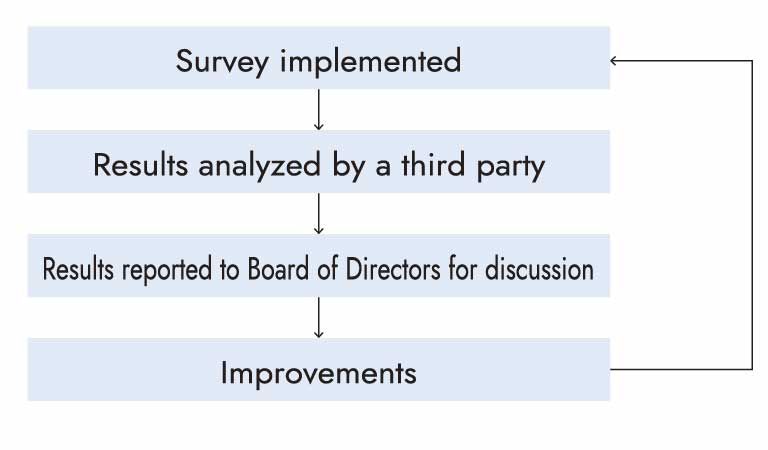
We evaluate the effectiveness of the Board of Directors to improve its functionality and enhance corporate value. With the support from a third party organization and by continuously implementing a cycle of surveys, analysis, and improvement, we aim to ensure a more objective and effective Board of Directors. The effectiveness evaluation conducted in September 2024 received generally positive feedback, and we believe that the effectiveness of the Board as a whole has been maintained. Meanwhile, we recognized issues such as oversight of the governance structure of the Group as a whole. In response, we have strengthened oversight systems, such as reporting of internal audits of subsidiaries to the Board of Directors, in addition to ongoing efforts to improve our governance system, the results of which have begun to manifest.
The effectiveness evaluation conducted in September 2025 also identified issues such as greater revitalization of discussions on company policy and strategy as well as continued strengthening of group-wide oversight in connection with corporate acquisitions. We will continue striving to improve the function of the Board of Directors by addressing and resolving these issues.
【Overview】
Target: Directors and Audit & Supervisory Board Members
Type: Self-evaluation using a five-grade evaluation and free-form descriptive questionnaire
Managed by: Third party organization
【Survey items】
- Overall operations and discussion items
- Support system for Directors and Audit & Supervisory Board Members
- Monitoring function
- Dialogue with investors
- Executive performance
- Operation of the Nomination and Compensation Committee
【Process】
Initiatives to strengthen corporate governance
| Year | Initiatives |
|---|---|
| 2015 | The percentage of independent Outside Directors rose to 14 % (2 members) |
| 2016 | Started the effectiveness evaluation of the Board of Directors |
| 2019 | Resolved to Introduce stock-based remuneration for Directors (Excluding Outside Directors) |
| 2020 | The percentage of independent Outside Directors rose to 27 % (3 members) Introduced Executive Officer System Entrusted the effectiveness evaluation of the Board of Directors to a third party |
| 2021 | The percentage of independent Outside Directors rose to 40 % (4 members) Reduced the Director's term of office from 2 years to 1 year Established the Nomination and Compensation Committee |
| 2023 | Resolved to Introduce short-term performance-linked remuneration for Directors (Excluding Outside Directors) |
| 2024 | Expanded the scope of the effectiveness evaluation of the Board of Directors to include the Nomination and Compensation Committee |
Training successors
To fulfill its corporate social responsibility on a sustainable basis, Hamamatsu Photonics believes it is vital to take effective steps to cultivate successors, not only for the president but also for directors. However, the Company has no officially stipulated procedures for cultivating successors.
Instead, the Company relies on a bottom-up process of manager development. A characteristic of the Company that has continued since its foundation is that each small manufacturing-group unit or “segment” is required to be profitable in its own right. Multiple small segments combine to comprise a manufacturing department, and the manufacturing departments combine to form a business division. Personnel in charge of each unit are asked to carry out management with an awareness of profitability. This arrangement enables managers to acquire the awareness and qualities they need to serve the Company as management professionals.
Training for Board members
We encourage directors and Audit & Supervisory Board Members to conduct voluntary self-training to enhance their ability to fulfill their duties. We also obtain training from outside sources.
【Examples of training topics】
2026: Business management and AI use
2025: Compliance and crisis management
2024: Dialogue with institutional investors
2023: Performance indicator
2022: Anti-corruption
2021: Revised Corporate Governance Code
2021: ESG management
2019: Patent Infringement Proceedings
2019: Cost of capital
2018: Directors’ duties and responsibilities
Prevention of conflict of interest
Our officers and employees will not engage in any conduct that conflicts with the interests of the Company for the benefit of an individual (including conflicts of interest and potential one) without just cause.
- Confirmation
-
It looks like you're in the . If this is not your location, please select the correct region or country below.
You're headed to Hamamatsu Photonics website for JP (English). If you want to view an other country's site, the optimized information will be provided by selecting options below.
In order to use this website comfortably, we use cookies. For cookie details please see our cookie policy.
- Cookie Policy
-
This website or its third-party tools use cookies, which are necessary to its functioning and required to achieve the purposes illustrated in this cookie policy. By closing the cookie warning banner, scrolling the page, clicking a link or continuing to browse otherwise, you agree to the use of cookies.
Hamamatsu uses cookies in order to enhance your experience on our website and ensure that our website functions.
You can visit this page at any time to learn more about cookies, get the most up to date information on how we use cookies and manage your cookie settings. We will not use cookies for any purpose other than the ones stated, but please note that we reserve the right to update our cookies.
1. What are cookies?
For modern websites to work according to visitor’s expectations, they need to collect certain basic information about visitors. To do this, a site will create small text files which are placed on visitor’s devices (computer or mobile) - these files are known as cookies when you access a website. Cookies are used in order to make websites function and work efficiently. Cookies are uniquely assigned to each visitor and can only be read by a web server in the domain that issued the cookie to the visitor. Cookies cannot be used to run programs or deliver viruses to a visitor’s device.
Cookies do various jobs which make the visitor’s experience of the internet much smoother and more interactive. For instance, cookies are used to remember the visitor’s preferences on sites they visit often, to remember language preference and to help navigate between pages more efficiently. Much, though not all, of the data collected is anonymous, though some of it is designed to detect browsing patterns and approximate geographical location to improve the visitor experience.
Certain type of cookies may require the data subject’s consent before storing them on the computer.
2. What are the different types of cookies?
This website uses two types of cookies:
- First party cookies. For our website, the first party cookies are controlled and maintained by Hamamatsu. No other parties have access to these cookies.
- Third party cookies. These cookies are implemented by organizations outside Hamamatsu. We do not have access to the data in these cookies, but we use these cookies to improve the overall website experience.
3. How do we use cookies?
This website uses cookies for following purposes:
- Certain cookies are necessary for our website to function. These are strictly necessary cookies and are required to enable website access, support navigation or provide relevant content. These cookies direct you to the correct region or country, and support security and ecommerce. Strictly necessary cookies also enforce your privacy preferences. Without these strictly necessary cookies, much of our website will not function.
- Analytics cookies are used to track website usage. This data enables us to improve our website usability, performance and website administration. In our analytics cookies, we do not store any personal identifying information.
- Functionality cookies. These are used to recognize you when you return to our website. This enables us to personalize our content for you, greet you by name and remember your preferences (for example, your choice of language or region).
- These cookies record your visit to our website, the pages you have visited and the links you have followed. We will use this information to make our website and the advertising displayed on it more relevant to your interests. We may also share this information with third parties for this purpose.
Cookies help us help you. Through the use of cookies, we learn what is important to our visitors and we develop and enhance website content and functionality to support your experience. Much of our website can be accessed if cookies are disabled, however certain website functions may not work. And, we believe your current and future visits will be enhanced if cookies are enabled.
4. Which cookies do we use?
There are two ways to manage cookie preferences.
- You can set your cookie preferences on your device or in your browser.
- You can set your cookie preferences at the website level.
If you don’t want to receive cookies, you can modify your browser so that it notifies you when cookies are sent to it or you can refuse cookies altogether. You can also delete cookies that have already been set.
If you wish to restrict or block web browser cookies which are set on your device then you can do this through your browser settings; the Help function within your browser should tell you how. Alternatively, you may wish to visit www.aboutcookies.org, which contains comprehensive information on how to do this on a wide variety of desktop browsers.
5. What are Internet tags and how do we use them with cookies?
Occasionally, we may use internet tags (also known as action tags, single-pixel GIFs, clear GIFs, invisible GIFs and 1-by-1 GIFs) at this site and may deploy these tags/cookies through a third-party advertising partner or a web analytical service partner which may be located and store the respective information (including your IP-address) in a foreign country. These tags/cookies are placed on both online advertisements that bring users to this site and on different pages of this site. We use this technology to measure the visitors' responses to our sites and the effectiveness of our advertising campaigns (including how many times a page is opened and which information is consulted) as well as to evaluate your use of this website. The third-party partner or the web analytical service partner may be able to collect data about visitors to our and other sites because of these internet tags/cookies, may compose reports regarding the website’s activity for us and may provide further services which are related to the use of the website and the internet. They may provide such information to other parties if there is a legal requirement that they do so, or if they hire the other parties to process information on their behalf.
If you would like more information about web tags and cookies associated with on-line advertising or to opt-out of third-party collection of this information, please visit the Network Advertising Initiative website http://www.networkadvertising.org.
6. Analytics and Advertisement Cookies
We use third-party cookies (such as Google Analytics) to track visitors on our website, to get reports about how visitors use the website and to inform, optimize and serve ads based on someone's past visits to our website.
You may opt-out of Google Analytics cookies by the websites provided by Google:
https://tools.google.com/dlpage/gaoptout?hl=en
As provided in this Privacy Policy (Article 5), you can learn more about opt-out cookies by the website provided by Network Advertising Initiative:
http://www.networkadvertising.org
We inform you that in such case you will not be able to wholly use all functions of our website.
Close