
Products












We are actively taking measures to improve product quality levels.
Applications







Why Hamamatsu?
Support


Our company





Investors




Japan (EN)
Select your region or country.

What is a spectrometer? | Spectrometers
What is spectral dispersion?
Spectral dispersion refers to the separation of light into its individual wavelengths. We can see phenomena that result from spectral dispersion in our everyday life. For example, a CD appears to have rainbow colors because the fine grooves on its surface act like a grating, dispersing the light that strikes it. Similarly, a rainbow appears after rain because water droplets suspended in the air act like a prism, dispersing sunlight.
A device that applies this phenomenon of spectral dispersion to measure the intensity of light at each wavelength is called a spectrometer. By dispersing light into its individual wavelengths and measuring the resulting spectrum, a spectrometer makes it possible to measure the color of a target or analyze its components.


Figure 1: Examples of spectral dispersion seen in everyday life
How light is dispersed
Spectrometers generally achieve spectral dispersion using a component called a dispersing element, which separates light into its individual wavelengths. Typical examples include prisms and gratings (diffraction gratings). Diffraction gratings have become the mainstream choice in many modern spectrometers due to their high dispersion characteristics.
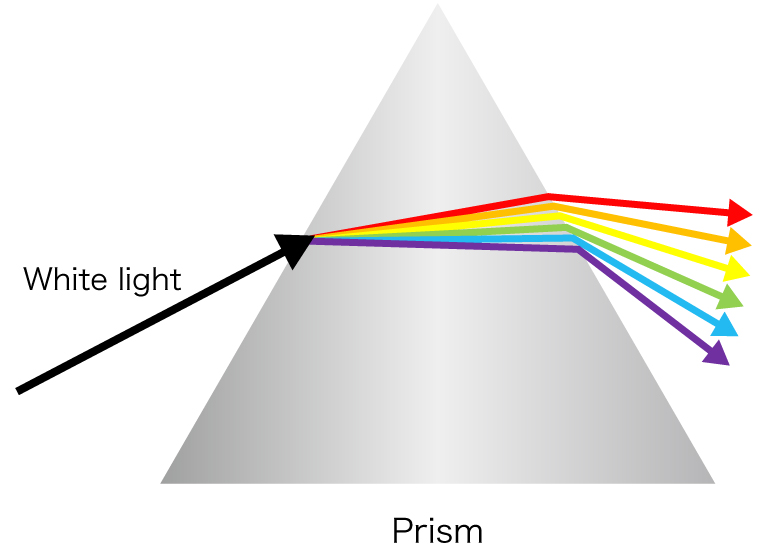
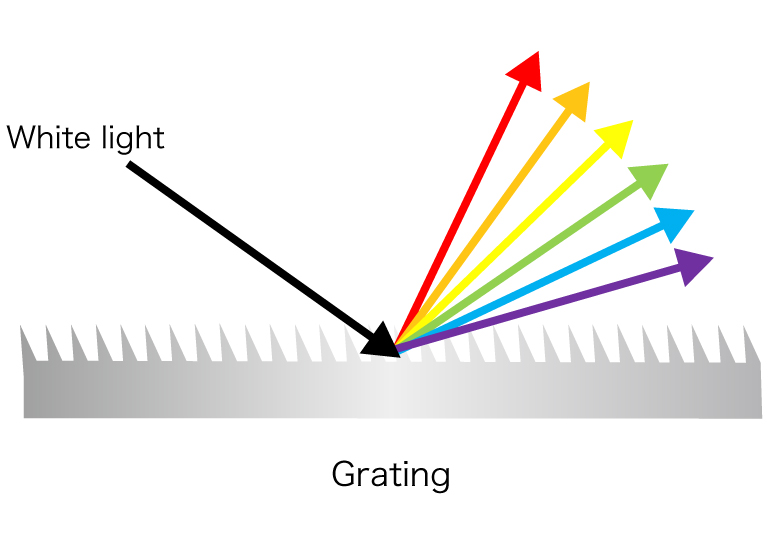
Figure 2: Examples of dispersing elements
What kind of data can be obtained with a spectrometer
A spectrometer measures the intensity of light at each wavelength. As shown in Figure 3, the data measured by a spectrometer is displayed as a graph with wavelength on the horizontal axis and light intensity on the vertical axis. This data is called a spectrum.
Spectrometers can measure various types of spectra, including a transmission spectrum, which shows the spectrum of light that has passed through the target; an absorption spectrum, which shows the amount of light absorbed by the target; and a fluorescence spectrum, which shows the intensity of fluorescence emitted by a target in response to excitation light.
The range of spectral data (spectral range) that can be measured and the fineness of the data (spectral resolution) vary depending on the spectrometer.
For details, see “Learn about spectrometer specifications”.
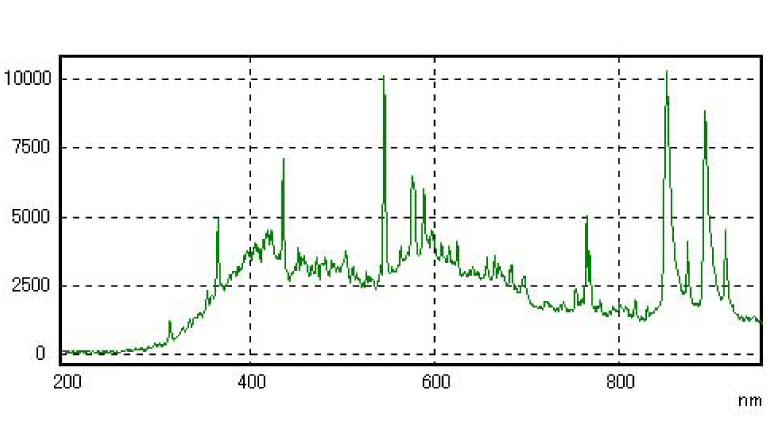
Figure 3: Example of spectral data
Applications of Spectrometers
Spectrometers are used for a wide variety of applications. Here are some examples of how spectrometers are used.
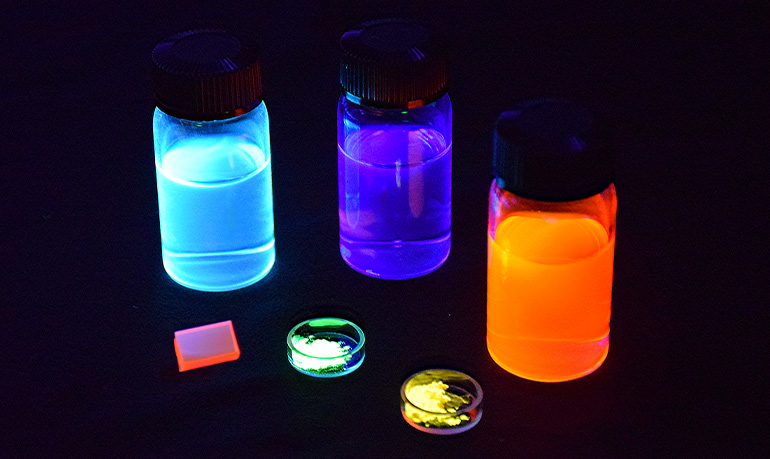
Luminescent material evaluation

Food iInspection

Film thickness measurement

Environmental monitoring

Plastic sorting

Astronomy

Optical communication

Material analysis

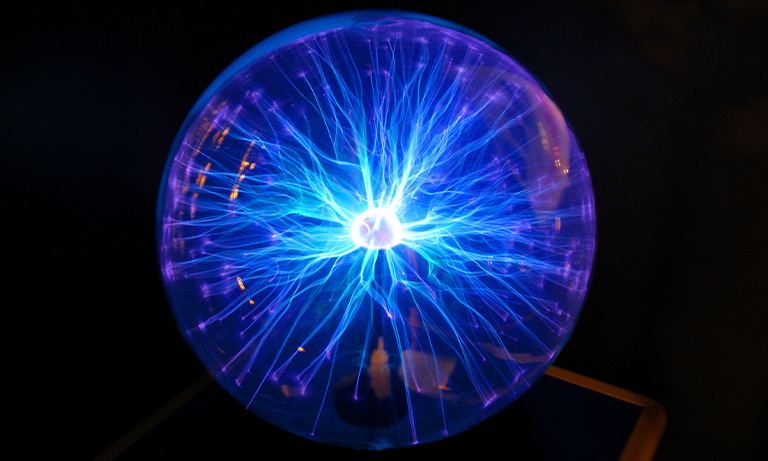
Plasma measurement
Color measurement

Types of spectrometers
Spectrometers are broadly classified into two types. One is dispersive spectrometers, which use a dispersing element such as a prism or grating. The other one is interferometric spectrometers, which use an interferometer such as a Michelson interferometer or Fabry-Perot interferometer.
The following sections explain the principle and mechanism of dispersive spectrometers and interferometric spectrometers, respectively.
Dispersive type
Dispersive spectrometers are spectrometers that use a dispersing element such as a prism or grating. Dispersive spectrometers are broadly divided into monochromators and polychromators.
Monochromators and polychromators
A monochromator is a spectrometer that uses a point sensor, such as a photomultiplier tube or photodiode, as its detector. Because the detector is a point sensor, an exit slit is placed in front of it to acquire only a specific range of wavelengths. Since the spectral resolution can be adjusted by changing the width of the exit slit, monochromators can achieve high spectral resolution. However, when measuring multiple wavelengths with a monochromator, the grating must be rotated, which results in longer measurement times compared with a polychromator.
A polychromator is a spectrometer that uses a CCD or CMOS line sensor as its detector. Because a line sensor has multiple pixels arranged along the wavelength direction, it can acquire multiple wavelengths simultaneously without rotating the grating. In a polychromator, the pixel size serves the role of an exit slit, so no exit slit is required in front of the detector. However, since the pixel size directly affects the spectral resolution, polychromators tend to have lower spectral resolution than monochromators.
| Spectrometer | Advantages | Disadvantages |
|---|---|---|
| Monochromator |
|
|
| Polychromator |
|
|
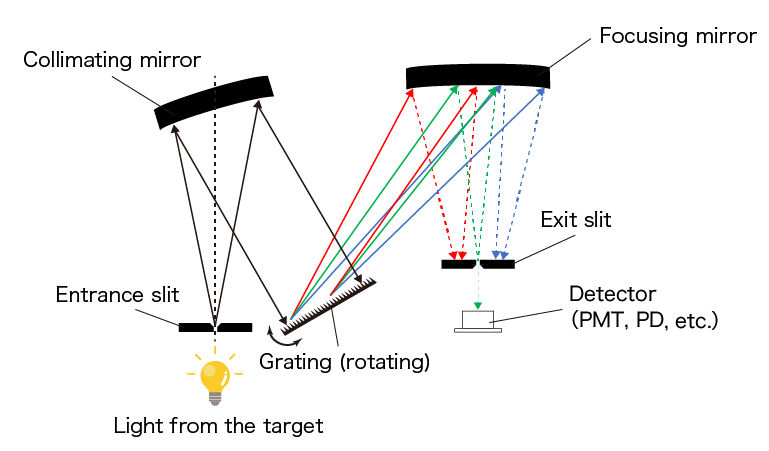
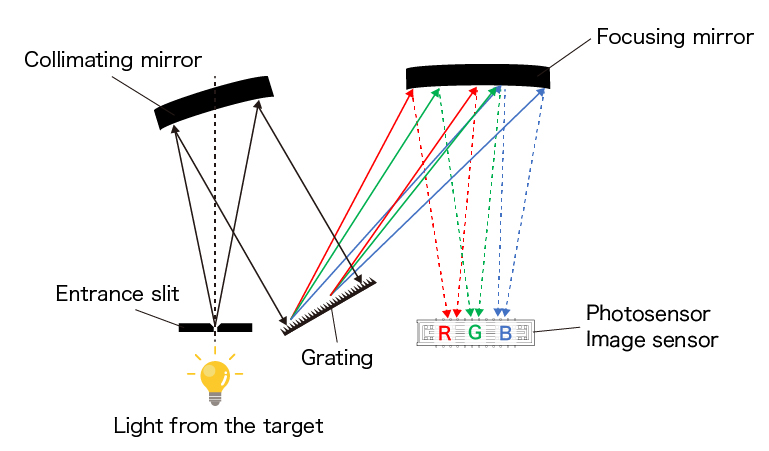
Figure 4: Structural diagram of a monochromator
Figure 5: Structural diagram of a polychromator
Interferometric Type
Interferometric spectrometers are spectrometers that use an interferometer such as a Michelson interferometer or a Fabry-Perot interferometer.
Fourier transform infrared spectroscopy (FTIR)
Fourier transform infrared spectroscopy (hereafter FTIR) is a spectroscopic method that obtains the light intensity at each wavelength by applying an interferometer called a Michelson interferometer, which consists of a movable mirror, a fixed mirror, a beam splitter, and a detector.
In the principle of FTIR, light emitted from the light source is split into two bams by the beam splitter, with one beam directed to the movable mirror and the other to the fixed mirror. The light reflected by each mirror then returns to the beam splitter, and the detector acquires the optical interference signal generated by the optical path difference between the two split beams. By mathematically separating the detected signal (Fourier transform), the light intensity at each wavelength can be obtained.
The main advantages of FTIR are as follows.
- High S/N through simultaneous measurement across the entire wavelength range (Fellgett advantage)
- High throughput without requiring a slit or similar component (Jacquinot advantage)
- High wavelength accuracy through laser calibration (Connes advantage)
Conventional FTIR instruments use a movable mirror driven by a stepper motor or similar mechanism, resulting in large benchtop instruments.
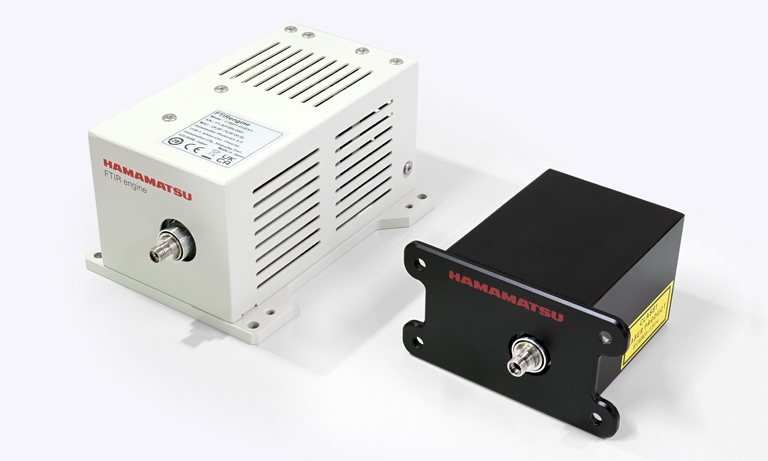
The Hamamatsu FTIR engine (FT-NIR spectrometer) successfully achieved an ultra-compact design by applying MOEMS (micro optical electro mechanical systems) technology to construct the optical interferometer.
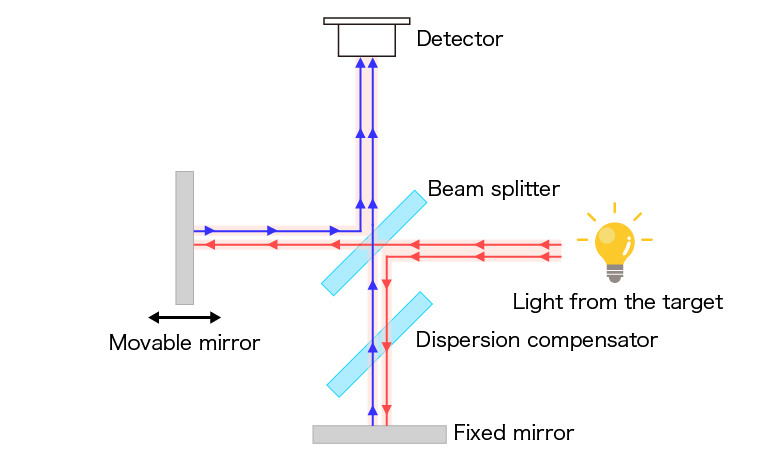
Figure 6: Schematic diagram of a typical Michelson interferometer
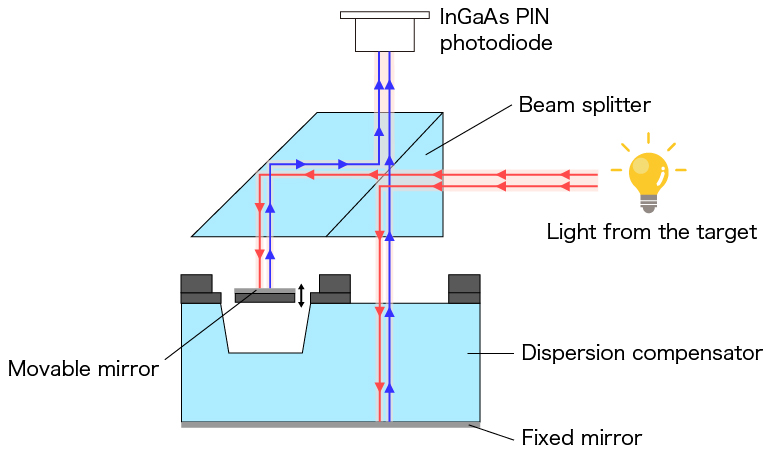
Figure 7: Schematic diagram of the Hamamatsu FTIR engine (FT-NIR spectrometer)
Fabry-Perot interferometer (FPI) spectrum sensor
A Fabry-Perot interferometer (hereafter FPI) is a spectroscopic device that extracts light of a specific wavelength by causing multiple reflections and interference of light between two reflecting surfaces. As light is repeatedly reflected between the two reflecting surfaces, it interferes with itself. Depending on its phase, the interfering light either reinforces or cancels itself out, and the phase differs depending on the wavelength. A Fabry-Perot interferometer adjusts the distance between the two reflecting surfaces to reinforce only a specific wavelength of light and selectively transmit it.
The Hamamatsu MEMS-FPI tunable filter has an upper mirror and a lower mirror that are arranged facing each other via an air gap. Voltage is applied across the mirrors, and the electrostatic attractive force is used to adjust the air gap. When the air gap is mλ/2 (m: integer), it functions as a filter that predominantly transmits light at wavelength λ. By combining a MEMS-FPI tunable filter with a single-element photosensor in a simple configuration, this product achieves an ultra-compact and low-cost spectral sensor.
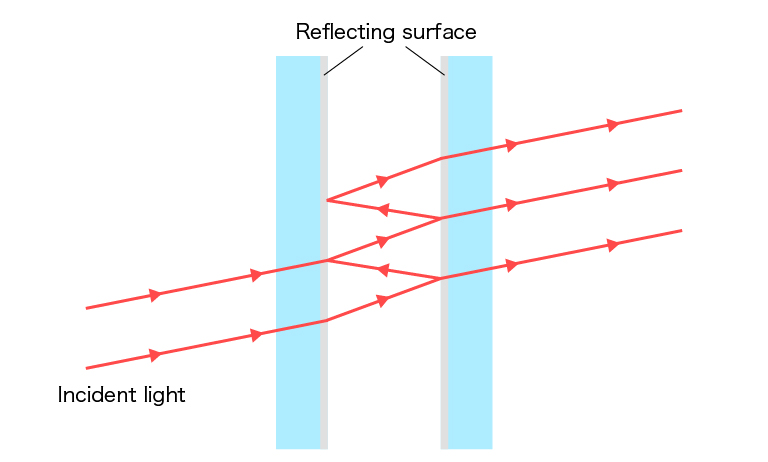
Figure 8: Schematic diagram of a Fabry-Perot interferometer
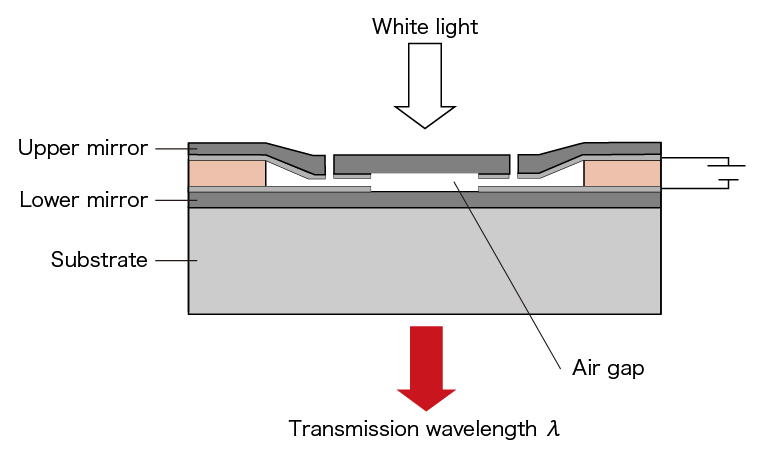
Figure 9: Schematic diagram of the Hamamatsu MEMS-FPI tunable filter
Hamamatsu spectrometer lineup
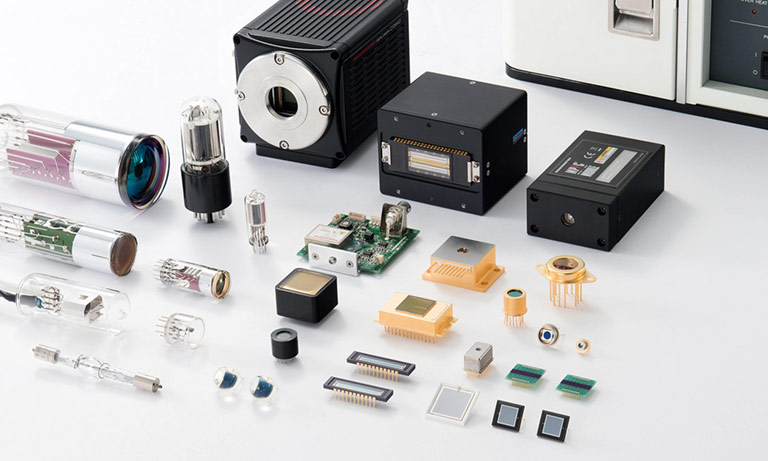
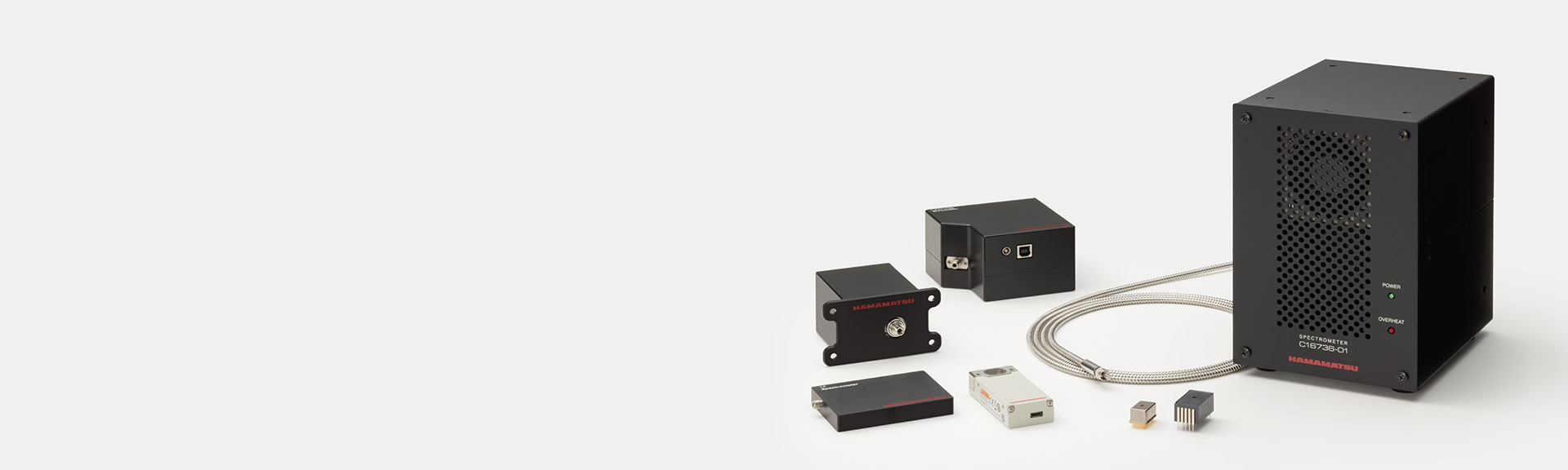
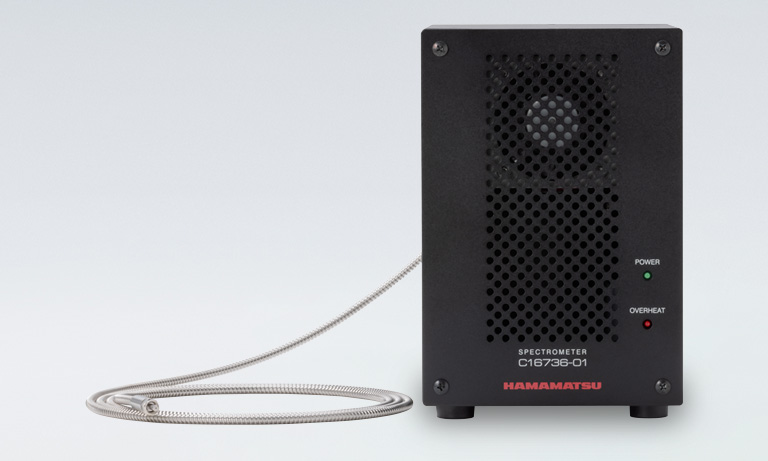
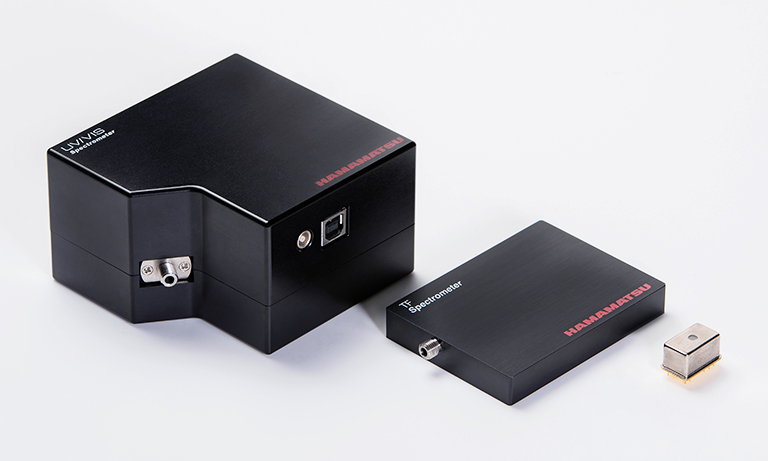
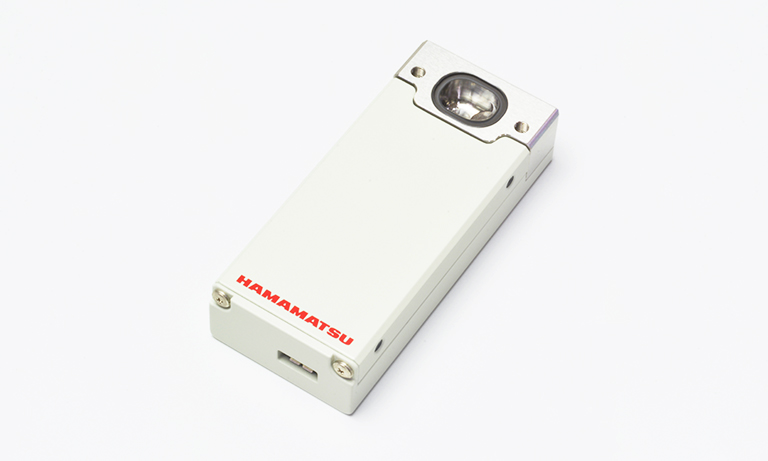
Hamamatsu Photonics offers a wide range of spectrometers, including high-performance spectrometers, compact mini-spectrometers, FTIR engines (FT-NIR spectrometers) with a built-in Michelson optical interferometer and control circuit, and MEMS-FPI spectroscopic modules with a built-in MEMS-FPI spectrum sensor and light source.
How to choose a spectrometer
Hamamatsu Photonics offers a lineup of various spectrometer types, including high-performance benchtop spectrometers, mini-spectrometers integrating an optical system, image sensor, and readout circuit into a compact housing, and extremely small, fingertip-sized spectrometer heads realized using MEMS and image sensor technologies.
This page provides tips for selecting the spectrometer that best suits your application from Hamamatsu's diverse spectrometer lineup. You can compare product specifications by spectral range, spectral resolution, and housing size.
Learn about spectrometer specifications
In addition to spectral range, spectral resolution, and housing size, there are various other specifications, such as dynamic range and sensor type, to consider when selecting a spectrometer.
For a more detailed understanding of spectrometer specifications and product comparison, see the “Learn about spectrometer specifications” page.
Application: luminescent material evaluation
The “Luminescent material evaluation” application page introduces the methods, principles, measuring devices, and measurement examples used to evaluate the characteristics of luminescent materials and light-emitting devices.
- Confirmation
-
It looks like you're in the . If this is not your location, please select the correct region or country below.
You're headed to Hamamatsu Photonics website for JP (English). If you want to view an other country's site, the optimized information will be provided by selecting options below.
In order to use this website comfortably, we use cookies. For cookie details please see our cookie policy.
- Cookie Policy
-
This website or its third-party tools use cookies, which are necessary to its functioning and required to achieve the purposes illustrated in this cookie policy. By closing the cookie warning banner, scrolling the page, clicking a link or continuing to browse otherwise, you agree to the use of cookies.
Hamamatsu uses cookies in order to enhance your experience on our website and ensure that our website functions.
You can visit this page at any time to learn more about cookies, get the most up to date information on how we use cookies and manage your cookie settings. We will not use cookies for any purpose other than the ones stated, but please note that we reserve the right to update our cookies.
1. What are cookies?
For modern websites to work according to visitor’s expectations, they need to collect certain basic information about visitors. To do this, a site will create small text files which are placed on visitor’s devices (computer or mobile) - these files are known as cookies when you access a website. Cookies are used in order to make websites function and work efficiently. Cookies are uniquely assigned to each visitor and can only be read by a web server in the domain that issued the cookie to the visitor. Cookies cannot be used to run programs or deliver viruses to a visitor’s device.
Cookies do various jobs which make the visitor’s experience of the internet much smoother and more interactive. For instance, cookies are used to remember the visitor’s preferences on sites they visit often, to remember language preference and to help navigate between pages more efficiently. Much, though not all, of the data collected is anonymous, though some of it is designed to detect browsing patterns and approximate geographical location to improve the visitor experience.
Certain type of cookies may require the data subject’s consent before storing them on the computer.
2. What are the different types of cookies?
This website uses two types of cookies:
- First party cookies. For our website, the first party cookies are controlled and maintained by Hamamatsu. No other parties have access to these cookies.
- Third party cookies. These cookies are implemented by organizations outside Hamamatsu. We do not have access to the data in these cookies, but we use these cookies to improve the overall website experience.
3. How do we use cookies?
This website uses cookies for following purposes:
- Certain cookies are necessary for our website to function. These are strictly necessary cookies and are required to enable website access, support navigation or provide relevant content. These cookies direct you to the correct region or country, and support security and ecommerce. Strictly necessary cookies also enforce your privacy preferences. Without these strictly necessary cookies, much of our website will not function.
- Analytics cookies are used to track website usage. This data enables us to improve our website usability, performance and website administration. In our analytics cookies, we do not store any personal identifying information.
- Functionality cookies. These are used to recognize you when you return to our website. This enables us to personalize our content for you, greet you by name and remember your preferences (for example, your choice of language or region).
- These cookies record your visit to our website, the pages you have visited and the links you have followed. We will use this information to make our website and the advertising displayed on it more relevant to your interests. We may also share this information with third parties for this purpose.
Cookies help us help you. Through the use of cookies, we learn what is important to our visitors and we develop and enhance website content and functionality to support your experience. Much of our website can be accessed if cookies are disabled, however certain website functions may not work. And, we believe your current and future visits will be enhanced if cookies are enabled.
4. Which cookies do we use?
There are two ways to manage cookie preferences.
- You can set your cookie preferences on your device or in your browser.
- You can set your cookie preferences at the website level.
If you don’t want to receive cookies, you can modify your browser so that it notifies you when cookies are sent to it or you can refuse cookies altogether. You can also delete cookies that have already been set.
If you wish to restrict or block web browser cookies which are set on your device then you can do this through your browser settings; the Help function within your browser should tell you how. Alternatively, you may wish to visit www.aboutcookies.org, which contains comprehensive information on how to do this on a wide variety of desktop browsers.
5. What are Internet tags and how do we use them with cookies?
Occasionally, we may use internet tags (also known as action tags, single-pixel GIFs, clear GIFs, invisible GIFs and 1-by-1 GIFs) at this site and may deploy these tags/cookies through a third-party advertising partner or a web analytical service partner which may be located and store the respective information (including your IP-address) in a foreign country. These tags/cookies are placed on both online advertisements that bring users to this site and on different pages of this site. We use this technology to measure the visitors' responses to our sites and the effectiveness of our advertising campaigns (including how many times a page is opened and which information is consulted) as well as to evaluate your use of this website. The third-party partner or the web analytical service partner may be able to collect data about visitors to our and other sites because of these internet tags/cookies, may compose reports regarding the website’s activity for us and may provide further services which are related to the use of the website and the internet. They may provide such information to other parties if there is a legal requirement that they do so, or if they hire the other parties to process information on their behalf.
If you would like more information about web tags and cookies associated with on-line advertising or to opt-out of third-party collection of this information, please visit the Network Advertising Initiative website http://www.networkadvertising.org.
6. Analytics and Advertisement Cookies
We use third-party cookies (such as Google Analytics) to track visitors on our website, to get reports about how visitors use the website and to inform, optimize and serve ads based on someone's past visits to our website.
You may opt-out of Google Analytics cookies by the websites provided by Google:
https://tools.google.com/dlpage/gaoptout?hl=en
As provided in this Privacy Policy (Article 5), you can learn more about opt-out cookies by the website provided by Network Advertising Initiative:
http://www.networkadvertising.org
We inform you that in such case you will not be able to wholly use all functions of our website.
Close