
Products










We are actively taking measures to improve product quality levels.
Applications







Why Hamamatsu?
Resources



Support



Our company





Investors








United States (EN)
Select your region or country.


See beyond the surface
Step into the captivating world of photonics as it revolutionizes the way we ensure food quality and sorting. In this enlightening video, we explore the powerful role of photonics technology in the food industry and its incredible impact on enhancing efficiency, accuracy, and consumer safety.
See how photonic technologies can "see beyond the surface" as food defects are found that the human eye cannot see.
Witness firsthand how this cutting-edge technology is transforming food quality control, facilitating seamless sorting operations, and ultimately delivering healthier, safer, and more consistent products to our tables.
Moisture content can greatly influence the quality and shelf life of agricultural products. The slight trace of additional moisture can indicate the start of mold. A bruise indicates that oxygen has penetrated the skin or peel into the fruit. Bruised fruit or vegetables will have brown spots and/or eventually turn completely brown. While most are safe to eat, bruised fruit are not aesthetically appealing or can be over-ripe. A bruised fruit or vegetable should be filtered out during the sorting and inspection process as it could indicate mold or be over-ripe.
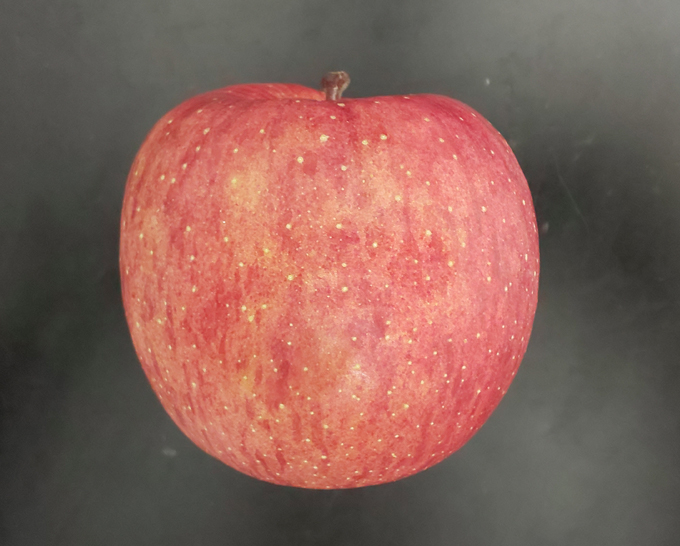
Visible wavelength image of an apple.
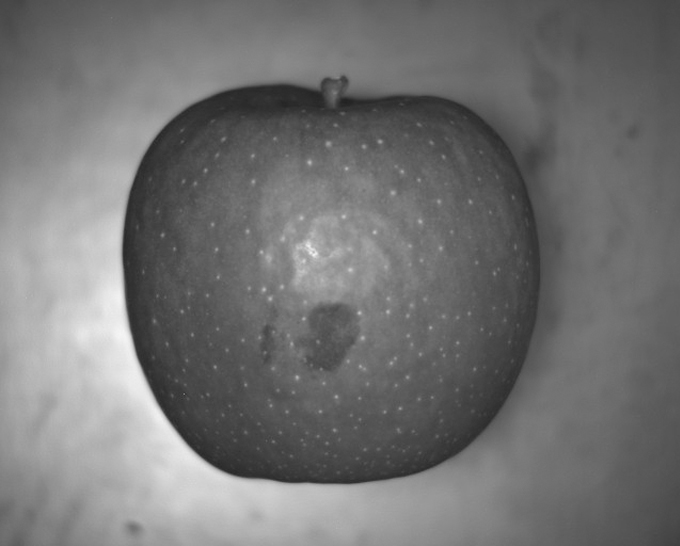
Infrared image of an apple, taken with C12741-03 InGaAs camera, shows hidden defects.
As fruits and vegetables travel down the conveyor belt, to optimize the food sorting inspection process, it is necessary to place different high-speed imaging devices at strategic locations on the conveyor belt. These sensors will automatically scan produce, detecting visible and invisible defects on produce that should be filtered out so they do not reach the store.
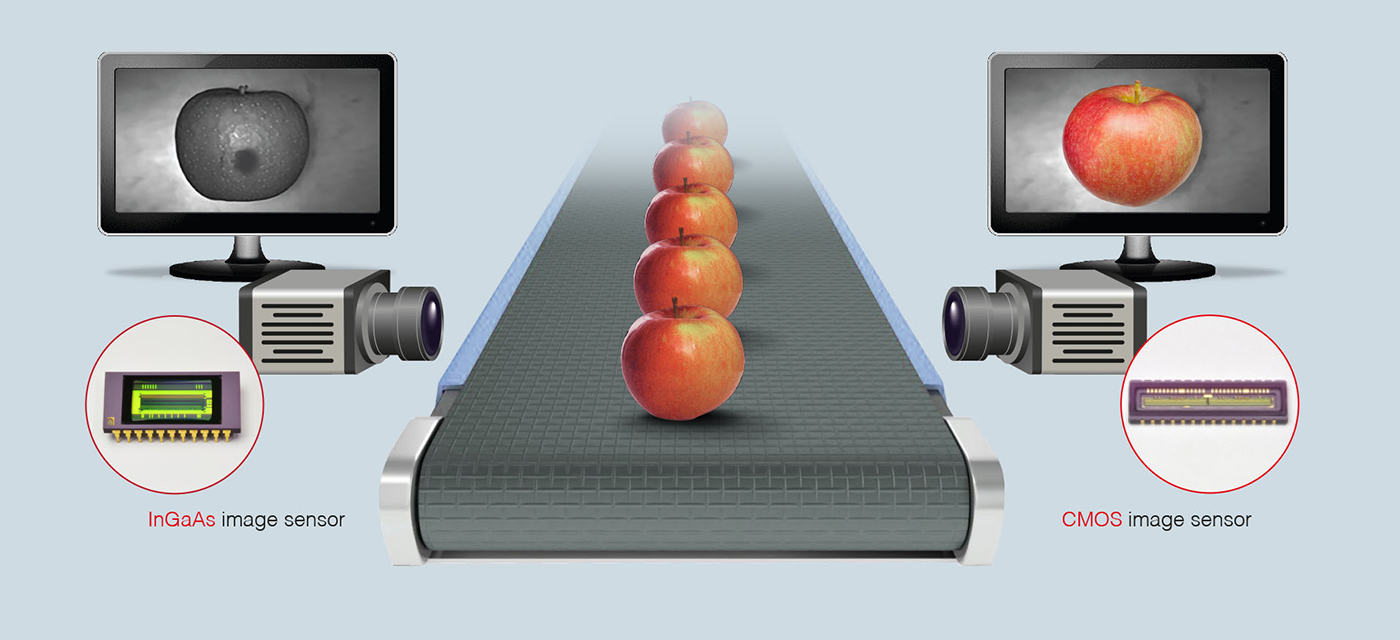
As apples travel down the conveyor belt, they are scanned using InGaAs and CMOS cameras. The InGaAs camera will show defects beginning to form under the skin that a human eye cannot see; the CMOS camera will show visible defects.
InGaAs detectors and cameras for SWIR imaging
Our line of InGaAs array detectors (InGaAs image sensors) feature:
- High sensitivity in the NIR and SWIR regions up to 2.55 µm
- Low readout noise
- Low dark noise
- High-speed response
- Built-in CMOS circuits for simple operation and easy signal processing
- Linear and area arrays available
InGaAs linear image sensors are suitable for in-line sorting of agricultural products because of their high-speed line rate and high sensitivity. They are available in a variety of cutoff wavelengths, pixel counts, and line readout speeds. Most of our linear image sensors have a metal or ceramic package, but we also offer ones with a flexible plastic cable as a less expensive option.
InGaAs area image sensors are suitable for hyperspectral imaging. High-speed frame rate, low readout noise, and high sensitivity characterize these area arrays. They are available in various cutoff wavelengths, pixel arrays, and frame rates.
Our line of InGaAs cameras feature:
- High sensitivity from 950 to 1700 nm
- Low readout noise
- High dynamic range
- USB 3.0
- Compact and light body
- Custom solutions
InGaAs cameras provide plug-and-play solutions using 1D InGaAs image sensors or 2D InGaAs image sensors. Also they are an easy solution for multispectral/ hyperspectral imaging cameras to be built based on the original camera.
We offer a broad selection of standard InGaAs products, but if they do not fit your requirements exactly, we can offer customized solutions.
Recommended products
CMOS linear image sensors
These are suitable for UV-VIS measurement in food inspection applications. CMOS sensors designed for spectroscopy and those designed for high-speed, in-line scanning are available.
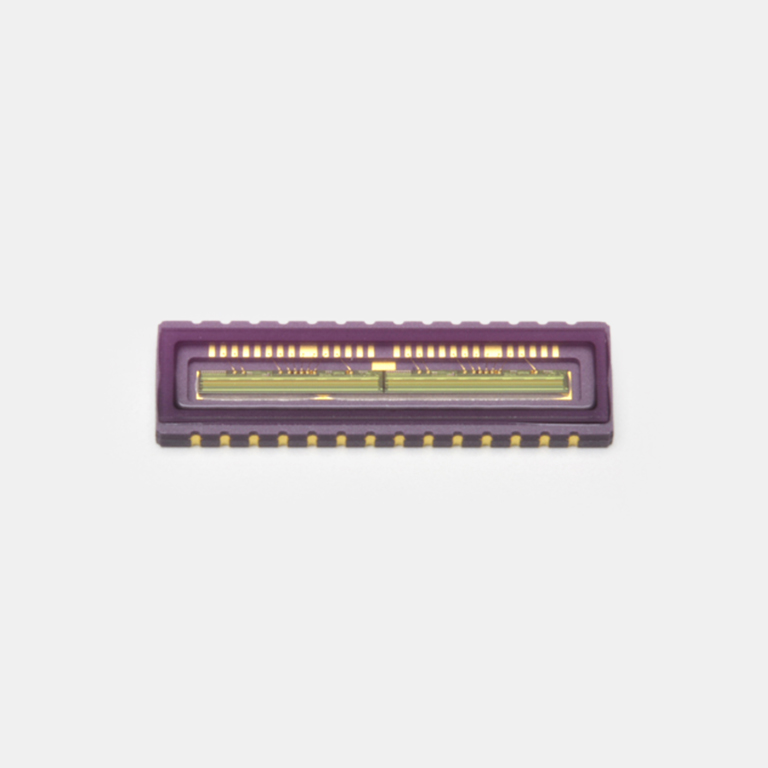
128-pixel CMOS linear image sensor with large pixels and low power consumption.
With 127 × 127 µm pixels and a 10 MHz data rate, the S14417 is ideal for applications that benefit from high light sensitivity and simple integration.
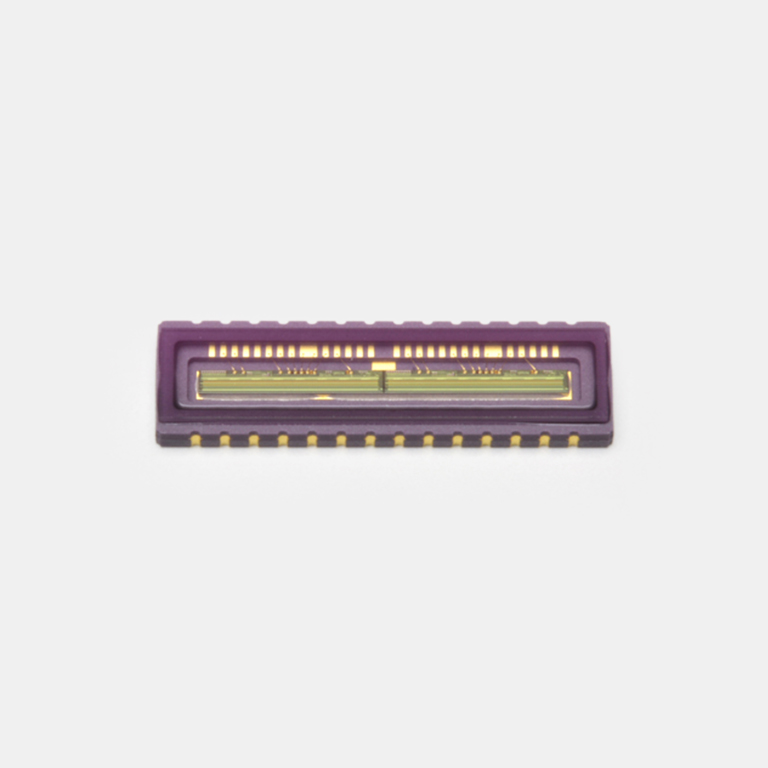
256-pixel CMOS sensor with compact pixel size for higher resolution.
With 63.5 × 63.5 µm pixels and a 10 MHz data rate, the S14416-02 provides improved resolution over the S14417 while keeping power consumption and design complexity low.
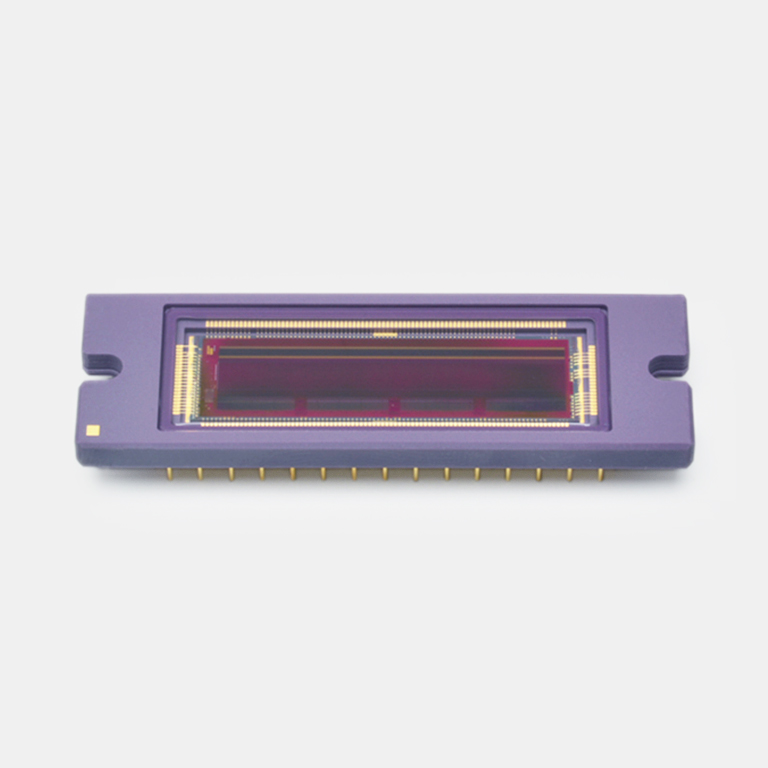
Developed for industrial cameras, this 4096-pixel CMOS sensor features integrated A/D conversion for high-speed, high-resolution imaging.
Featuring ultra-small 7 × 7 µm pixels, 100 klines/s speed, and built-in 10/12-bit A/D converters, the S13774 is built for high-speed, high-resolution imaging systems.
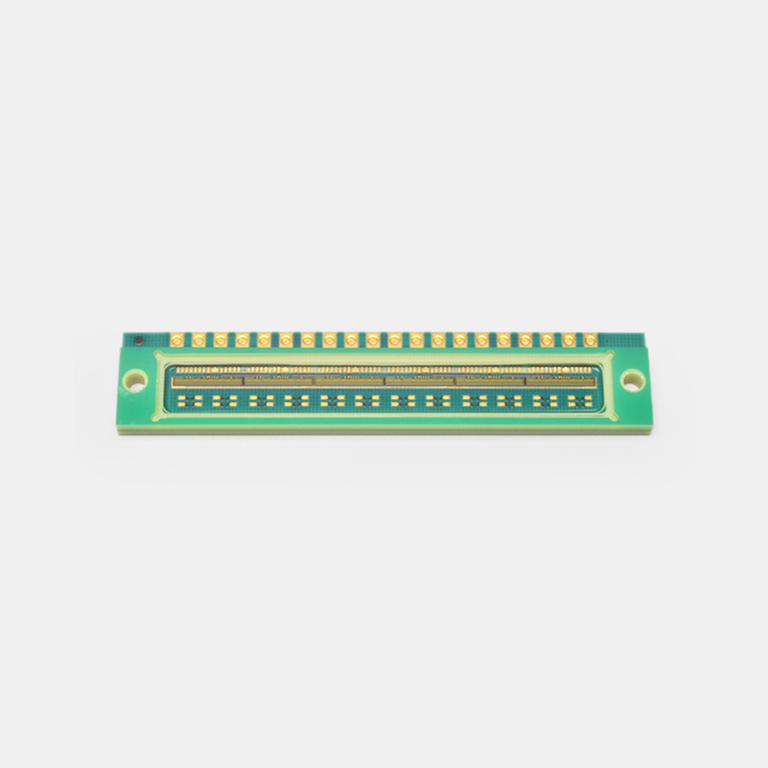
Higher resolution version of the S14417 with 384 pixels.
Maintaining the same 127 µm pixel size, this model triples the pixel count for improved coverage without sacrificing simplicity or power efficiency.
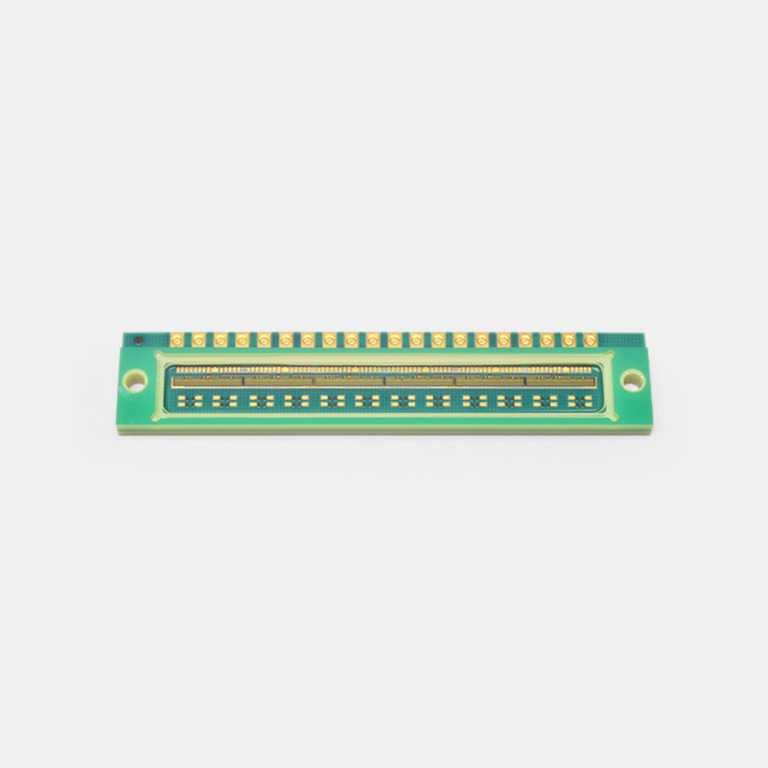
High-resolution 768-pixel CMOS sensor with compact pixels.
The highest-resolution model in the S14416 line, ideal for applications needing fine detail and fast, low-power performance with 63.5 µm pixel size.
CMOS area image sensors
Designed to be integrated into cameras, these CMOS area arrays offer imaging capability across a wide spectral range from UV to NIR.
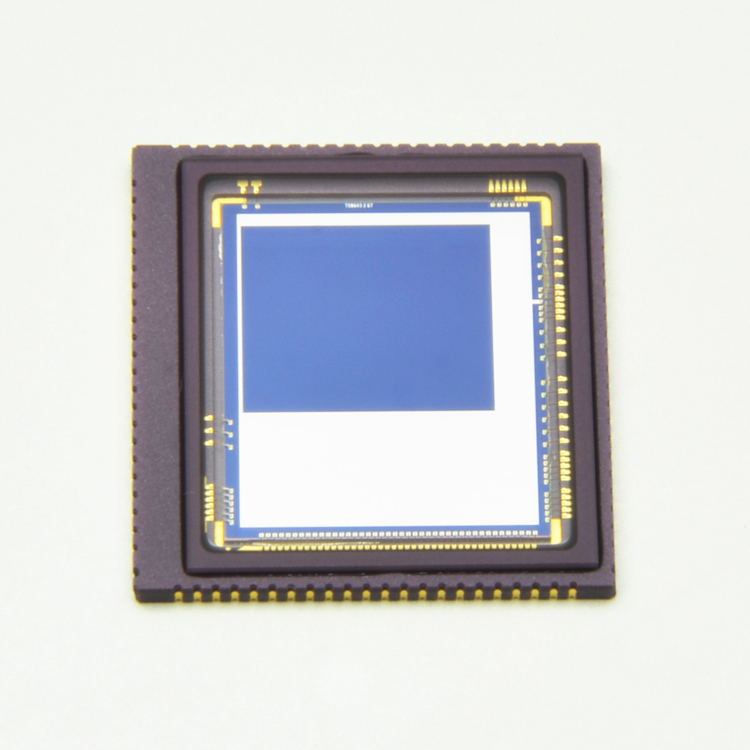
The S14501 features a 2560 × 2048 pixel array and 3.2 μm pixel pitch, delivering high resolution and sensitivity for applications like machine vision, microscopy, and scientific imaging. Its larger format and built-in A/D conversion support detailed, efficient image capture.
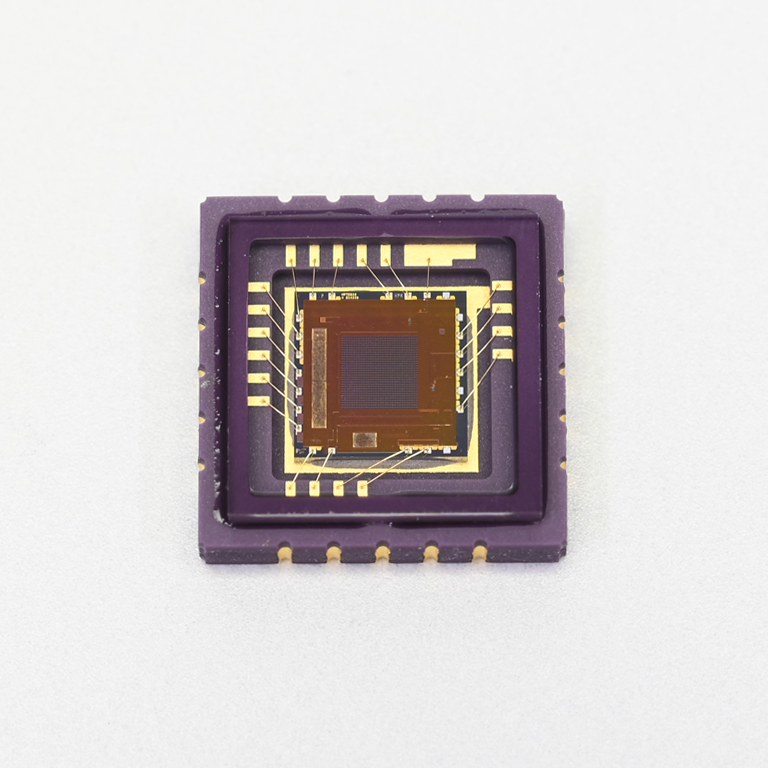
With a 2048 × 1088 pixel array and 2.8 μm pixel pitch, the S14250 offers fast, reliable imaging in compact systems. Ideal for embedded vision and industrial use, it combines a small footprint with integrated A/D conversion for streamlined performance.
InGaAs linear image sensors
Their sensitivity and fast speed make these InGaAs linear image sensors appropriate for in-line sorting of food based on NIR and SWIR detection. For conveyor belt, in-line inspection, 40K lps.
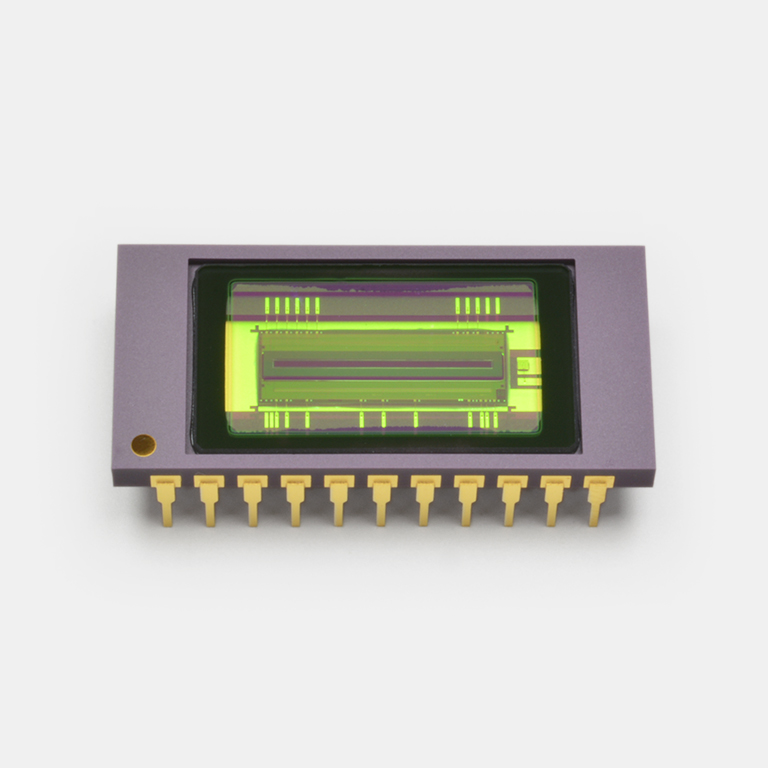
With a 25 μm pixel pitch and 1024 active pixels, the G14714-1024DK delivers high spatial resolution and a wide detection width, making it ideal for hyperspectral imaging, precision optical sorting, and detailed NIR analysis.
Need fine detail and resolution? Go with the G14714-1024DK.
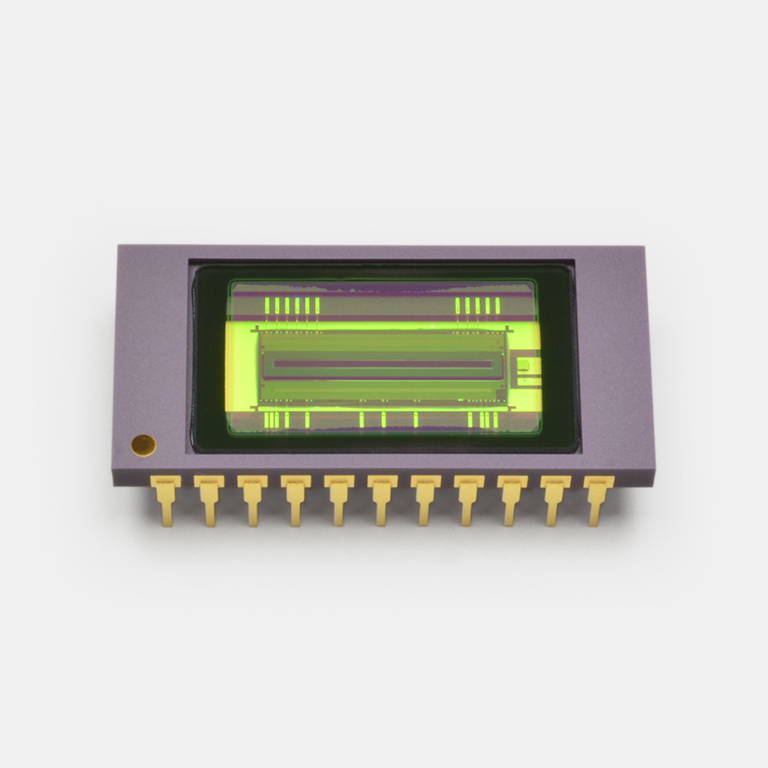
The G14714-512DE features a 50 μm pixel pitch and 512 pixels, offering greater sensitivity per pixel and faster readout performance. It’s well-suited for real-time monitoring tasks such as moisture content inspection, NIR spectroscopy, and web inspection in industrial settings.
Need speed and sensitivity? The G14714-512DE is your match.
InGaAs area image sensors
Suitable for hyperspectral imaging, InGaAs area image sensors have high sensitivity and fast frame rates.
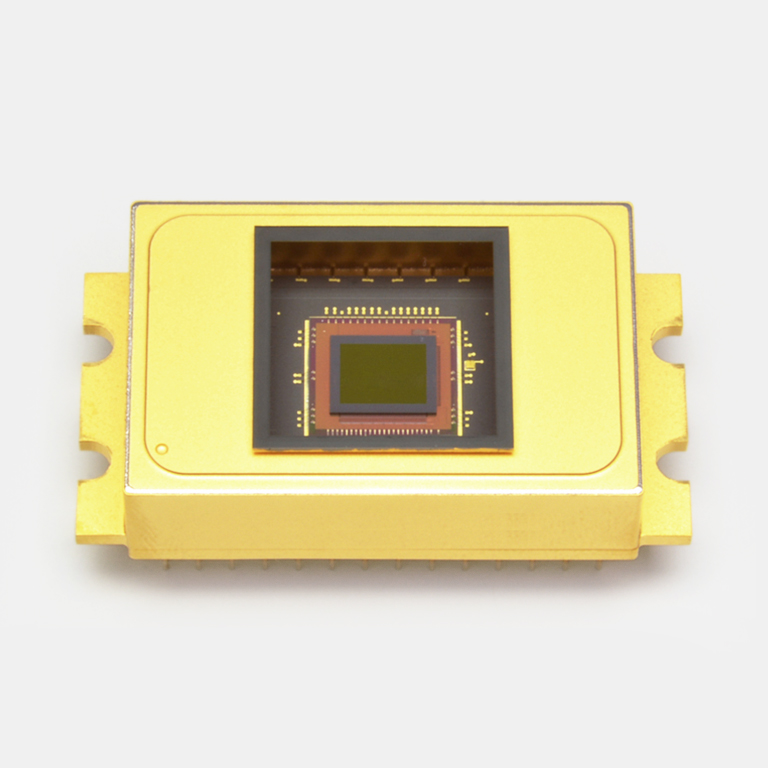
A high-speed, cost-effective InGaAs area sensor designed for near-infrared (NIR) imaging in the 0.95–1.69 µm range. With a frame rate of 507 fps, low dark current (0.03–0.3 pA), and two-stage thermoelectric cooling, it’s well-suited for general-purpose NIR applications that require fast performance and low noise without extended wavelength sensitivity.
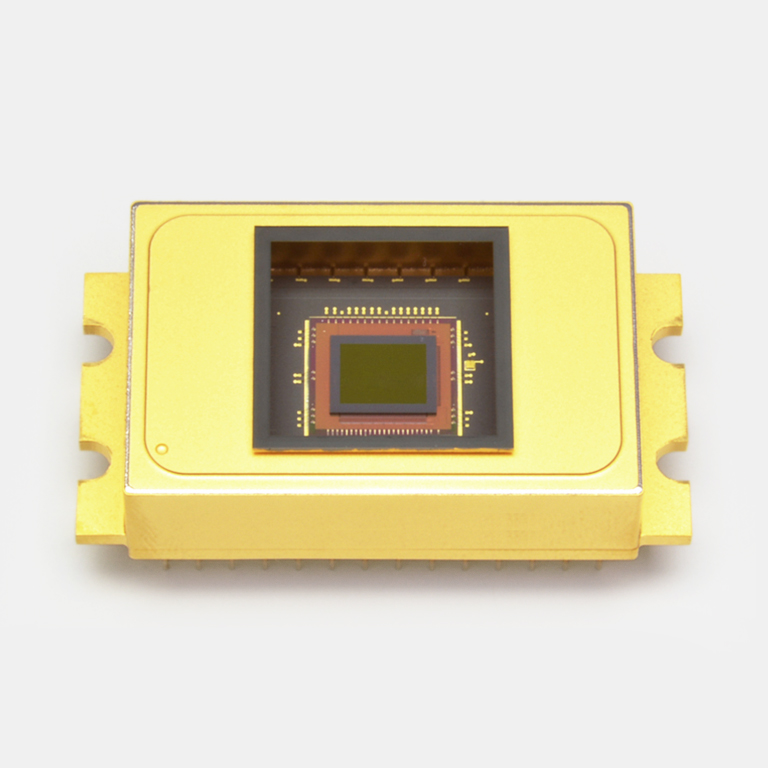
Extends detection into the short-wavelength infrared (SWIR) region with a 1.30–2.15 µm spectral range. Maintaining a frame rate of 507 fps, it’s optimized for applications like chemical imaging or semiconductor inspection where broader SWIR sensitivity is critical. Dark current ranges from 0.3 to 30 pA, and it features the same robust two-stage TE cooling.
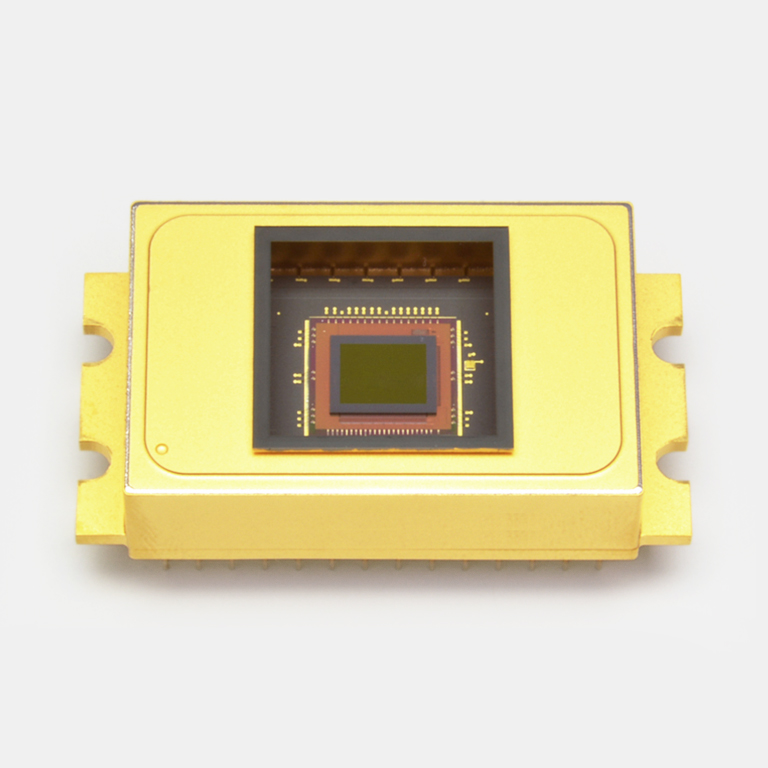
Offers balanced NIR performance with a spectral response from 1.12–1.85 µm. It combines moderate dark current (~0.3 pA), a fast 509 fps frame rate, and the same two-stage cooling for stability. This model is ideal for applications that demand a trade-off between high sensitivity and broad wavelength coverage without pushing into the deeper SWIR range.
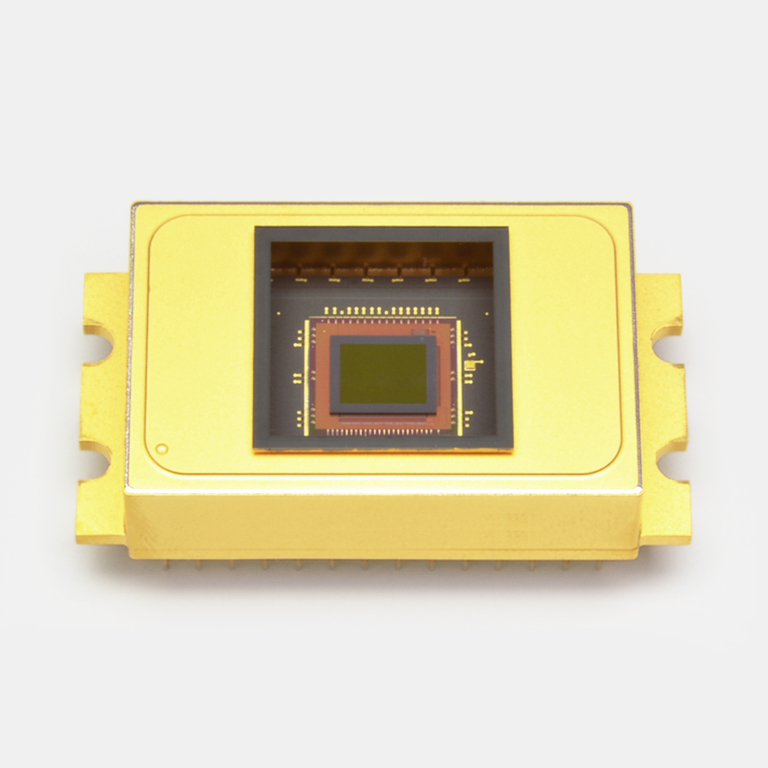
Delivers the deepest spectral reach in the series, covering 1.70–2.55 µm for advanced SWIR imaging tasks. Also operating at 507 fps with dark current from 0.3 to 30 pA, this model is suited for specialized applications requiring deep infrared detection, such as thermal analysis, material characterization, or water content measurement.
InGaAs cameras
Suitable for plug-and-play solution with high sensitivity InGaAs image sensors built in.
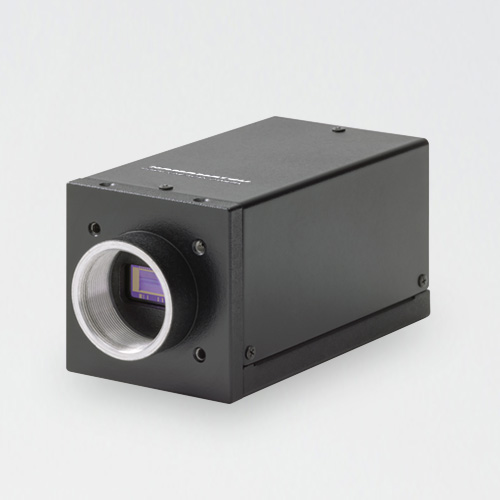
A high-speed InGaAs line scan camera optimized for short-wavelength infrared (SWIR) imaging, covering a spectral range from 950 nm to 1700 nm. Featuring a 1024-pixel linear array with 12.5 μm pixel pitch, it achieves a maximum line rate of 40 kHz. Its compact design and Gigabit Ethernet interface make it ideal for in-line, non-destructive inspection applications such as semiconductor wafer pattern inspection, food quality control, and material sorting. Advanced image processing functions like background subtraction and real-time shading correction enhance image quality for precise analysis.
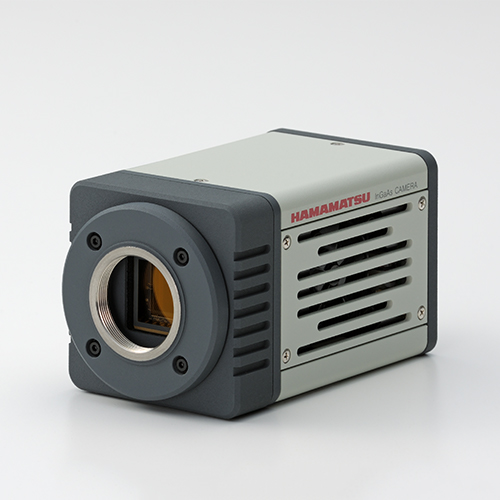
A versatile InGaAs area scan camera with sensitivity in the near-infrared region from 950 nm to 1700 nm. It offers a resolution of 640 × 512 pixels with 20 μm pixel size, providing a balance between image detail and sensitivity. The camera supports both analog (EIA) and USB 3.0 interfaces, facilitating integration into various systems. With a frame rate of approximately 60 frames per second and features like Peltier cooling for low noise performance, it's suitable for applications including internal inspection of silicon wafers, evaluation of solar cells, and analysis of optical communication devices.
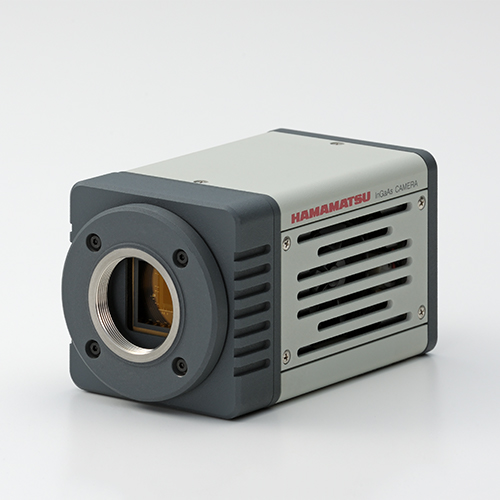
A high-speed InGaAs area scan camera designed for near-infrared imaging between 950 nm and 1700 nm. It features a resolution of 320 × 256 pixels with 20 μm pixel size and supports both rolling and global shutter modes. The camera achieves a frame rate of approximately 216 frames per second in rolling shutter mode, making it suitable for applications requiring rapid image acquisition. Its USB 3.0 interface ensures easy connectivity, and Peltier cooling maintains low noise levels for high-quality imaging in tasks such as laser beam alignment, inspection of silicon wafers, and evaluation of solar cells.
- Confirmation
-
It looks like you're in the . If this is not your location, please select the correct region or country below.
You're headed to Hamamatsu Photonics website for US (English). If you want to view an other country's site, the optimized information will be provided by selecting options below.
In order to use this website comfortably, we use cookies. For cookie details please see our cookie policy.
- Cookie Policy
-
This website or its third-party tools use cookies, which are necessary to its functioning and required to achieve the purposes illustrated in this cookie policy. By closing the cookie warning banner, scrolling the page, clicking a link or continuing to browse otherwise, you agree to the use of cookies.
Hamamatsu uses cookies in order to enhance your experience on our website and ensure that our website functions.
You can visit this page at any time to learn more about cookies, get the most up to date information on how we use cookies and manage your cookie settings. We will not use cookies for any purpose other than the ones stated, but please note that we reserve the right to update our cookies.
1. What are cookies?
For modern websites to work according to visitor’s expectations, they need to collect certain basic information about visitors. To do this, a site will create small text files which are placed on visitor’s devices (computer or mobile) - these files are known as cookies when you access a website. Cookies are used in order to make websites function and work efficiently. Cookies are uniquely assigned to each visitor and can only be read by a web server in the domain that issued the cookie to the visitor. Cookies cannot be used to run programs or deliver viruses to a visitor’s device.
Cookies do various jobs which make the visitor’s experience of the internet much smoother and more interactive. For instance, cookies are used to remember the visitor’s preferences on sites they visit often, to remember language preference and to help navigate between pages more efficiently. Much, though not all, of the data collected is anonymous, though some of it is designed to detect browsing patterns and approximate geographical location to improve the visitor experience.
Certain type of cookies may require the data subject’s consent before storing them on the computer.
2. What are the different types of cookies?
This website uses two types of cookies:
- First party cookies. For our website, the first party cookies are controlled and maintained by Hamamatsu. No other parties have access to these cookies.
- Third party cookies. These cookies are implemented by organizations outside Hamamatsu. We do not have access to the data in these cookies, but we use these cookies to improve the overall website experience.
3. How do we use cookies?
This website uses cookies for following purposes:
- Certain cookies are necessary for our website to function. These are strictly necessary cookies and are required to enable website access, support navigation or provide relevant content. These cookies direct you to the correct region or country, and support security and ecommerce. Strictly necessary cookies also enforce your privacy preferences. Without these strictly necessary cookies, much of our website will not function.
- Analytics cookies are used to track website usage. This data enables us to improve our website usability, performance and website administration. In our analytics cookies, we do not store any personal identifying information.
- Functionality cookies. These are used to recognize you when you return to our website. This enables us to personalize our content for you, greet you by name and remember your preferences (for example, your choice of language or region).
- These cookies record your visit to our website, the pages you have visited and the links you have followed. We will use this information to make our website and the advertising displayed on it more relevant to your interests. We may also share this information with third parties for this purpose.
Cookies help us help you. Through the use of cookies, we learn what is important to our visitors and we develop and enhance website content and functionality to support your experience. Much of our website can be accessed if cookies are disabled, however certain website functions may not work. And, we believe your current and future visits will be enhanced if cookies are enabled.
4. Which cookies do we use?
There are two ways to manage cookie preferences.
- You can set your cookie preferences on your device or in your browser.
- You can set your cookie preferences at the website level.
If you don’t want to receive cookies, you can modify your browser so that it notifies you when cookies are sent to it or you can refuse cookies altogether. You can also delete cookies that have already been set.
If you wish to restrict or block web browser cookies which are set on your device then you can do this through your browser settings; the Help function within your browser should tell you how. Alternatively, you may wish to visit www.aboutcookies.org, which contains comprehensive information on how to do this on a wide variety of desktop browsers.
5. What are Internet tags and how do we use them with cookies?
Occasionally, we may use internet tags (also known as action tags, single-pixel GIFs, clear GIFs, invisible GIFs and 1-by-1 GIFs) at this site and may deploy these tags/cookies through a third-party advertising partner or a web analytical service partner which may be located and store the respective information (including your IP-address) in a foreign country. These tags/cookies are placed on both online advertisements that bring users to this site and on different pages of this site. We use this technology to measure the visitors' responses to our sites and the effectiveness of our advertising campaigns (including how many times a page is opened and which information is consulted) as well as to evaluate your use of this website. The third-party partner or the web analytical service partner may be able to collect data about visitors to our and other sites because of these internet tags/cookies, may compose reports regarding the website’s activity for us and may provide further services which are related to the use of the website and the internet. They may provide such information to other parties if there is a legal requirement that they do so, or if they hire the other parties to process information on their behalf.
If you would like more information about web tags and cookies associated with on-line advertising or to opt-out of third-party collection of this information, please visit the Network Advertising Initiative website http://www.networkadvertising.org.
6. Analytics and Advertisement Cookies
We use third-party cookies (such as Google Analytics) to track visitors on our website, to get reports about how visitors use the website and to inform, optimize and serve ads based on someone's past visits to our website.
You may opt-out of Google Analytics cookies by the websites provided by Google:
https://tools.google.com/dlpage/gaoptout?hl=en
As provided in this Privacy Policy (Article 5), you can learn more about opt-out cookies by the website provided by Network Advertising Initiative:
http://www.networkadvertising.org
We inform you that in such case you will not be able to wholly use all functions of our website.
Close