
Products










We are actively taking measures to improve product quality levels.
Applications







Why Hamamatsu?
Resources



Support



Our company





Investors








United States (EN)
Select your region or country.

Modular optical platform
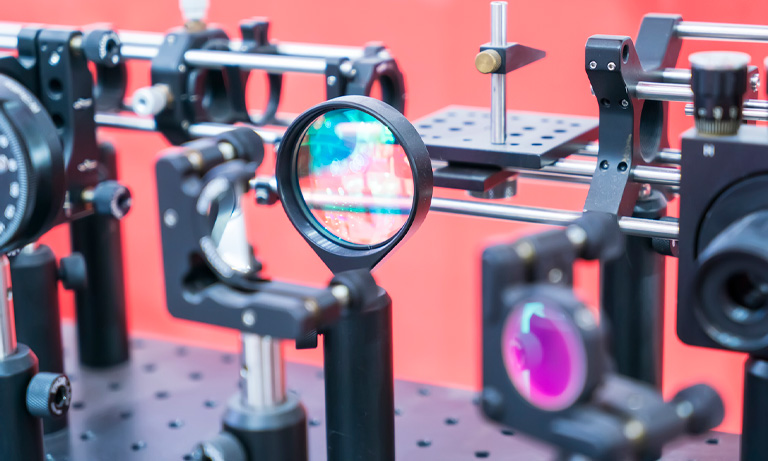
Modular photonics platform for faster R&D and prototyping
What is a modular optical platform?
The modular optical platform is a configurable optical development system that enables rapid setup and optimization of:
- Spectroscopy configurations
- Reflectance and absorption measurement setups
- Fluorescence detection systems, and other custom optical configurations
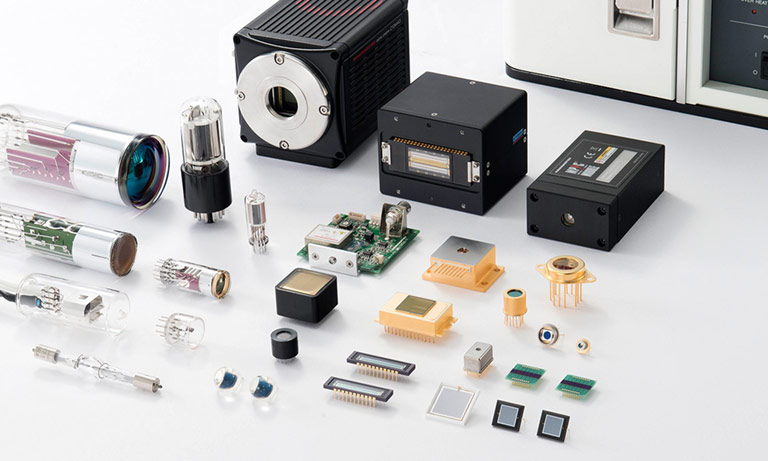
Using interchangeable detectors and light sources with configurable optical paths, engineers can prototype, test, and refine photonic system designs efficiently within a single integrated framework.
Whether developing a spectroscopy instrument, material identification system, or advanced optical sensing platform, the modular optical platform provides a flexible and scalable foundation for rapid optical system development.
How can a modular optical platform accelerate photonics innovation?
Our modular optical platform is designed to accelerate optical system development, prototyping, and proof-of-concept validation.
1. Reduces time from idea to experiment
- Enables immediate demonstrations and verification, including on‑site evaluation when applicable
- Shortens setup and iteration cycles, allowing teams to quickly move from concept to functional testing and informed decision‑making
2. Early access to verification data
- Rapidly generates meaningful verification data and demo results
- Supports internal reviews, technical alignment, and business decision processes
- Helps bring consensus across engineering, management, and other stakeholders early
3. Supports exploration across wavelengths and techniques
- Adapts easily to measurements from UV to NIR using interchangeable light sources and detectors
- Enables rapid switching between absorbance, reflectance, and fluorescence configurations without system redesign
- Allows users to explore new measurement techniques and refine performance as application needs evolve
4. Higher implementation success
- Verified configurations reduce technical gaps and uncertainties before deployment
- Minimizes post‑implementation changes, rework, and integration issues
What applications can the modular optical platform support?
Its modular design supports a wide range of applications, enabling absorbance, reflectance, and fluorescence measurements with simple reconfiguration.
As some examples, this system supports UV, Visible, and NIR measurements for:
- Material characterization/identification
- Pharmaceutical analysis
- Agricultural/environmental sensing
- QA/QC verification
What makes the modular optical platform flexible and scalable?
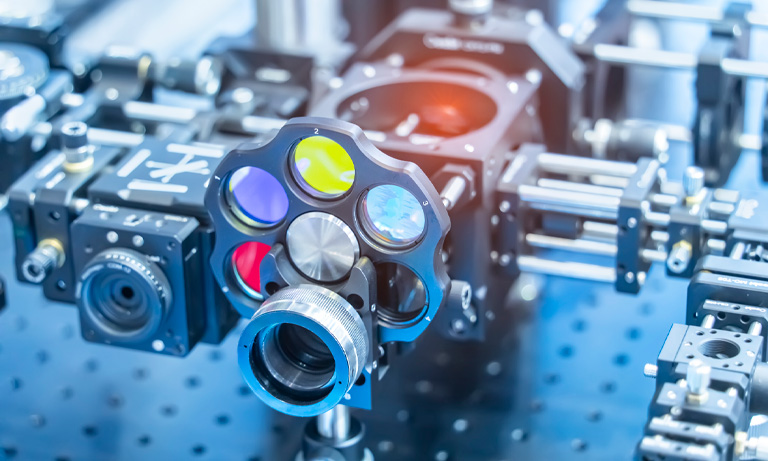
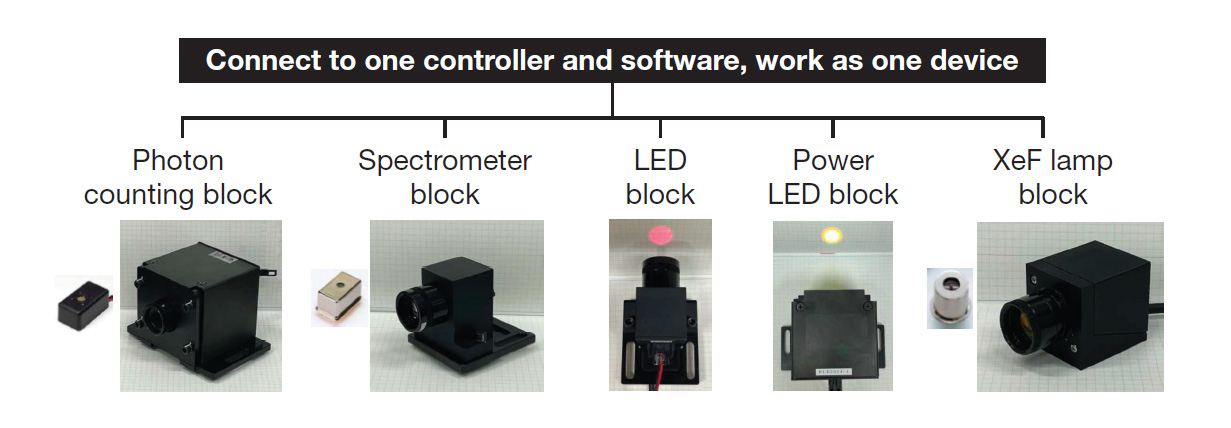
The platform’s flexibility and scalability come from its interchangeable optical blocks, configurable optical paths, standardized mechanical and electronic interfaces, and adaptable software, allowing new measurement modes, detectors, and applications to be added without redesigning the entire system.
How are control and data acquisition integrated?
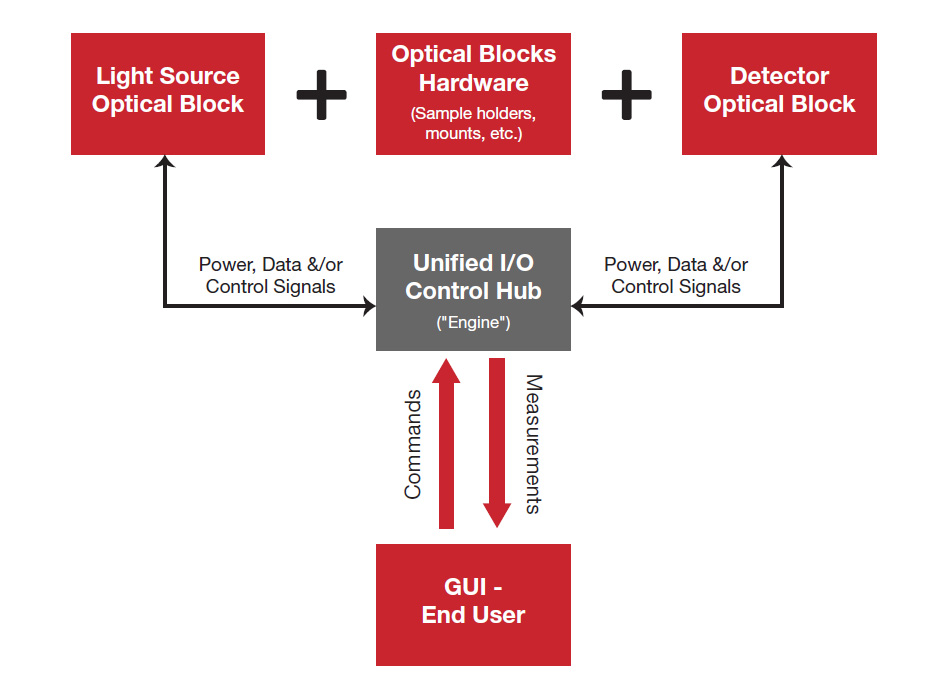
A centralized control hub manages:
- Light source modulation
- Detector synchronization
- Signal routing
- Data acquisition and visualization
Optional AI-driven software tools can assist with calibration, classification, and predictive modeling.
What is the development workflow?
- Application consultation
Define wavelength range, sensitivity requirements, sample type, and system constraints. - Optical system design proposal
Optical path configuration, detector selection, electronics integration, and cost estimation. - Platform integration and delivery
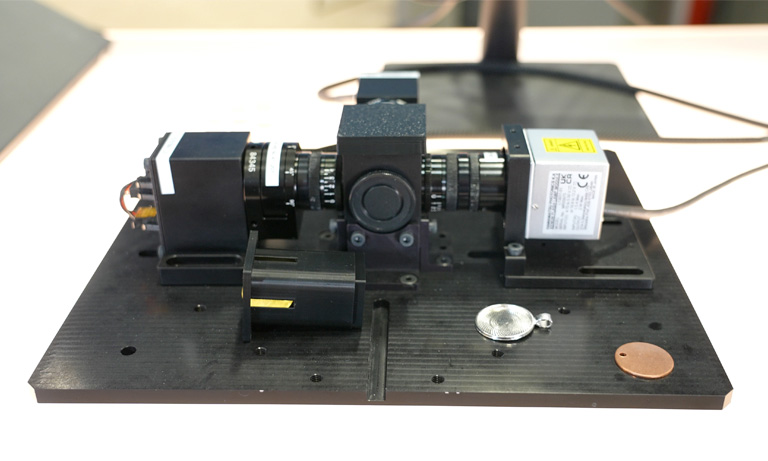
Fully assembled modular photonics platform ready for validation. - System expansion and optimization
Modify or scale the system as the application matures.
Recommended products
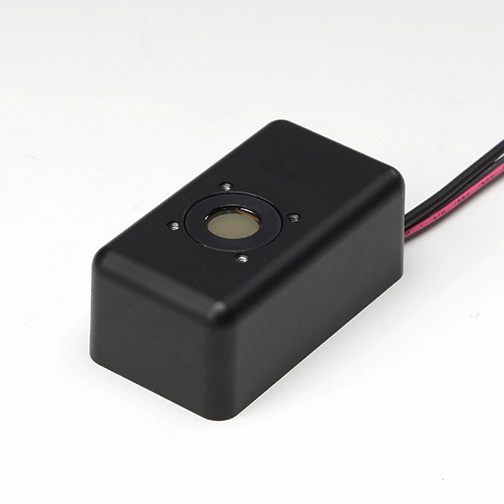
Provides high-sensitivity photon detection across the 230–870 nm range, enabling precise low-light measurements in UV–VIS applications. Its compact, integrated design makes it easy to incorporate into modular systems for rapid prototyping.
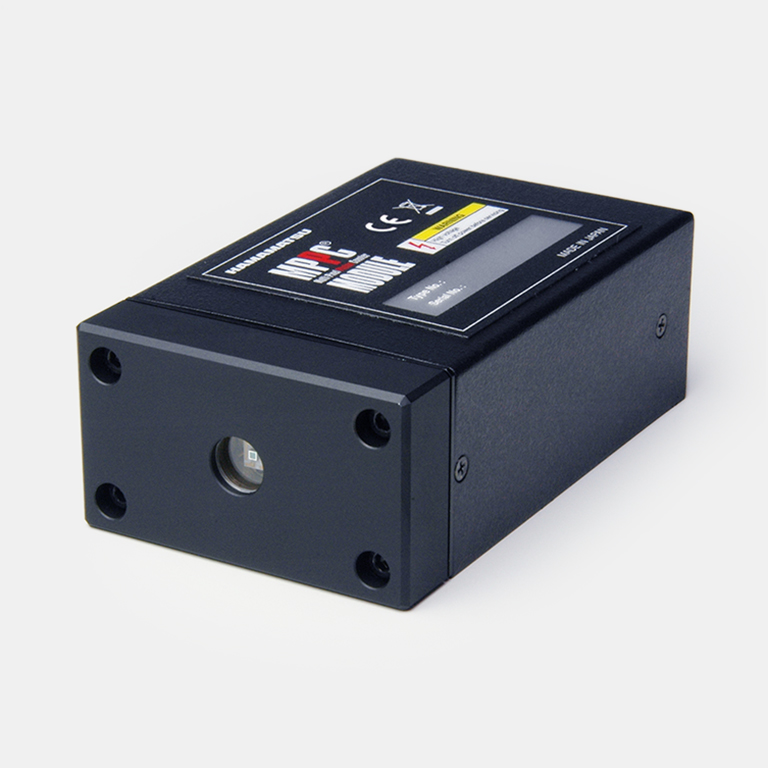
A solid-state photon counting solution operating from 320–900 nm, offering high gain in a compact form factor. It integrates easily into modular setups, enabling scalable and flexible system design.
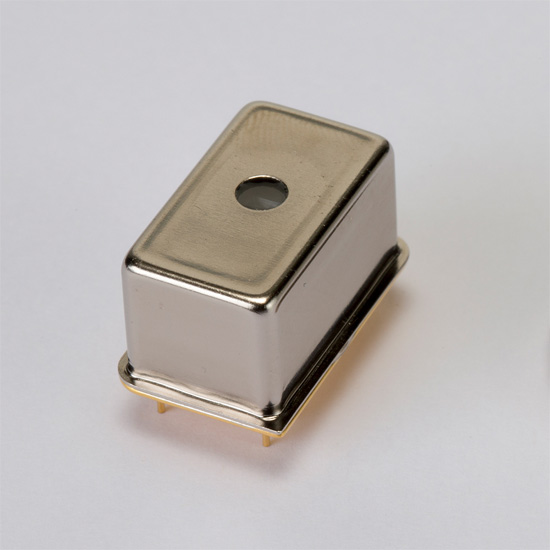
A miniaturized spectrometer covering 340–850 nm for compact spectral analysis within modular platforms. Its small footprint and plug-and-play capability support flexible system design and rapid iteration.
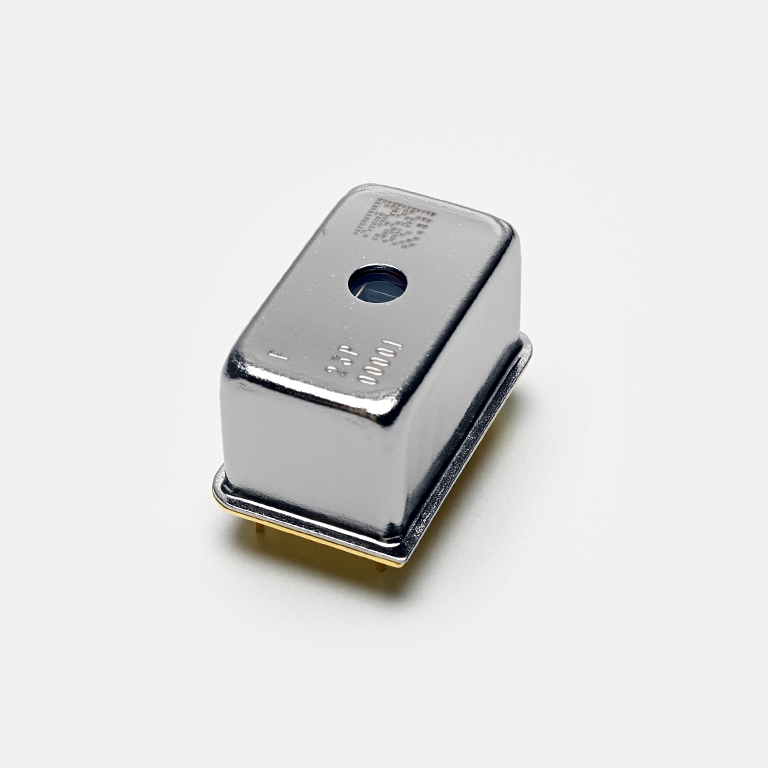
Extends spectral measurement into the 190–440 nm range, enabling UV analysis in modular architectures. Its compact design allows seamless integration for applications requiring broader wavelength coverage.
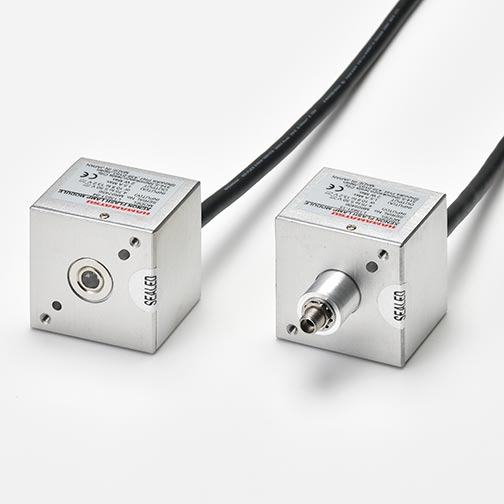
Provides a stable, broadband pulsed light source across 185–2500 nm, ideal for spectroscopy applications. Its compact form factor allows easy integration and interchangeability within optical setups.
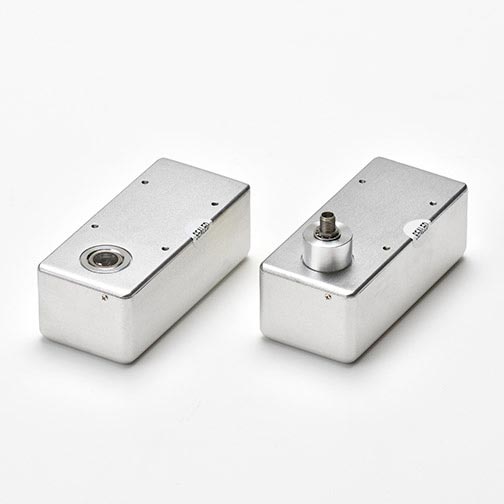
Delivers high output power across 185-2500 nm for applications requiring high peak irradiance. Its easy-to-operate interface makes it suitable for modular platform integration.
- Confirmation
-
It looks like you're in the . If this is not your location, please select the correct region or country below.
You're headed to Hamamatsu Photonics website for US (English). If you want to view an other country's site, the optimized information will be provided by selecting options below.
In order to use this website comfortably, we use cookies. For cookie details please see our cookie policy.
- Cookie Policy
-
This website or its third-party tools use cookies, which are necessary to its functioning and required to achieve the purposes illustrated in this cookie policy. By closing the cookie warning banner, scrolling the page, clicking a link or continuing to browse otherwise, you agree to the use of cookies.
Hamamatsu uses cookies in order to enhance your experience on our website and ensure that our website functions.
You can visit this page at any time to learn more about cookies, get the most up to date information on how we use cookies and manage your cookie settings. We will not use cookies for any purpose other than the ones stated, but please note that we reserve the right to update our cookies.
1. What are cookies?
For modern websites to work according to visitor’s expectations, they need to collect certain basic information about visitors. To do this, a site will create small text files which are placed on visitor’s devices (computer or mobile) - these files are known as cookies when you access a website. Cookies are used in order to make websites function and work efficiently. Cookies are uniquely assigned to each visitor and can only be read by a web server in the domain that issued the cookie to the visitor. Cookies cannot be used to run programs or deliver viruses to a visitor’s device.
Cookies do various jobs which make the visitor’s experience of the internet much smoother and more interactive. For instance, cookies are used to remember the visitor’s preferences on sites they visit often, to remember language preference and to help navigate between pages more efficiently. Much, though not all, of the data collected is anonymous, though some of it is designed to detect browsing patterns and approximate geographical location to improve the visitor experience.
Certain type of cookies may require the data subject’s consent before storing them on the computer.
2. What are the different types of cookies?
This website uses two types of cookies:
- First party cookies. For our website, the first party cookies are controlled and maintained by Hamamatsu. No other parties have access to these cookies.
- Third party cookies. These cookies are implemented by organizations outside Hamamatsu. We do not have access to the data in these cookies, but we use these cookies to improve the overall website experience.
3. How do we use cookies?
This website uses cookies for following purposes:
- Certain cookies are necessary for our website to function. These are strictly necessary cookies and are required to enable website access, support navigation or provide relevant content. These cookies direct you to the correct region or country, and support security and ecommerce. Strictly necessary cookies also enforce your privacy preferences. Without these strictly necessary cookies, much of our website will not function.
- Analytics cookies are used to track website usage. This data enables us to improve our website usability, performance and website administration. In our analytics cookies, we do not store any personal identifying information.
- Functionality cookies. These are used to recognize you when you return to our website. This enables us to personalize our content for you, greet you by name and remember your preferences (for example, your choice of language or region).
- These cookies record your visit to our website, the pages you have visited and the links you have followed. We will use this information to make our website and the advertising displayed on it more relevant to your interests. We may also share this information with third parties for this purpose.
Cookies help us help you. Through the use of cookies, we learn what is important to our visitors and we develop and enhance website content and functionality to support your experience. Much of our website can be accessed if cookies are disabled, however certain website functions may not work. And, we believe your current and future visits will be enhanced if cookies are enabled.
4. Which cookies do we use?
There are two ways to manage cookie preferences.
- You can set your cookie preferences on your device or in your browser.
- You can set your cookie preferences at the website level.
If you don’t want to receive cookies, you can modify your browser so that it notifies you when cookies are sent to it or you can refuse cookies altogether. You can also delete cookies that have already been set.
If you wish to restrict or block web browser cookies which are set on your device then you can do this through your browser settings; the Help function within your browser should tell you how. Alternatively, you may wish to visit www.aboutcookies.org, which contains comprehensive information on how to do this on a wide variety of desktop browsers.
5. What are Internet tags and how do we use them with cookies?
Occasionally, we may use internet tags (also known as action tags, single-pixel GIFs, clear GIFs, invisible GIFs and 1-by-1 GIFs) at this site and may deploy these tags/cookies through a third-party advertising partner or a web analytical service partner which may be located and store the respective information (including your IP-address) in a foreign country. These tags/cookies are placed on both online advertisements that bring users to this site and on different pages of this site. We use this technology to measure the visitors' responses to our sites and the effectiveness of our advertising campaigns (including how many times a page is opened and which information is consulted) as well as to evaluate your use of this website. The third-party partner or the web analytical service partner may be able to collect data about visitors to our and other sites because of these internet tags/cookies, may compose reports regarding the website’s activity for us and may provide further services which are related to the use of the website and the internet. They may provide such information to other parties if there is a legal requirement that they do so, or if they hire the other parties to process information on their behalf.
If you would like more information about web tags and cookies associated with on-line advertising or to opt-out of third-party collection of this information, please visit the Network Advertising Initiative website http://www.networkadvertising.org.
6. Analytics and Advertisement Cookies
We use third-party cookies (such as Google Analytics) to track visitors on our website, to get reports about how visitors use the website and to inform, optimize and serve ads based on someone's past visits to our website.
You may opt-out of Google Analytics cookies by the websites provided by Google:
https://tools.google.com/dlpage/gaoptout?hl=en
As provided in this Privacy Policy (Article 5), you can learn more about opt-out cookies by the website provided by Network Advertising Initiative:
http://www.networkadvertising.org
We inform you that in such case you will not be able to wholly use all functions of our website.
Close