
Products










We are actively taking measures to improve product quality levels.
Applications






Why Hamamatsu?
Resources



Support



Our company





Investors








United States (EN)
Select your region or country.
FDSS®-μCELL v2 Kinetic Plate Imager
C13299-02
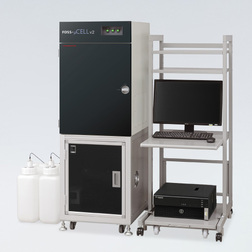
FDSS®-μCELL is a laboratory screening system that compactly integrates technologies developed in drug discovery screening, enabling a purpose-built system that is simple to use.
Simultaneous measurement and analysis of the kinetics of a sample’s fluorescence or luminescence intensity in all wells at the time of compound addition are made possible by the high sensitivity qCMOS® sensor and dispenser head (96 tip type / 384 tip type). Screening various compounds at high throughput is enabled by measurement under the same conditions with no time lag between wells.
FDSS is a registered trademark of Hamamatsu Photonics K.K. (China, France, Germany, Italy, Japan, UK, USA).
Achieving high-sensitivity imaging across a wide range of applications
High-sensitivity luminescence / high-speed fluorescence measurement
The high sensitivity qCMOS sensor comes as a standard in the FDSS-μCELL v2 optical system. In fluorescence and luminescence measurements, high quantitative performance has been achieved for low-light imaging and high-speed fluorescence changes. Even with fluorescent proteins that have low fluorescence intensity, high-precision real-time measurements can be achieved, enabling more detailed analysis of cellular responses.
Cell number evaluation using Cell Viability Assay kit
The qCMOS sensor offers measurement with wide linearity range and high sensitivity, enabling luminescence detection even with small numbers of cells.
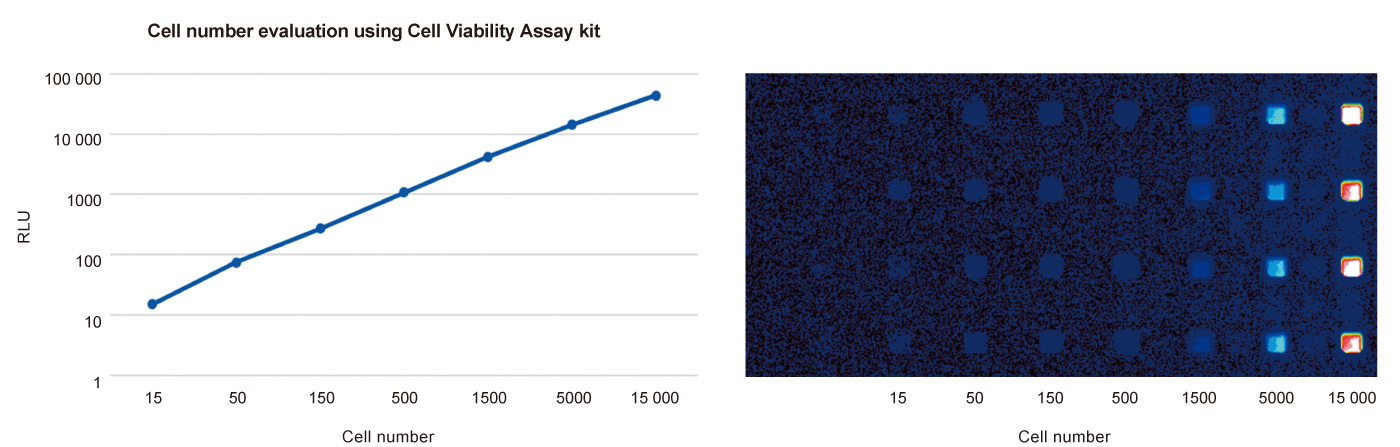
Cell : CHO-K (15 000, 5000, 500, 150, 50, 15 cells/well)
Kit : Cell Titer (Promega Corporation)
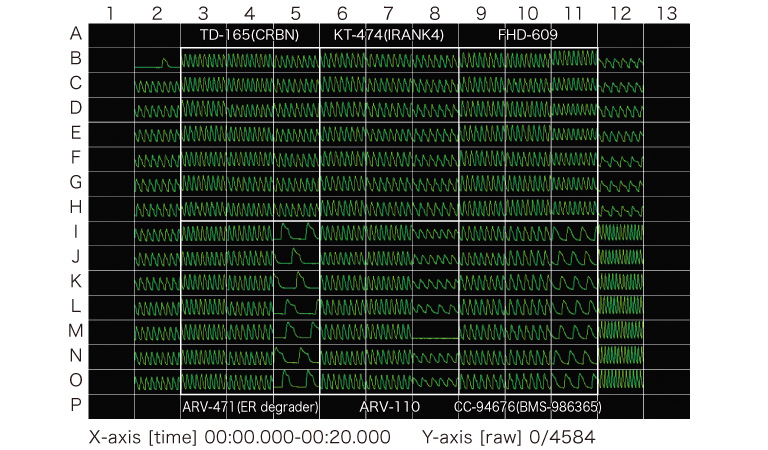
Measurement of calcium concentration changes associated with beating in iPS-derived cardiomyocytes
qCMOS sensors enable high-speed measurement of minute changes in fluorescence.
Cell : iCell Cardiomyocytes2 (CDI)
Dye : EarlyTox kit
Condition : PROTAC Evaluation high speed, modeconc=0.1, 1, 10 µM, 48 h exposure
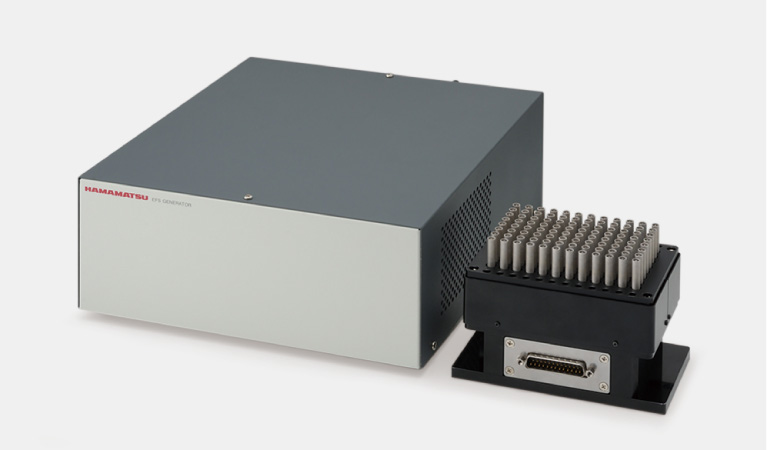
EFS pacing system
Electric field stimulation using electrodes is an effective technique for pacing of cardiomyocyte and skeletal muscle cells and for neuronal oscillation. FDSS-μCELL v2 simultaneously stimulates all wells of a 96 multi-EFS electrodes. It can be used in contraction timing control of muscle cells such as cardiomyocytes and skeletal muscle, or in Ca2+ oscillation control of nerve cells.
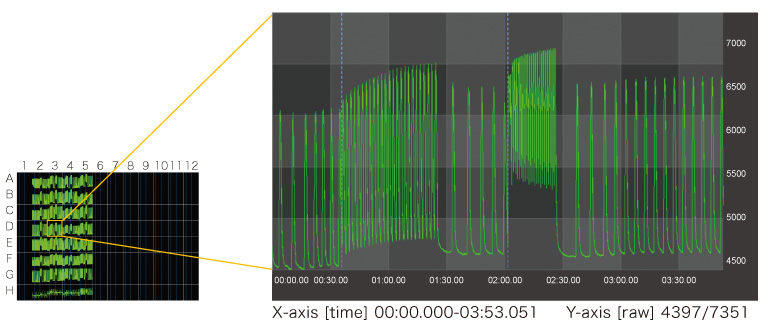
Example of measuring automatically beating iPS-derived cardiomyocytes
EFS pacing can be applied during calcium measurement (Cal-520AM) in automatically beating iPS-derived cardiomyocytes.
Cell : MyoridgeCarmyA
Dye : 2 μM Cal-520AM
Condition : 1st frequency 0.5 Hz, 2nd frequency 1 Hz
Applications
1. GPCR

FDSS-μCELL v2 is capable of detecting messengers, such as Ca2+ and cAMP, which are major contributors to the GPCR signaling system by using fluorescence and luminescence probes. FDSS-μCELL v2 allows simultaneous dispensing and kinetic measurement of compounds in whole microplate wells, thus realizing high throughput screening.
・Ca2+ measurement: Fluo-4, Fluo-8, Cal-520, Aequorin
・cAMP measurement: Glo-Sensor
2. Ion channel
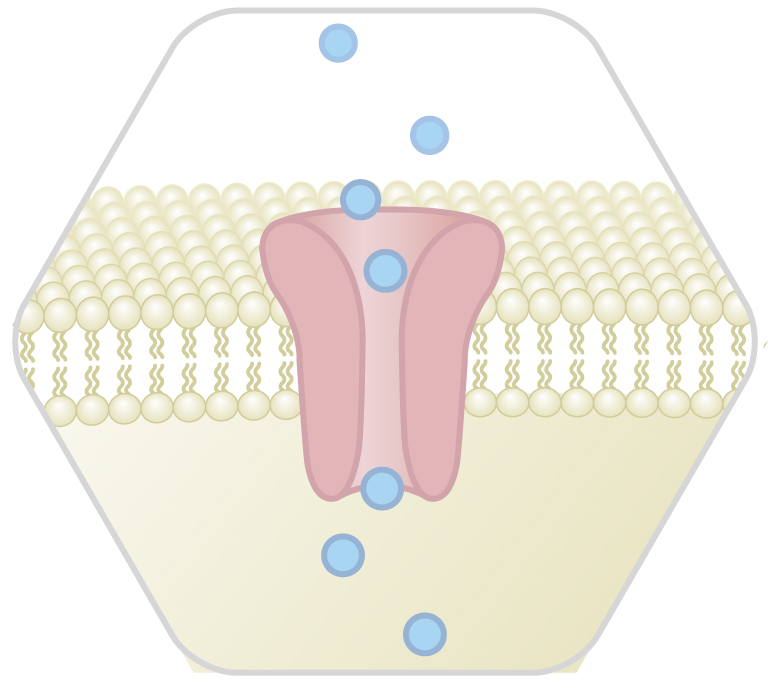
FDSS-μCELL v2 performs high throughput drug screening using voltage-sensitive fluorescent dyes or fluorescent indicators for different ions.
・Na+ measurement: ANG-2, Corona-Green, Corona-Red, Sodium-Green
・K+ measurement: FluxOR
・Cl- measurement: MEQ, MQAE, YFP
・Membrane potential measurement: FluoVolt, Di-8-ANEPPS, DiBAC4 (3)
3. Luminescence
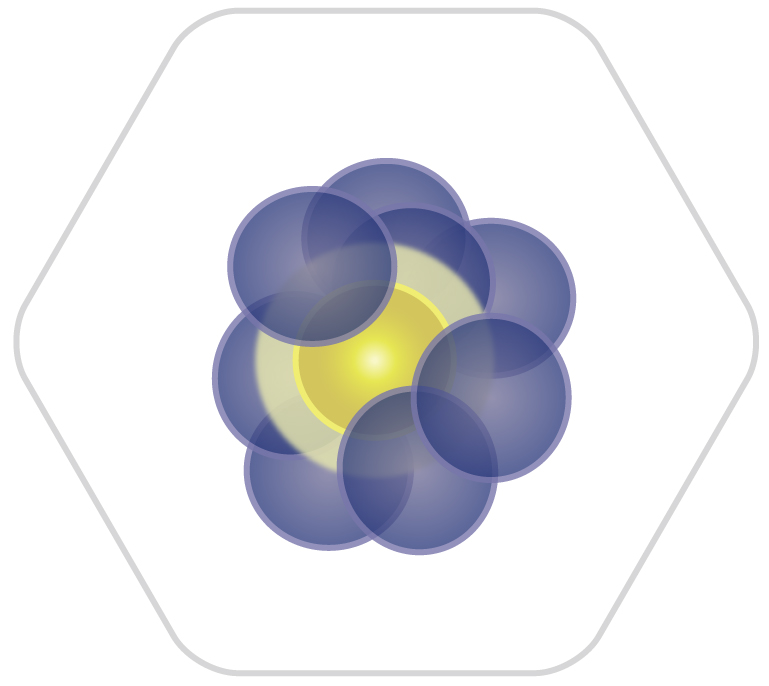
With its high-sensitivity qCMOS sensor, the FDSS-μCELL v2 performs different assays simultaneously using luminescence probes on a single microplate. This allows high-throughput screening without bothersome time lags after substrate addition.
4. BRET / FRET
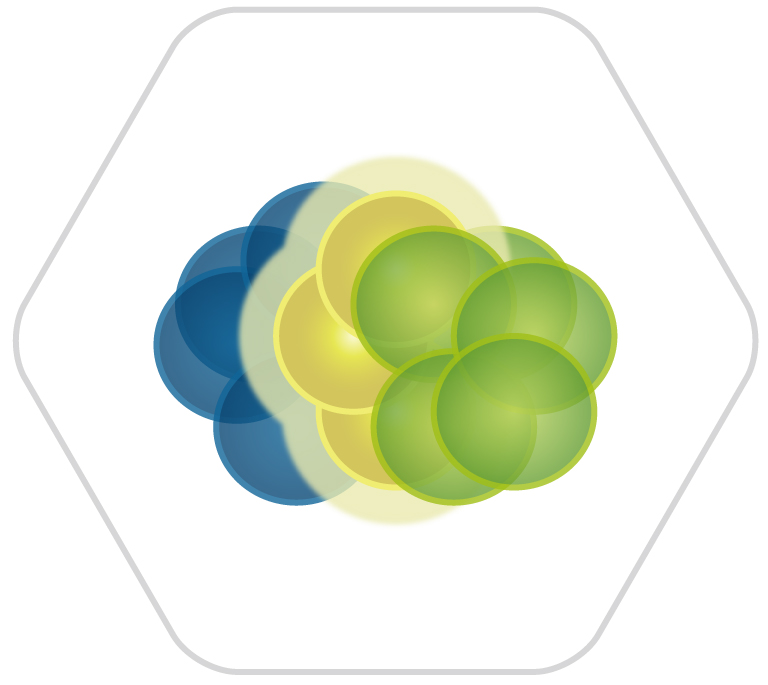
FDSS-μCELL v2 simultaneously performs BRET (bioluminescence resonance energy transfer) measurements, a luminescence-based approach, and FRET (fluorescence resonance energy transfer) measurements, a fluorescence-based approach, on a single microplate using the high sensitivity qCMOS sensor and an automatic filter changer.
・BRET: BRET1, BRET2, NanoBRETⓇ
・FRET: C/Y FRET, VSP, Cameleon
5. iPS-cell
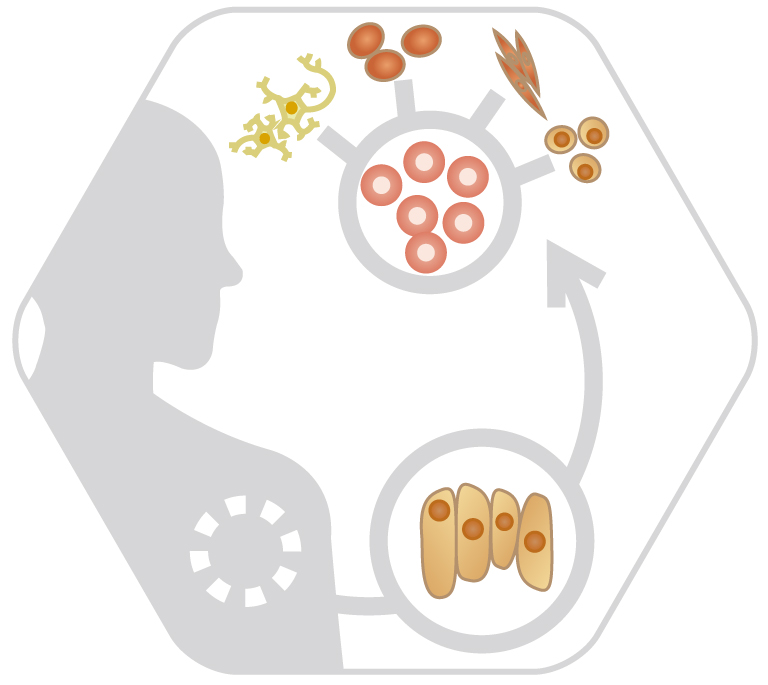
Various differentiated cells have recently been created from iPSC (induced pluripotent stem cell), and this increasingly allows for the conduct of cell-based assays using human-derived native cells. In particular, iPS Cardiotoxicity, iPS Neurotoxicity, and iPS Hematotoxicity assessments have been increasingly performed as safety evaluation of compounds. FDSS-μCELL v2 performs high-throughput toxicity screening.
Specifications
| Dispense (96 tip type) A10118-24 |
10 μL ~ 200 μL |
|---|---|
| Dispense (384 tip type) A10118-26 |
1 μL ~ 30 μL |
| Sensor | Hamamatsu qCMOS sensor dedicated to FDSS |
| Sampling rate | 10 Hz (10 data point per second) Maximum with U8524-11 option 120 Hz (120 data point per second) |
| Sampling interval | 0.1 s minimum With U8524-11 option 0.0083 s minimum |
| Light source | 470 nm excitation and 540 nm emission 530 nm excitation and 593 nm emission |
| Plate positions | One stage for assay plate, two stages for compound plate |
| Adaptable microplate | Clear bottom black 96/384 plates (SBS format height 8 mm to 15 mm) |
| Tip/Plate loading | Manual loading |
| Number of sampling data point | 1 to 50 000 sampling |
| Power supply specification | Input power supply: AC 100 V to AC 240 V, Frequency: 50 Hz/60 Hz |
| Power consumption when AC 100 V to AC 120 V (Data Analysis unit and FDSS-μCELL main unit with heater) |
Approx. 1300 VA (Data analysis unit: approx. 500 VA, dispenser main unit: approx. 300 VA, heater unit, approx. 500 VA) |
| Ambient operating temperature | +15 ℃ ~ +30 ℃ |
| Dimension/weight(Main unit ) *Data analysis unit is not included |
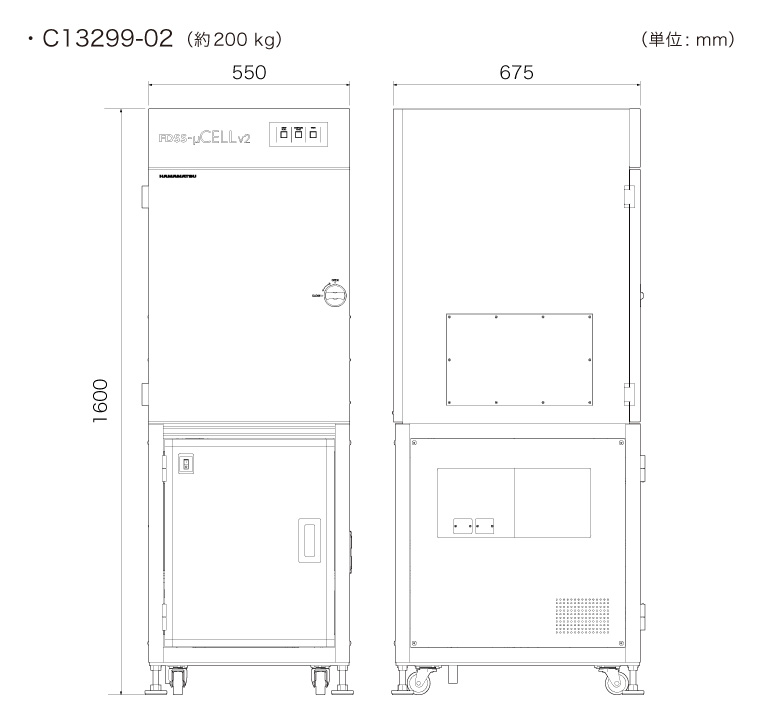
550 mm (W) × 675 mm (D) × 1600 mm (H) / approx. 200 kg |
Dimensions
Related products
- Confirmation
-
It looks like you're in the . If this is not your location, please select the correct region or country below.
You're headed to Hamamatsu Photonics website for US (English). If you want to view an other country's site, the optimized information will be provided by selecting options below.
In order to use this website comfortably, we use cookies. For cookie details please see our cookie policy.
- Cookie Policy
-
This website or its third-party tools use cookies, which are necessary to its functioning and required to achieve the purposes illustrated in this cookie policy. By closing the cookie warning banner, scrolling the page, clicking a link or continuing to browse otherwise, you agree to the use of cookies.
Hamamatsu uses cookies in order to enhance your experience on our website and ensure that our website functions.
You can visit this page at any time to learn more about cookies, get the most up to date information on how we use cookies and manage your cookie settings. We will not use cookies for any purpose other than the ones stated, but please note that we reserve the right to update our cookies.
1. What are cookies?
For modern websites to work according to visitor’s expectations, they need to collect certain basic information about visitors. To do this, a site will create small text files which are placed on visitor’s devices (computer or mobile) - these files are known as cookies when you access a website. Cookies are used in order to make websites function and work efficiently. Cookies are uniquely assigned to each visitor and can only be read by a web server in the domain that issued the cookie to the visitor. Cookies cannot be used to run programs or deliver viruses to a visitor’s device.
Cookies do various jobs which make the visitor’s experience of the internet much smoother and more interactive. For instance, cookies are used to remember the visitor’s preferences on sites they visit often, to remember language preference and to help navigate between pages more efficiently. Much, though not all, of the data collected is anonymous, though some of it is designed to detect browsing patterns and approximate geographical location to improve the visitor experience.
Certain type of cookies may require the data subject’s consent before storing them on the computer.
2. What are the different types of cookies?
This website uses two types of cookies:
- First party cookies. For our website, the first party cookies are controlled and maintained by Hamamatsu. No other parties have access to these cookies.
- Third party cookies. These cookies are implemented by organizations outside Hamamatsu. We do not have access to the data in these cookies, but we use these cookies to improve the overall website experience.
3. How do we use cookies?
This website uses cookies for following purposes:
- Certain cookies are necessary for our website to function. These are strictly necessary cookies and are required to enable website access, support navigation or provide relevant content. These cookies direct you to the correct region or country, and support security and ecommerce. Strictly necessary cookies also enforce your privacy preferences. Without these strictly necessary cookies, much of our website will not function.
- Analytics cookies are used to track website usage. This data enables us to improve our website usability, performance and website administration. In our analytics cookies, we do not store any personal identifying information.
- Functionality cookies. These are used to recognize you when you return to our website. This enables us to personalize our content for you, greet you by name and remember your preferences (for example, your choice of language or region).
- These cookies record your visit to our website, the pages you have visited and the links you have followed. We will use this information to make our website and the advertising displayed on it more relevant to your interests. We may also share this information with third parties for this purpose.
Cookies help us help you. Through the use of cookies, we learn what is important to our visitors and we develop and enhance website content and functionality to support your experience. Much of our website can be accessed if cookies are disabled, however certain website functions may not work. And, we believe your current and future visits will be enhanced if cookies are enabled.
4. Which cookies do we use?
There are two ways to manage cookie preferences.
- You can set your cookie preferences on your device or in your browser.
- You can set your cookie preferences at the website level.
If you don’t want to receive cookies, you can modify your browser so that it notifies you when cookies are sent to it or you can refuse cookies altogether. You can also delete cookies that have already been set.
If you wish to restrict or block web browser cookies which are set on your device then you can do this through your browser settings; the Help function within your browser should tell you how. Alternatively, you may wish to visit www.aboutcookies.org, which contains comprehensive information on how to do this on a wide variety of desktop browsers.
5. What are Internet tags and how do we use them with cookies?
Occasionally, we may use internet tags (also known as action tags, single-pixel GIFs, clear GIFs, invisible GIFs and 1-by-1 GIFs) at this site and may deploy these tags/cookies through a third-party advertising partner or a web analytical service partner which may be located and store the respective information (including your IP-address) in a foreign country. These tags/cookies are placed on both online advertisements that bring users to this site and on different pages of this site. We use this technology to measure the visitors' responses to our sites and the effectiveness of our advertising campaigns (including how many times a page is opened and which information is consulted) as well as to evaluate your use of this website. The third-party partner or the web analytical service partner may be able to collect data about visitors to our and other sites because of these internet tags/cookies, may compose reports regarding the website’s activity for us and may provide further services which are related to the use of the website and the internet. They may provide such information to other parties if there is a legal requirement that they do so, or if they hire the other parties to process information on their behalf.
If you would like more information about web tags and cookies associated with on-line advertising or to opt-out of third-party collection of this information, please visit the Network Advertising Initiative website http://www.networkadvertising.org.
6. Analytics and Advertisement Cookies
We use third-party cookies (such as Google Analytics) to track visitors on our website, to get reports about how visitors use the website and to inform, optimize and serve ads based on someone's past visits to our website.
You may opt-out of Google Analytics cookies by the websites provided by Google:
https://tools.google.com/dlpage/gaoptout?hl=en
As provided in this Privacy Policy (Article 5), you can learn more about opt-out cookies by the website provided by Network Advertising Initiative:
http://www.networkadvertising.org
We inform you that in such case you will not be able to wholly use all functions of our website.
Close