
Products










We are actively taking measures to improve product quality levels.
Applications













Why Hamamatsu?
Resources





Support




Our company







Investors








United Kingdom (EN)
Select your region or country.


High-speed hybrid detector architecture for time-of-flight mass spectrometry
Detector performance is central to time-of-flight mass spectrometry (ToF MS), where temporal response, dynamic range, and operational stability determine how well ions are resolved, identified, and measured. Conventional microchannel plate (MCP) assemblies deliver the sub‑nanosecond speed required for ToF MS, but their architecture can become limiting when applications also demand quantitative robustness, resistance to saturation, and long operational lifetimes. Hamamatsu Photonics’ MIGHTION hybrid detector addresses these constraints by combining an MCP with an avalanche diode (AD).
Why detector performance matters in ToF workflows
ToF MS separates ions by measuring the time they take to reach the detector after acceleration through an electric field. Small mass differences can produce very small arrival-time differences, so the detector must respond on a sub-nanosecond timescale to preserve resolution. For many workflows, speed must also be combined with stable behavior across changing signal intensities, especially when complex samples or quantitative data are involved.
The detector challenge is therefore to maintain fast response while supporting linearity, usable dynamic range, and durability under repeated charge loading.
Limitations of conventional MCP detectors
Conventional MCP assemblies provide the speed required for ToF MS, but their architecture also introduces limits that MIGHTION is designed to address.
MCP assemblies are widely used in ToF MS instruments. MCPs are porous plates that convert incoming ions into electrons at high speed. A typical MCP used in ToF MS has a time response below 1 ns and can amplify a signal by 103–104. In a detector assembly, electrons generated in the MCP are collected by a metal anode to generate a time-stamped current pulse linked to a specific mass.
Many ToF MS detector assemblies use two oppositely oriented MCPs in a chevron configuration. The second MCP increases total gain to around 106, enabling single-ion detection, but it also increases susceptibility to saturation as ion flux rises. This constrains dynamic range. Capacitance between the second MCP and anode can slow temporal response, while the second MCP carries a high charge load that accelerates degradation over time.
MIGHTION hybrid detector: an MCP and avalanche diode solution
Hamamatsu Photonics supplies MCPs and MCP assemblies for ToF MS instrument manufacturers. MIGHTION builds on this experience with a hybrid detector architecture that combines a single MCP with an AD, which detects amplified electrons at high speed [1]. The AD replaces the second MCP and conventional metal anode, preserving sensitivity while addressing limits in dynamic range, response speed, and lifetime [2].
In this configuration, the MCP provides ion-to-electron conversion and initial multiplication, while the AD adds gain and signal readout. Because the AD has built-in gain, MIGHTION does not require a second MCP for single-ion sensitivity. An electron lens focuses secondary electrons from the MCP onto a small AD, helping to reduce capacitance without sacrificing sensitivity. Figure 1 compares a standard MCP assembly with MIGHTION.
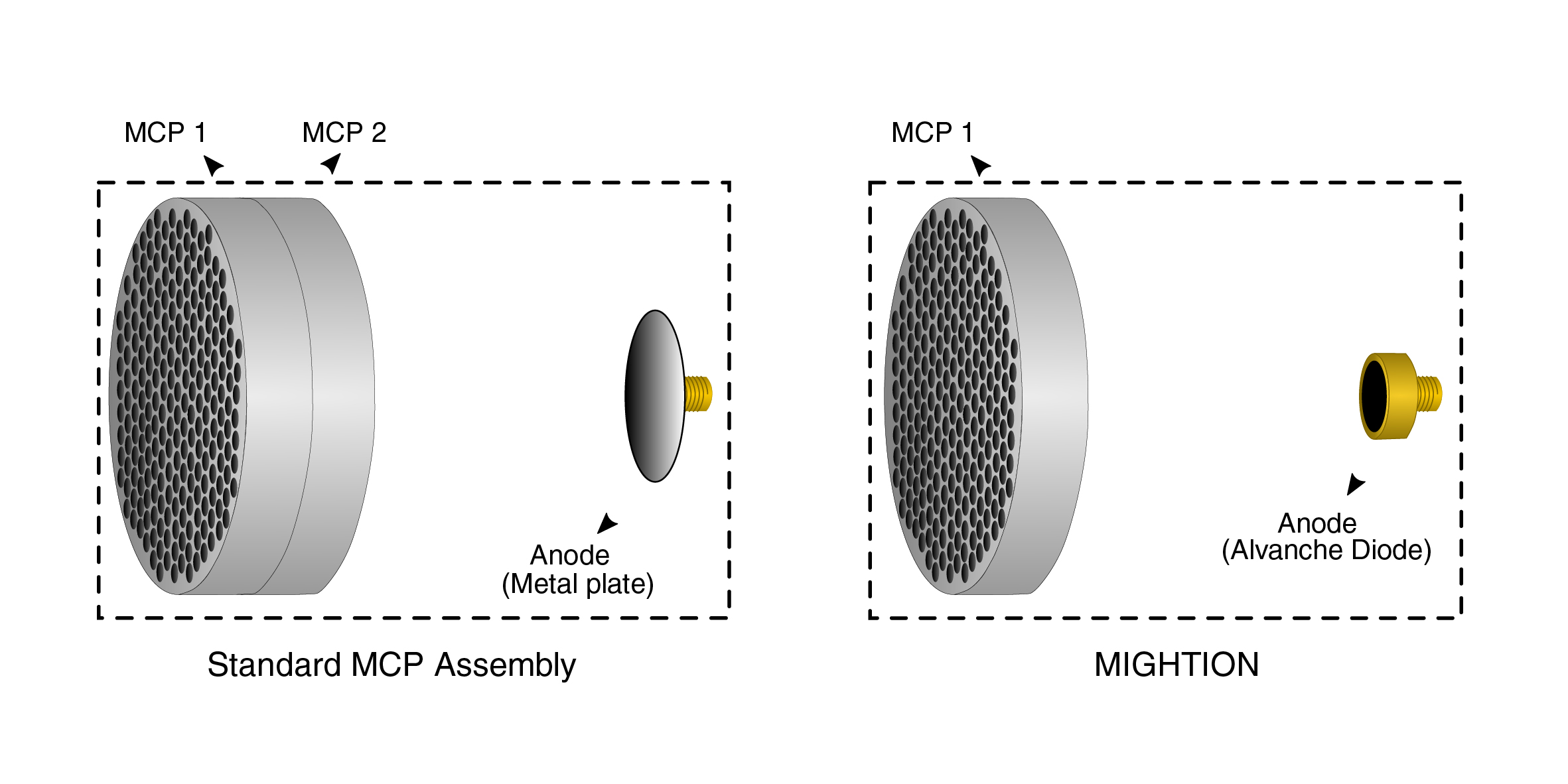
Figure 1. In MIGHTION the second MCP (“MCP 2”) and the metal anode used in a standard MCP assembly are replaced by an avalanche diode (AD).
Key MIGHTION benefits: dynamic range, speed, and lifetime
By replacing the second MCP and anode with an AD, MIGHTION redistributes amplification and readout across the MCP and the semiconductor device. This architectural change directly addresses three common limits of chevron MCP assemblies:
| Benefit | Design change | Application impact |
|---|---|---|
| Large dynamic range | AD supports detection at moderate gain and tolerates higher ion flux | Wider usable signal range before saturation |
| Faster temporal response | Lower capacitance from removing second MCP and metal anode | Sharper pulses for ToF MS timing |
| Long lifetime | Lower charge loading and more robust AD readout | Longer service intervals |
Applications for high-speed MCP hybrid detectors
These characteristics are valuable in ToF MS applications that require fast signal discrimination and stable detector behavior under variable ion flux, including MALDI-TOF workflows, biomolecular analysis, and complex biological sample characterization. In these settings, resistance to saturation and longer service life can be as important as time resolution because they affect reproducibility, uptime, and maintenance intervals.
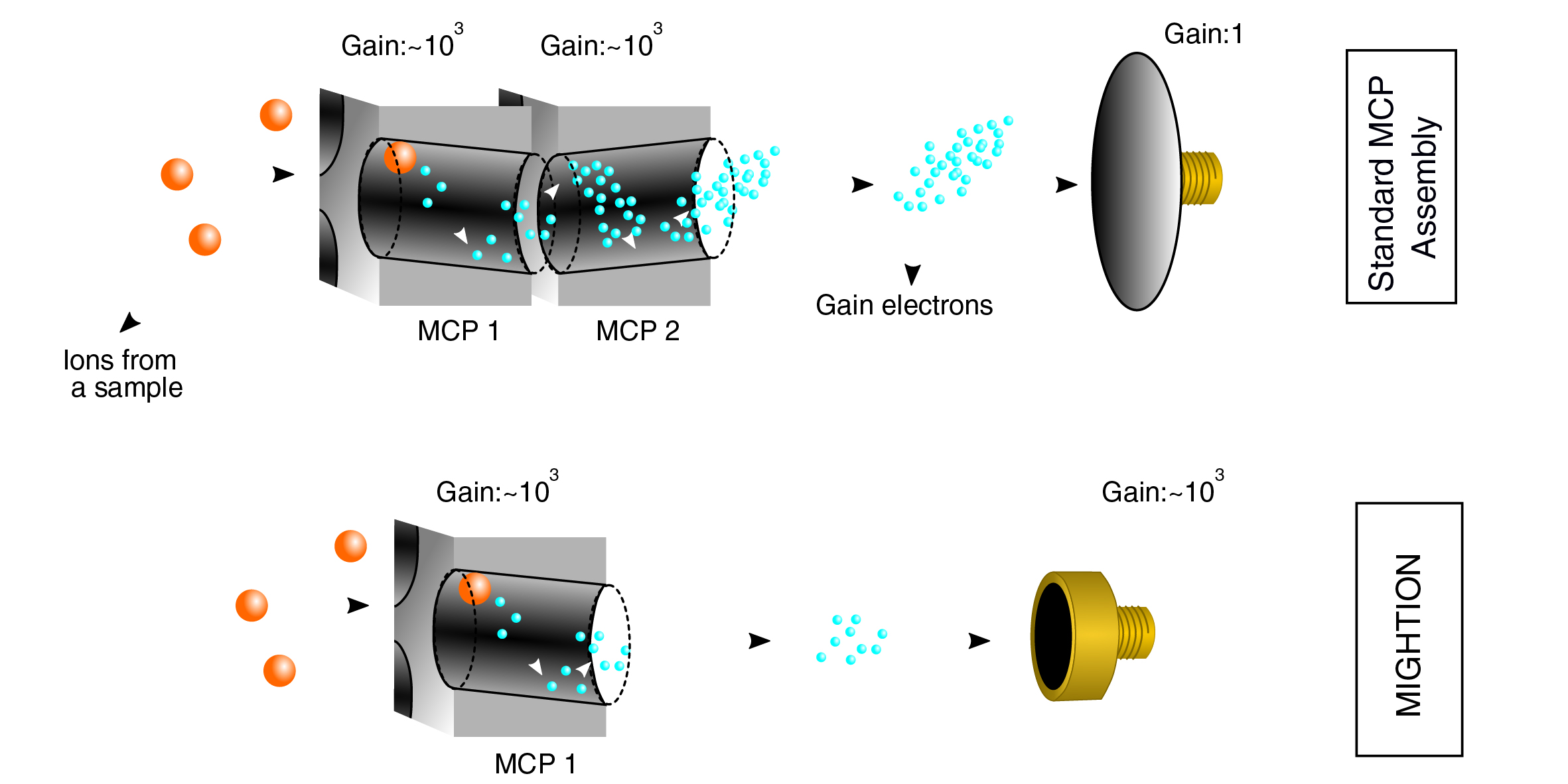
Figure 2. Comparison of detection mechanisms in a standard MCP assembly and MIGHTION. In a chevron MCP assembly, the second MCP (“MCP 2”) receives a high charge load and degrades quickly. In MIGHTION, the AD provides the second‑stage gain with minimal degradation, supporting longer detector lifetimes.
Improving ToF MS detector performance with MIGHTION
The comparison table summarizes the detector characteristics in practical terms. MIGHTION remains within the speed range required for high-speed ToF MS detection, while its dynamic range and lifetime figures support sustained use under demanding signal conditions. For instrument developers, this combination can help when optimizing for sensitivity, throughput, quantitative robustness, and service interval planning.
MIGHTION demonstrates how detector architecture can resolve long-standing compromises in ToF MS. By combining an MCP with an AD, it retains the fast response needed for time-of-flight detection while improving resistance to saturation and extending lifetime compared with conventional MCP detector configurations.
The following metrics illustrate how MIGHTION compares with typical MCP‑based detector configurations available on the market.
| Detector Performance Metrics | MIGHTION | Reference 1 | Reference 2 |
|---|---|---|---|
| Time resolution (ns) | 0.5 | 0.7 | 0.4 |
| Dynamic range (max DC current) | 200 µA | 100 µA | 10 µA |
| Lifetime | 250 C | – | < 1 C |
MIGHTION detectors can be customized to fit instrument design requirements, including detector geometry, electronics integration, operating conditions, and target application needs.
References
[1] Hamamatsu Photonics, “MIGHTION hybrid detector,” YouTube. https://www.youtube.com/watch?v=K3Ci4CuzopQ (accessed Jul. 9, 2026).
[2] H. Hiroshi Kobayashi, T. a b, Toshinobu Hondo, N. c d, Naruaki Imaoka, M. Suyama, and M. Toyoda, b, Motohiro Suyama a, Michisato Toyoda b c “Development of novel ion detector that combines a microchannel plate with an avalanche diode,” Nucl. Instrum. Methods Phys. Res. A, vol. 971, Art. no. 164110, 2020, doi: 10.1016/j.nima.2020.164110.
- Confirmation
-
It looks like you're in the . If this is not your location, please select the correct region or country below.
You're headed to Hamamatsu Photonics website for GB (English). If you want to view an other country's site, the optimized information will be provided by selecting options below.
In order to use this website comfortably, we use cookies. For cookie details please see our cookie policy.
- Cookie Policy
-
This website or its third-party tools use cookies, which are necessary to its functioning and required to achieve the purposes illustrated in this cookie policy. By closing the cookie warning banner, scrolling the page, clicking a link or continuing to browse otherwise, you agree to the use of cookies.
Hamamatsu uses cookies in order to enhance your experience on our website and ensure that our website functions.
You can visit this page at any time to learn more about cookies, get the most up to date information on how we use cookies and manage your cookie settings. We will not use cookies for any purpose other than the ones stated, but please note that we reserve the right to update our cookies.
1. What are cookies?
For modern websites to work according to visitor’s expectations, they need to collect certain basic information about visitors. To do this, a site will create small text files which are placed on visitor’s devices (computer or mobile) - these files are known as cookies when you access a website. Cookies are used in order to make websites function and work efficiently. Cookies are uniquely assigned to each visitor and can only be read by a web server in the domain that issued the cookie to the visitor. Cookies cannot be used to run programs or deliver viruses to a visitor’s device.
Cookies do various jobs which make the visitor’s experience of the internet much smoother and more interactive. For instance, cookies are used to remember the visitor’s preferences on sites they visit often, to remember language preference and to help navigate between pages more efficiently. Much, though not all, of the data collected is anonymous, though some of it is designed to detect browsing patterns and approximate geographical location to improve the visitor experience.
Certain type of cookies may require the data subject’s consent before storing them on the computer.
2. What are the different types of cookies?
This website uses two types of cookies:
- First party cookies. For our website, the first party cookies are controlled and maintained by Hamamatsu. No other parties have access to these cookies.
- Third party cookies. These cookies are implemented by organizations outside Hamamatsu. We do not have access to the data in these cookies, but we use these cookies to improve the overall website experience.
3. How do we use cookies?
This website uses cookies for following purposes:
- Certain cookies are necessary for our website to function. These are strictly necessary cookies and are required to enable website access, support navigation or provide relevant content. These cookies direct you to the correct region or country, and support security and ecommerce. Strictly necessary cookies also enforce your privacy preferences. Without these strictly necessary cookies, much of our website will not function.
- Analytics cookies are used to track website usage. This data enables us to improve our website usability, performance and website administration. In our analytics cookies, we do not store any personal identifying information.
- Functionality cookies. These are used to recognize you when you return to our website. This enables us to personalize our content for you, greet you by name and remember your preferences (for example, your choice of language or region).
- These cookies record your visit to our website, the pages you have visited and the links you have followed. We will use this information to make our website and the advertising displayed on it more relevant to your interests. We may also share this information with third parties for this purpose.
Cookies help us help you. Through the use of cookies, we learn what is important to our visitors and we develop and enhance website content and functionality to support your experience. Much of our website can be accessed if cookies are disabled, however certain website functions may not work. And, we believe your current and future visits will be enhanced if cookies are enabled.
4. Which cookies do we use?
There are two ways to manage cookie preferences.
- You can set your cookie preferences on your device or in your browser.
- You can set your cookie preferences at the website level.
If you don’t want to receive cookies, you can modify your browser so that it notifies you when cookies are sent to it or you can refuse cookies altogether. You can also delete cookies that have already been set.
If you wish to restrict or block web browser cookies which are set on your device then you can do this through your browser settings; the Help function within your browser should tell you how. Alternatively, you may wish to visit www.aboutcookies.org, which contains comprehensive information on how to do this on a wide variety of desktop browsers.
5. What are Internet tags and how do we use them with cookies?
Occasionally, we may use internet tags (also known as action tags, single-pixel GIFs, clear GIFs, invisible GIFs and 1-by-1 GIFs) at this site and may deploy these tags/cookies through a third-party advertising partner or a web analytical service partner which may be located and store the respective information (including your IP-address) in a foreign country. These tags/cookies are placed on both online advertisements that bring users to this site and on different pages of this site. We use this technology to measure the visitors' responses to our sites and the effectiveness of our advertising campaigns (including how many times a page is opened and which information is consulted) as well as to evaluate your use of this website. The third-party partner or the web analytical service partner may be able to collect data about visitors to our and other sites because of these internet tags/cookies, may compose reports regarding the website’s activity for us and may provide further services which are related to the use of the website and the internet. They may provide such information to other parties if there is a legal requirement that they do so, or if they hire the other parties to process information on their behalf.
If you would like more information about web tags and cookies associated with on-line advertising or to opt-out of third-party collection of this information, please visit the Network Advertising Initiative website http://www.networkadvertising.org.
6. Analytics and Advertisement Cookies
We use third-party cookies (such as Google Analytics) to track visitors on our website, to get reports about how visitors use the website and to inform, optimize and serve ads based on someone's past visits to our website.
You may opt-out of Google Analytics cookies by the websites provided by Google:
https://tools.google.com/dlpage/gaoptout?hl=en
As provided in this Privacy Policy (Article 5), you can learn more about opt-out cookies by the website provided by Network Advertising Initiative:
http://www.networkadvertising.org
We inform you that in such case you will not be able to wholly use all functions of our website.
Close