
Products










We are actively taking measures to improve product quality levels.
Applications















Why Hamamatsu?
Resources





Support




Our company







Investors








United Kingdom (EN)
Select your region or country.


Large active-area InAsSb detectors for room-temperature MWIR sensing: Technical considerations for legacy PbSe technology replacement
Room‑temperature mid‑wave infrared (MWIR, 3–5 µm) detectors are widely used in NDIR gas sensing, industrial monitoring, environmental sensing, and portable analytical instruments. PbSe detectors have historically been adopted because they offer strong MWIR sensitivity, relatively large active areas, and straightforward integration into compact optical designs.
However, their photoconductive operation can introduce excess low‑frequency noise, slower response, drift, and aging effects that increase calibration burden and reduce long‑term measurement stability. These limitations, combined with lead‑related RoHS considerations, are driving interest in large‑active‑area InAsSb photovoltaic detectors as a practical, room‑temperature alternative.
Requirements for modern MWIR sensor systems
Modern MWIR systems increasingly require:
- Reliable room-temperature operation
- Low noise and stable baseline behavior
- Fast response for modulated or transient signals
- Repeatable performance across production volumes
- Compatibility with compact, cost-optimized optics
PbSe detectors can meet basic sensitivity requirements, but their photoconductive architecture may limit stability, modulation bandwidth, and long‑term maintainability.
PbSe and InAsSb operating principles
PbSe detectors operate in photoconductive mode and require external bias. Photoconductive gain can increase responsivity but may also introduce excess 1/f noise at low operating frequencies, affecting baseline stability and calibration in long-duration measurements [1].
InAsSb detectors operate in photovoltaic mode and typically generate signal without detector bias. The large active area detectors recently achieved by state-of-the-art semiconductor fabrication technology allowe greater flexibility in filter selection, optical layout, and application design [2].
| Detector type | Operating behavior | System implication |
|---|---|---|
|
PbSe photoconductive |
Requires detector bias; signal is generated through a light-induced change in resistance. | Useful responsivity but may contribute excess low-frequency noise, baseline drift, and calibration burden. |
|
InAsSb photovoltaic |
Generates photo-voltage or photo-current at a junction, without bias. | Supports faster response, lower-noise operation, and more stable long-duration behavior. |
Table 1: PbSe photoconductive versus InAsSb photovoltaic operating behavior and system implications.
Methodology and measurement example
Example NDIR measurement configuration
A typical room-temperature MWIR NDIR system includes:
- A infrared source
- A gas cell or sample path
- Wavelength-selective optical filters
- A detector
- A low-noise readout circuit
In this configuration, a large-active-area InAsSb detector helps maintain optical throughput while supporting faster modulation and stable baseline behavior.
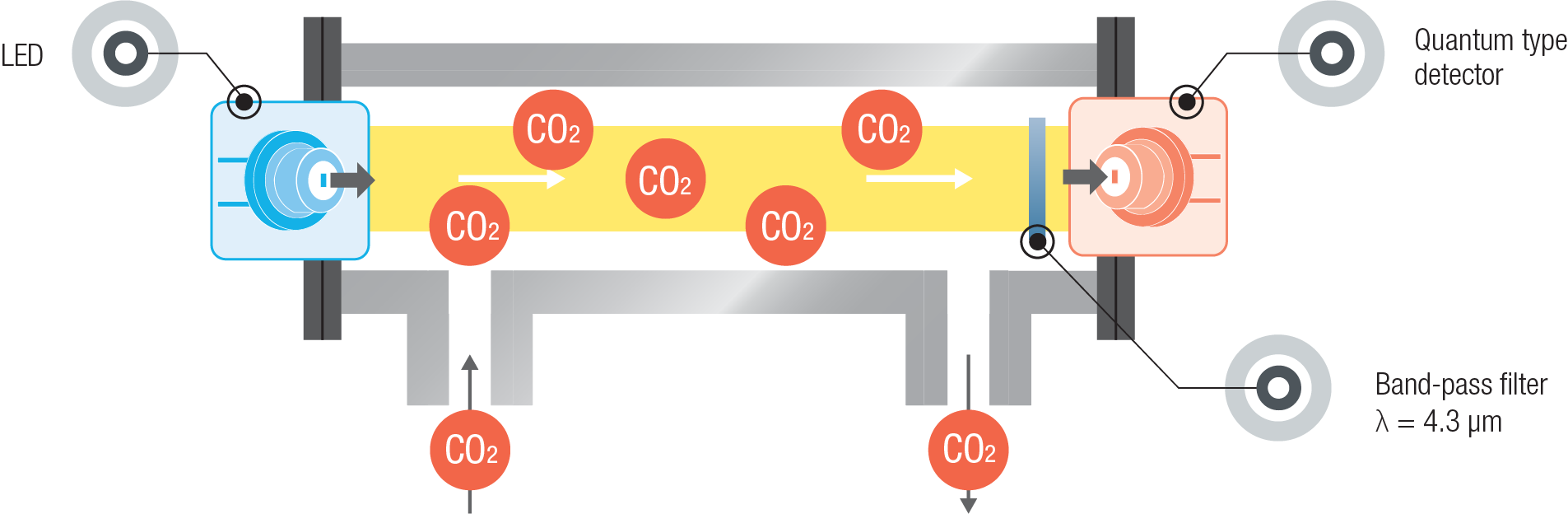
Fig. 1: Example NDIR optical path: infrared source, sample cell, optical filter, large-active-area InAsSb detector, and signal-processing electronics.
Parameters under evaluation
Detector selection was compared at the system level, considering:
- Linearity and dynamic range
- Response time and modulation bandwidth
- Baseline stability and reliability
- Optical throughput and alignment tolerance
- Production repeatability
- Regulatory and lifecycle requirements
This approach reflects practical constraints in compact MWIR instruments, where optical layout, stability, and manufacturability often limit performance more than detector sensitivity alone.
Performance Results
Linearity and Dynamic Range
InAsSb photovoltaic detectors offer excellent linearity, allowing stronger light sources to be used without attenuation. Their wide dynamic range can improve signal quality and enable the detection of a broad range of gas concentrations. In MWIR NDIR gas sensing, this means the system can operate without changing the light source intensity, making it simpler and more robust.
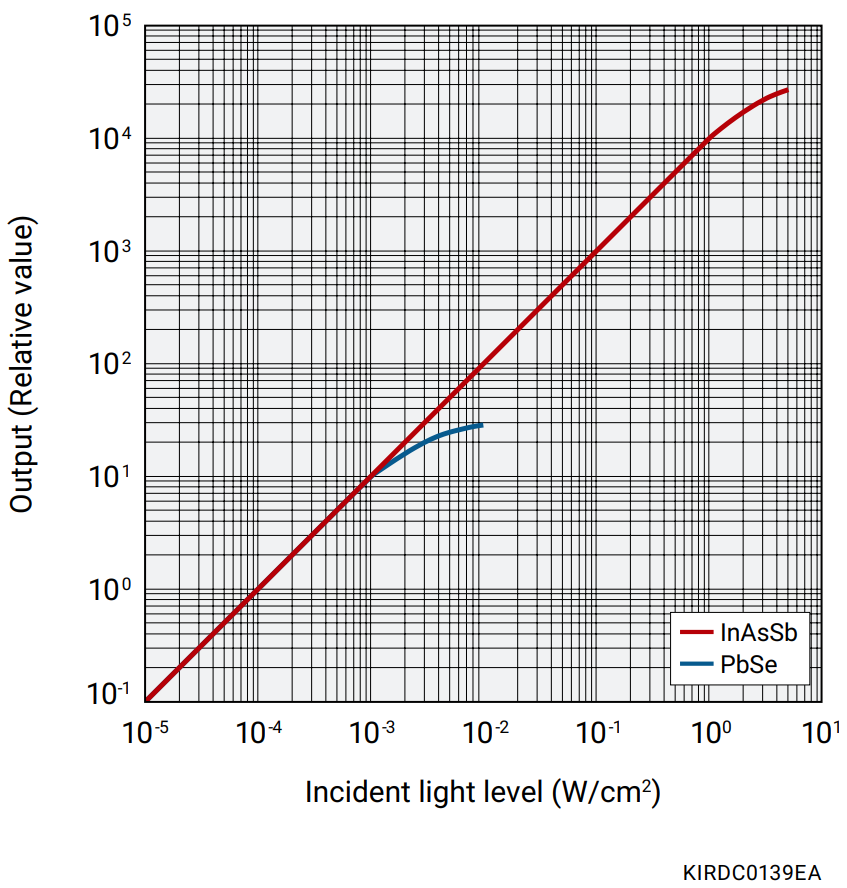
Fig. 2: Typical output linearity of InAsSb detector compared to PbSe.
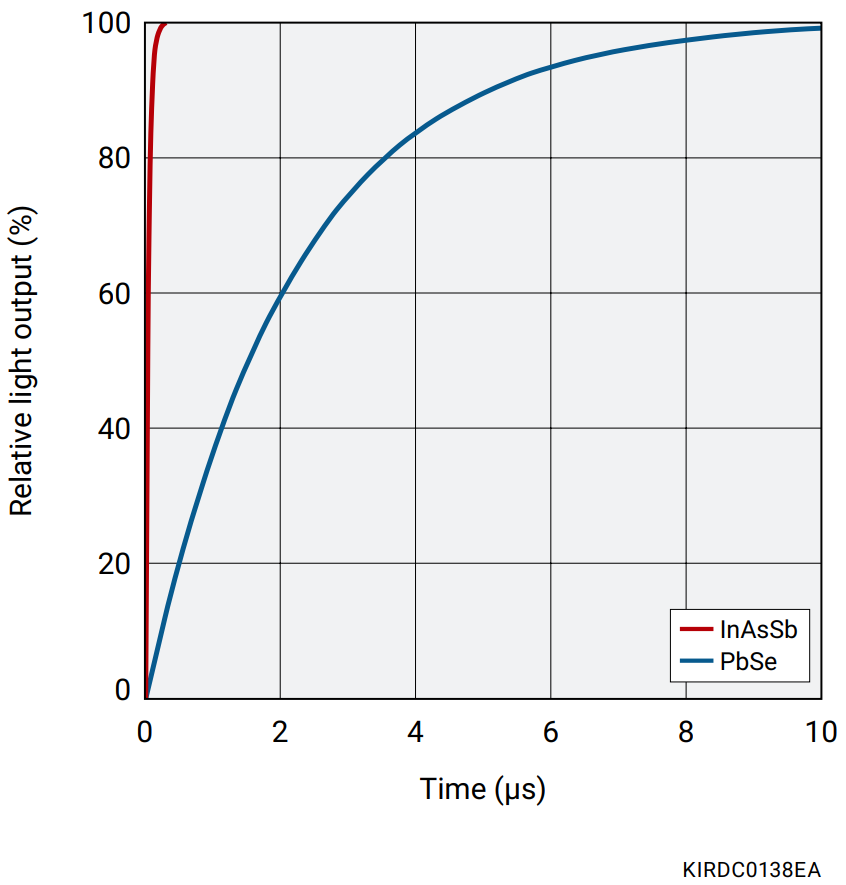
Fig. 3: Typical response speed of InAsSb detectors compared to PbSe
Response Speed and Modulation Bandwidth
Fast temporal response enables higher modulation frequencies, improved measurement throughput, and more flexible digital signal processing. InAsSb detectors typically achieve nano to microsecond scale response, supporting chopped-source, pulsed-source, and dynamically changing measurement conditions. When coupled with lock-in amplification, a MWIR NDIR gas sensor can benefit from faster sensor response by achieving a lower limit of detection for its target gas.
| Detector | Architecture | Typical response time | Bandwidth implication | System impact |
|---|---|---|---|---|
|
PbSe detector |
Photoconductive | Microsecond-scale | Suitable for low- to mid-frequency optical chopping or modulation; may limit higher-frequency operation depending on detector design and readout electronics. | May constrain modulation frequency, settling time, and measurement throughput in faster MWIR sensing systems. |
|
InAsSb detector |
Photovoltaic | Nano- to microsecond-scale | Supports higher modulation frequencies and faster transient measurements. | Enables faster signal acquisition, improved compatibility with digital lock-in and readout techniques, and more responsive MWIR sensing systems. |
Table 2: Response-time and bandwidth characteristics summarized from published comparisons of room-temperature PbSe and InAsSb MWIR detector technologies [2], [3].
Baseline Stability and Reliability
Stable detector behavior reduces calibration burden and supports confidence in long-duration measurements. Large-active-area InAsSb detectors maintain consistent electro‑optical characteristics over time and temperature, supporting reproducible system performance.
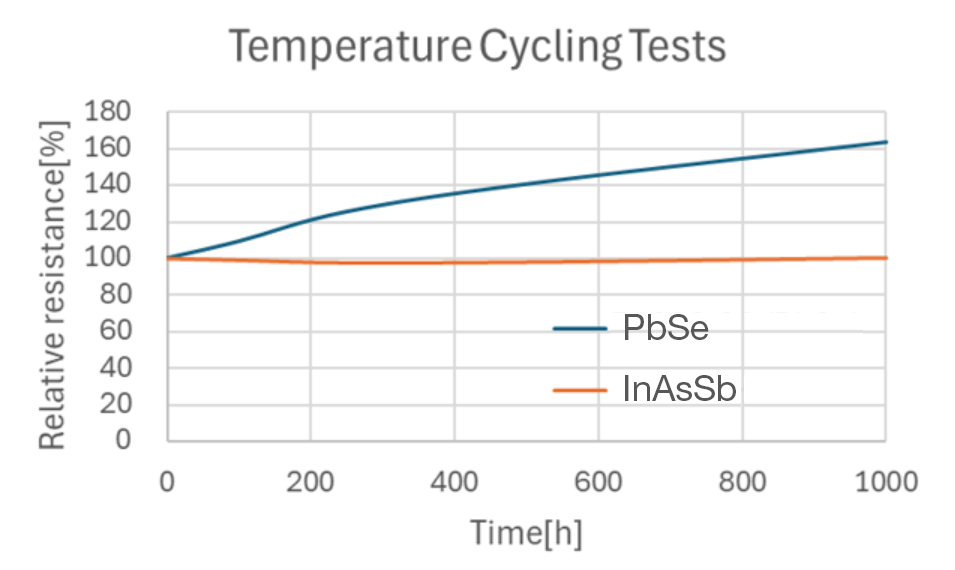
Fig. 4: Typical behavior over time for InAsSb and PbSe detectors.
Optical Throughput and System-Level Impact
A larger detector area collects more optical signals, relaxes source, filter, and detector alignment, and simplifies compact optical designs. For PbSe replacement programs, millimeter-scale InAsSb devices allow OEMs to retain existing optical concepts while improving response speed, baseline stability, reproducibility, and regulatory positioning.
RoHS and Lifecycle Considerations
PbSe detectors contain lead and may depend on RoHS exemptions. InAsSb detectors can support an intrinsically compliant detector strategy.
For OEMs and system integrators, this can:
- Reduce dependency on temporary exemptions
- Simplify compliance documentation and supply-chain qualification
- Lower regulatory risk for future product revisions
As regulatory frameworks tighten, moving from exempted materials toward inherently compliant technologies is becoming a strategic lifecycle decision [6].
Applications and Detector Selection
Target Applications
Large‑active‑area InAsSb detectors are suitable for:
- NDIR gas sensing for CO₂, CH₄, and hydrocarbons
- Industrial and process-control sensors
- Environmental monitoring
- Remote temperature monitoring
- Portable analytical instruments
- Medical and breath-analysis systems
PbSe-to-InAsSb Selection Guide
Detector selection should consider system‑level constraints such as optical design, stability, manufacturability, compliance, and lifecycle requirements.
| Design factor | InAsSb benefit | Why it matters |
|---|---|---|
| Speed and modulation | Fast photovoltaic response supports chopped, pulsed, and digitally processed MWIR signals. | Higher modulation frequencies improve throughput and signal processing flexibility. |
| Optical throughput | Large active area improves light collection and relaxes alignment tolerance. | Compact sensors are often limited by source power, alignment, and optical layout. |
| Baseline stability | Photovoltaic operation supports lower-noise, stable signal behavior. | Signal drift increases calibration burden. |
| PbSe migration | Large-area InAsSb offers a practical migration path with improved speed and stability. | OEMs often refresh platforms without redesigning the full optical path. |
| Regulatory planning | InAsSb supports a lower-risk, RoHS-ready strategy. | Lead-based detector materials can depend on RoHS exemptions. |
Conclusion
Large-active-area InAsSb detectors combine photovoltaic operation, room-temperature MWIR sensitivity, fast response, stable baseline behavior, and practical optical collection.
For OEMs and system integrators, they offer a direct, lower-risk route for replacing legacy PbSe technology without unnecessary optical compromise, while supporting RoHS-ready lifecycle planning and stable long‑term system performance.
References
[1] G.-D. Zhang, Q.-S. Zhu, B.-C. Xue et al., “Research Status and Development Trend of Uncooled PbSe Mid-Infrared Photo-Conductive Detectors,” Infrared, vol. 45, no. 5, pp. 1-17, 2024. Accessed June 2026
[2] “Room-temperature operated MWIR detector comparison study,” PMC (PubMed Central). Available: https://pmc.ncbi.nlm.nih.gov/articles/PMC7763214/. Accessed June 2026
[3] “Performance comparison of room-temperature operated mid-infrared IV-VI and III-V detectors,” SPIE Digital Library. Available: https://www.spiedigitallibrary.org/conference-proceedings-of-spie/PC13892/PC138920B/Performance-comparison-of-room-temperature-operated-mid-infrared-IV-VI/10.1117/12.3081662.full. Accessed June 2026
[4] Infrared Materials, “RoHS Directives.” Available: https://infraredmaterials.com/resources-2/rohs-directives/. Accessed June 2026
[5] Laser Components, “RoHS Directives for PbS/PbSe Detectors.” Available: https://www.lasercomponents.com/fileadmin/user_upload/home/Datasheets/lc-lead-salt/rohs-directives-pbs-pbse.pdf. Accessed June 2026
[6] European Commission, “RoHS Directive Implementation.” Available: https://environment.ec.europa.eu/topics/waste-and-recycling/rohs-directive/rohs-directive-implementation_en. Accessed June 2026
- Confirmation
-
It looks like you're in the . If this is not your location, please select the correct region or country below.
You're headed to Hamamatsu Photonics website for GB (English). If you want to view an other country's site, the optimized information will be provided by selecting options below.
In order to use this website comfortably, we use cookies. For cookie details please see our cookie policy.
- Cookie Policy
-
This website or its third-party tools use cookies, which are necessary to its functioning and required to achieve the purposes illustrated in this cookie policy. By closing the cookie warning banner, scrolling the page, clicking a link or continuing to browse otherwise, you agree to the use of cookies.
Hamamatsu uses cookies in order to enhance your experience on our website and ensure that our website functions.
You can visit this page at any time to learn more about cookies, get the most up to date information on how we use cookies and manage your cookie settings. We will not use cookies for any purpose other than the ones stated, but please note that we reserve the right to update our cookies.
1. What are cookies?
For modern websites to work according to visitor’s expectations, they need to collect certain basic information about visitors. To do this, a site will create small text files which are placed on visitor’s devices (computer or mobile) - these files are known as cookies when you access a website. Cookies are used in order to make websites function and work efficiently. Cookies are uniquely assigned to each visitor and can only be read by a web server in the domain that issued the cookie to the visitor. Cookies cannot be used to run programs or deliver viruses to a visitor’s device.
Cookies do various jobs which make the visitor’s experience of the internet much smoother and more interactive. For instance, cookies are used to remember the visitor’s preferences on sites they visit often, to remember language preference and to help navigate between pages more efficiently. Much, though not all, of the data collected is anonymous, though some of it is designed to detect browsing patterns and approximate geographical location to improve the visitor experience.
Certain type of cookies may require the data subject’s consent before storing them on the computer.
2. What are the different types of cookies?
This website uses two types of cookies:
- First party cookies. For our website, the first party cookies are controlled and maintained by Hamamatsu. No other parties have access to these cookies.
- Third party cookies. These cookies are implemented by organizations outside Hamamatsu. We do not have access to the data in these cookies, but we use these cookies to improve the overall website experience.
3. How do we use cookies?
This website uses cookies for following purposes:
- Certain cookies are necessary for our website to function. These are strictly necessary cookies and are required to enable website access, support navigation or provide relevant content. These cookies direct you to the correct region or country, and support security and ecommerce. Strictly necessary cookies also enforce your privacy preferences. Without these strictly necessary cookies, much of our website will not function.
- Analytics cookies are used to track website usage. This data enables us to improve our website usability, performance and website administration. In our analytics cookies, we do not store any personal identifying information.
- Functionality cookies. These are used to recognize you when you return to our website. This enables us to personalize our content for you, greet you by name and remember your preferences (for example, your choice of language or region).
- These cookies record your visit to our website, the pages you have visited and the links you have followed. We will use this information to make our website and the advertising displayed on it more relevant to your interests. We may also share this information with third parties for this purpose.
Cookies help us help you. Through the use of cookies, we learn what is important to our visitors and we develop and enhance website content and functionality to support your experience. Much of our website can be accessed if cookies are disabled, however certain website functions may not work. And, we believe your current and future visits will be enhanced if cookies are enabled.
4. Which cookies do we use?
There are two ways to manage cookie preferences.
- You can set your cookie preferences on your device or in your browser.
- You can set your cookie preferences at the website level.
If you don’t want to receive cookies, you can modify your browser so that it notifies you when cookies are sent to it or you can refuse cookies altogether. You can also delete cookies that have already been set.
If you wish to restrict or block web browser cookies which are set on your device then you can do this through your browser settings; the Help function within your browser should tell you how. Alternatively, you may wish to visit www.aboutcookies.org, which contains comprehensive information on how to do this on a wide variety of desktop browsers.
5. What are Internet tags and how do we use them with cookies?
Occasionally, we may use internet tags (also known as action tags, single-pixel GIFs, clear GIFs, invisible GIFs and 1-by-1 GIFs) at this site and may deploy these tags/cookies through a third-party advertising partner or a web analytical service partner which may be located and store the respective information (including your IP-address) in a foreign country. These tags/cookies are placed on both online advertisements that bring users to this site and on different pages of this site. We use this technology to measure the visitors' responses to our sites and the effectiveness of our advertising campaigns (including how many times a page is opened and which information is consulted) as well as to evaluate your use of this website. The third-party partner or the web analytical service partner may be able to collect data about visitors to our and other sites because of these internet tags/cookies, may compose reports regarding the website’s activity for us and may provide further services which are related to the use of the website and the internet. They may provide such information to other parties if there is a legal requirement that they do so, or if they hire the other parties to process information on their behalf.
If you would like more information about web tags and cookies associated with on-line advertising or to opt-out of third-party collection of this information, please visit the Network Advertising Initiative website http://www.networkadvertising.org.
6. Analytics and Advertisement Cookies
We use third-party cookies (such as Google Analytics) to track visitors on our website, to get reports about how visitors use the website and to inform, optimize and serve ads based on someone's past visits to our website.
You may opt-out of Google Analytics cookies by the websites provided by Google:
https://tools.google.com/dlpage/gaoptout?hl=en
As provided in this Privacy Policy (Article 5), you can learn more about opt-out cookies by the website provided by Network Advertising Initiative:
http://www.networkadvertising.org
We inform you that in such case you will not be able to wholly use all functions of our website.
Close