
Products










We are actively taking measures to improve product quality levels.
Applications















Why Hamamatsu?
Resources





Support




Our company







Investors








United Kingdom (EN)
Select your region or country.


Turning data into insight:
A decade of stable methane sensing
Methane (CH4) has a short-term warming potential that is 80 times higher than carbon dioxide (CO2) [1], a fact that has driven growing demand for reliable, real-world CH4 measurements. However, achieving stable, sub-ppm detection in compact, field-ready systems is an engineering challenge. For over a decade, Axetris has delivered highprecision tunable diode laser absorption spectroscopy (TDLAS) modules designed to meet these requirements, supported by Hamamatsu Photonics’ low-noise, highly stable InGaAs PIN photodiodes and early integration guidance.
CH4 monitoring is gaining attention as governments, research institutes, and industry groups work to better understand and reduce greenhouse gas emissions. In the oil and gas sector, European Union has already established clear CH4 reporting requirements, and several regulatory milestones have been implemented in recent years, each adding new expectations around measurement and reporting. Operators are now required to carry out real CH4 measurements – not just estimates – and submit this data to authorities.[2] In the United States, recent deregulation has slowed mandatory CH4 monitoring, although many leading operators continue voluntary measurements to manage leaks and maintain environmental performance. As a result, dependable leak detection and quantification tools are becoming increasingly important across the industry.
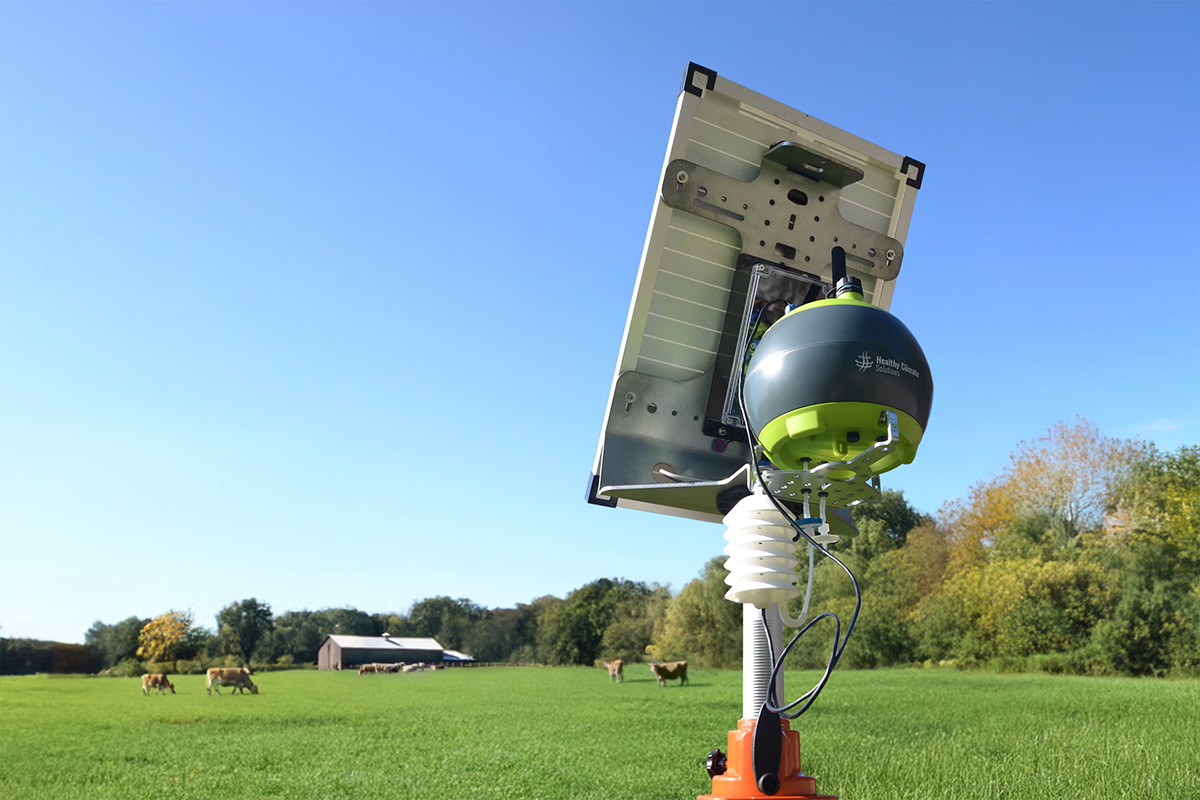
Continuous CH4 emission monitoring around barns (Axetris)
In the livestock sector, CH4 monitoring is at an earlier stage. Formal regulation has not yet been introduced, but several European countries – particularly the Netherlands and Belgium – are funding long-term measurement programs to better quantify CH4 emissions under real farm conditions. These initiatives aim to complement or refine the model-based emission factors currently used in national inventories, and are driving increased demand for sensing technologies that deliver stable, repeatable performance
Engineering precision for real-world environments
Axetris, part of the Leister Group, is based in central Switzerland and focused on developing and manufacturing high-performance gas detection modules for CH4, ammonia (NH3), and CO2. Its laser gas detection (LGD) product line is used across a wide range of industries and applications, including oil and gas leak detection, fence-line monitoring, livestock emissions research, and medical breath analysis. These systems offer compact form factors, high sensitivity, and longterm stability, and are valued by research institutes, environmental scientists and system integrators who rely on precise, dependable data generation.

Axetris'integrated LGD Compact CH4 for outdoor CH4 monitoring
In Europe, Axetris has become a key contributor to livestock CH4 research; universities and governmentfunded programs rely on the company’s LGD systems for barn-based studies that investigate how diet, feeding schedules, animal behavior and housing conditions influence CH4 emissions from cattle and other livestock.[3] These datasets are increasingly being used to improve understanding of livestock CH4 emissions, which may help to inform future policy discussions, making the repeatability and stability of Axetris’ technologies particularly important.
The challenge of achieving stable sub-ppm detection
Developing a compact, field-ready CH4 sensor brings several engineering challenges. CH4 absorption in the near-infrared (NIR) region – around 1.6 μm – is relatively weak, making it challenging for compact TDLAS systems to detect the very small changes in optical transmission required for sub-ppm measurements. Although CH4 absorbs more strongly at 3.3 μm, the 1.6 μm region is preferred as it is covered by mature, stable, and compact telecom-grade lasers and detectors suitable for field applications.
The optical path for these sensors is limited by the small form factor, meaning that drift, vibration, and environmental noise have a greater impact on the signal, while fluctuations in polarization can introduce additional measurement error. To compensate for these limitations, the optical components must work well together to preserve signal quality. The laser needs to maintain consistent beam alignment and wavelength stability, while the photodiode must deliver very low noise, low dark current, and strong responsivity at the relevant wavelength.
Axetris selected Hamamatsu Photonics’ InGaAs PIN photodiode to form the core detection element in its CH4 sensing systems more than 15 years ago, and it has since been the detector of choice. Low noise and dark current allow the photodiode to meet Axetris’ sub-ppm detection requirements, while the large active area helps to preserve alignment if the beam shifts due to temperature fluctuations or mechanical stresses. The low polarization dependence loss (PDL) design of the photodiode further reduces signal fluctuations caused by polarization changes, improving overall stability in compact TDLAS modules.
"Hamamatsu Photonics has been rock solid in terms of delivery, performance, and field reliability. The detector just works, and that’s exactly what you need in this kind of system."
Baz Matvichuk (Head of Sales & Product Management, Axetris)
Hamamatsu Photonics offers various InGaAs photodiode packaging option, from left to right: Surface mount chip-on-board (COB) package, surface mount ceramic package and CAN package.
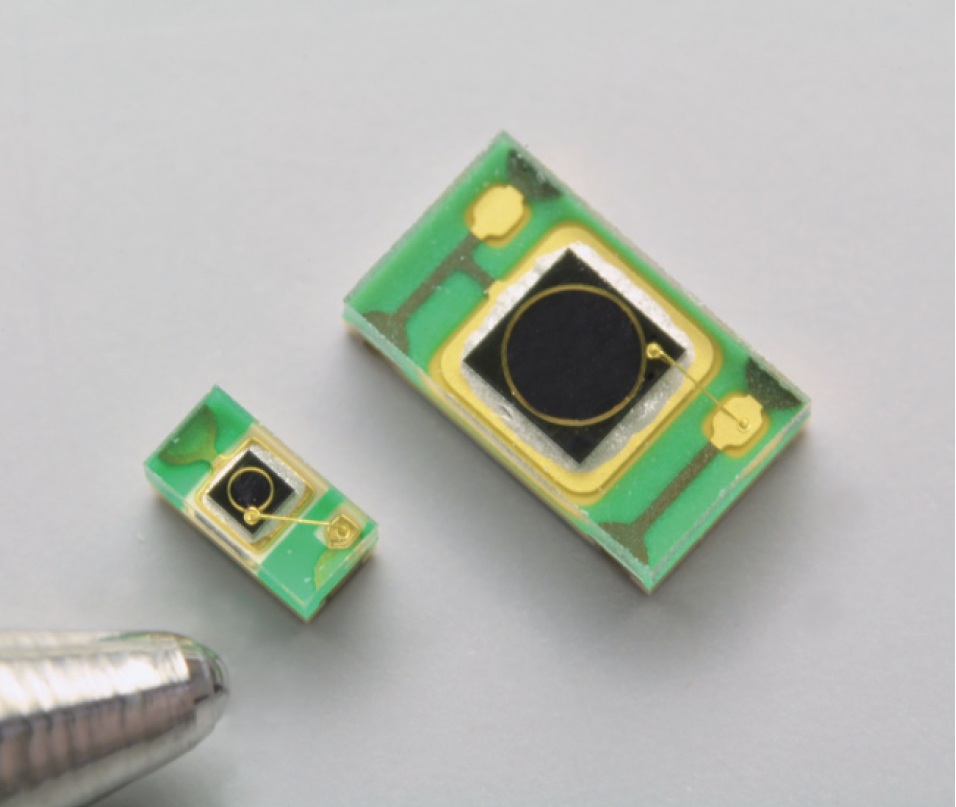
Surface mount chip-on-board (COB) package
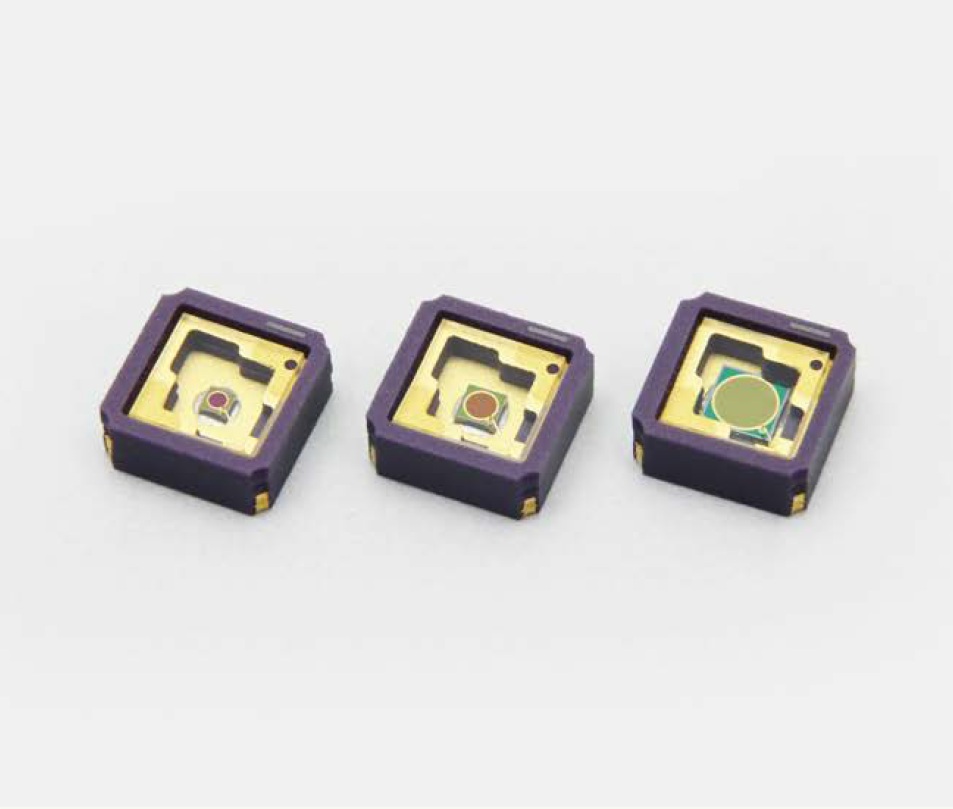
Surface mount ceramic package
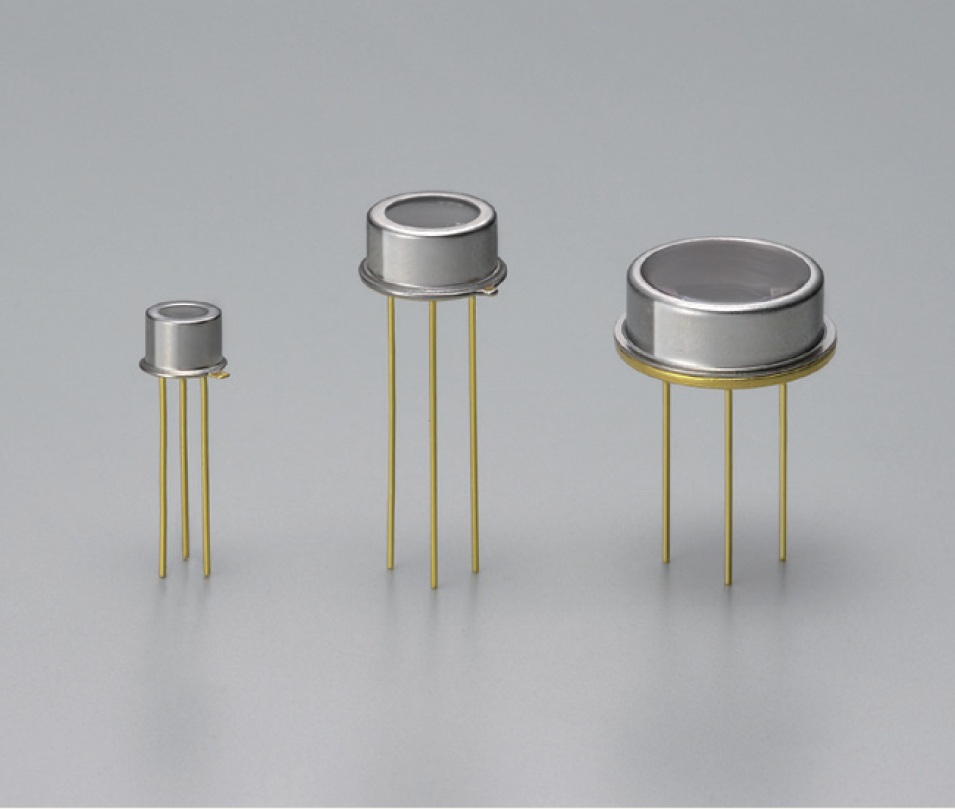
CAN package
This long-running relationship has involved more than supplying components; Hamamatsu Photonics has provided practical guidance and technical support from the initial integration through to later optimization work, helping Axetris to refine how the detector performed within the compact TDLAS architecture. Rui Protasio, Product Manager at Axetris, explained: “When we first integrated the photodiode, we had support from Hamamatsu Photonics on how to package it – things like the cap, anti-reflection coatings and some custom options not shown on the website. That helped us to optimize the detector for our compact design. We have a very small optical path, so every source of noise becomes a problem, and the low-PDL photodiode really allowed us to reach the performance we needed without having to increase the form factor.”
The detector has proven consistent, reliable, and robust for more than a decade, helping Axetris to deliver stable, repeatable measurements in both research and industrial settings. Baz Matvichuk, Head of Sales & Product Management, noted: “Hamamatsu Photonics has been rock solid in terms of delivery, performance, and field reliability. The detector just works, and that’s exactly what you need in this kind of system.”
Summary
The shift towards measured, rather than estimated, CH4 emissions is driving demand for sensing technologies that perform reliably in varied environments. Axetris’ experience illustrates the engineering considerations behind achieving sub-ppm performance in compact systems, where optical alignment, detector behavior, and long-term stability directly influence data quality. Hamamatsu Photonics’ InGaAs PIN photodiodes have provided the consistency required for these measurements, supported by a collaborative relationship that included early technical guidance and componentlevel optimization. The result is a sensing approach that supports repeatable, real-world measurements, which are increasingly important for research programs, regulatory reporting, and operational monitoring in applications like livestock management and the oil and gas sector.
About Axetris
Axetris AG, part of the Leister Group, develops and manufactures high-performance components for gas measurement and micro-optical applications. Founded in 1998 and based in Switzerland, the company specializes in TDLAS solutions for precise and stable gas sensing. Axetris’ technologies are used globally in emissions monitoring, industrial process control, safety, and environmental research. All core manufacturing, assembly, and calibration processes are carried out in Swiss cleanroom facilities to ensure consistent quality and long-term reliability.

References
[1] Mar, Kathleen A, et al. (2022) Beyond CO2 equivalence: The impacts of methane on climate, ecosystems, and health. Environmental Science & Policy. 134: 127-136.
[2] European Commission. (2024) Questions and Answers on the EU Regulation to reduce methane emissions in the energy sector. Accessed: 24 November 2025. [Online] https://ec.europa.eu/commission/presscorner/api/files/document/print/en/qanda_24_2258/QANDA_24_2258_EN.pdf
[3] Schep, CA et al. (2023) Inventarisatie van methaansensoren en validatie van de Axetris LGD Compact-A CH4 ten behoeve van continue emissiemonitoring in de melkveehouderij. (Rapport / Wageningen Livestock Research; No. 1456). Wageningen Livestock Research. [Online] https://doi.org/10.18174/641807
- Confirmation
-
It looks like you're in the . If this is not your location, please select the correct region or country below.
You're headed to Hamamatsu Photonics website for GB (English). If you want to view an other country's site, the optimized information will be provided by selecting options below.
In order to use this website comfortably, we use cookies. For cookie details please see our cookie policy.
- Cookie Policy
-
This website or its third-party tools use cookies, which are necessary to its functioning and required to achieve the purposes illustrated in this cookie policy. By closing the cookie warning banner, scrolling the page, clicking a link or continuing to browse otherwise, you agree to the use of cookies.
Hamamatsu uses cookies in order to enhance your experience on our website and ensure that our website functions.
You can visit this page at any time to learn more about cookies, get the most up to date information on how we use cookies and manage your cookie settings. We will not use cookies for any purpose other than the ones stated, but please note that we reserve the right to update our cookies.
1. What are cookies?
For modern websites to work according to visitor’s expectations, they need to collect certain basic information about visitors. To do this, a site will create small text files which are placed on visitor’s devices (computer or mobile) - these files are known as cookies when you access a website. Cookies are used in order to make websites function and work efficiently. Cookies are uniquely assigned to each visitor and can only be read by a web server in the domain that issued the cookie to the visitor. Cookies cannot be used to run programs or deliver viruses to a visitor’s device.
Cookies do various jobs which make the visitor’s experience of the internet much smoother and more interactive. For instance, cookies are used to remember the visitor’s preferences on sites they visit often, to remember language preference and to help navigate between pages more efficiently. Much, though not all, of the data collected is anonymous, though some of it is designed to detect browsing patterns and approximate geographical location to improve the visitor experience.
Certain type of cookies may require the data subject’s consent before storing them on the computer.
2. What are the different types of cookies?
This website uses two types of cookies:
- First party cookies. For our website, the first party cookies are controlled and maintained by Hamamatsu. No other parties have access to these cookies.
- Third party cookies. These cookies are implemented by organizations outside Hamamatsu. We do not have access to the data in these cookies, but we use these cookies to improve the overall website experience.
3. How do we use cookies?
This website uses cookies for following purposes:
- Certain cookies are necessary for our website to function. These are strictly necessary cookies and are required to enable website access, support navigation or provide relevant content. These cookies direct you to the correct region or country, and support security and ecommerce. Strictly necessary cookies also enforce your privacy preferences. Without these strictly necessary cookies, much of our website will not function.
- Analytics cookies are used to track website usage. This data enables us to improve our website usability, performance and website administration. In our analytics cookies, we do not store any personal identifying information.
- Functionality cookies. These are used to recognize you when you return to our website. This enables us to personalize our content for you, greet you by name and remember your preferences (for example, your choice of language or region).
- These cookies record your visit to our website, the pages you have visited and the links you have followed. We will use this information to make our website and the advertising displayed on it more relevant to your interests. We may also share this information with third parties for this purpose.
Cookies help us help you. Through the use of cookies, we learn what is important to our visitors and we develop and enhance website content and functionality to support your experience. Much of our website can be accessed if cookies are disabled, however certain website functions may not work. And, we believe your current and future visits will be enhanced if cookies are enabled.
4. Which cookies do we use?
There are two ways to manage cookie preferences.
- You can set your cookie preferences on your device or in your browser.
- You can set your cookie preferences at the website level.
If you don’t want to receive cookies, you can modify your browser so that it notifies you when cookies are sent to it or you can refuse cookies altogether. You can also delete cookies that have already been set.
If you wish to restrict or block web browser cookies which are set on your device then you can do this through your browser settings; the Help function within your browser should tell you how. Alternatively, you may wish to visit www.aboutcookies.org, which contains comprehensive information on how to do this on a wide variety of desktop browsers.
5. What are Internet tags and how do we use them with cookies?
Occasionally, we may use internet tags (also known as action tags, single-pixel GIFs, clear GIFs, invisible GIFs and 1-by-1 GIFs) at this site and may deploy these tags/cookies through a third-party advertising partner or a web analytical service partner which may be located and store the respective information (including your IP-address) in a foreign country. These tags/cookies are placed on both online advertisements that bring users to this site and on different pages of this site. We use this technology to measure the visitors' responses to our sites and the effectiveness of our advertising campaigns (including how many times a page is opened and which information is consulted) as well as to evaluate your use of this website. The third-party partner or the web analytical service partner may be able to collect data about visitors to our and other sites because of these internet tags/cookies, may compose reports regarding the website’s activity for us and may provide further services which are related to the use of the website and the internet. They may provide such information to other parties if there is a legal requirement that they do so, or if they hire the other parties to process information on their behalf.
If you would like more information about web tags and cookies associated with on-line advertising or to opt-out of third-party collection of this information, please visit the Network Advertising Initiative website http://www.networkadvertising.org.
6. Analytics and Advertisement Cookies
We use third-party cookies (such as Google Analytics) to track visitors on our website, to get reports about how visitors use the website and to inform, optimize and serve ads based on someone's past visits to our website.
You may opt-out of Google Analytics cookies by the websites provided by Google:
https://tools.google.com/dlpage/gaoptout?hl=en
As provided in this Privacy Policy (Article 5), you can learn more about opt-out cookies by the website provided by Network Advertising Initiative:
http://www.networkadvertising.org
We inform you that in such case you will not be able to wholly use all functions of our website.
Close