
Products
















We are actively taking measures to improve product quality levels.
Applications







Why Hamamatsu?
Resources



Support



Our company





Investors








United States (EN)
Select your region or country.
Supply chain
Hamamatsu Photonics group supply chain policy
As a responsible member of the global supply chain, the Hamamatsu Photonics group promotes sustainable procurement that considers environmental protection, human rights and labor, safety and health, and corporate ethics. This commitment extends not only to our own companies or groups but throughout our entire supply chain, grounded in mutual trust with suppliers.
As part of our sustainability efforts, we have distributed the "Hamamatsu Photonics Supply Chain Code of Conduct" to our suppliers. This document helps them understand the "Hamamatsu Photonics Group Basic Policy of Sustainability" and supports the promotion of Corporate Social Responsibility activities. We believe that formulating and promoting activities for the Business Continuity Plan is essential to fulfilling our responsibility to provide consistent and reliable products to society.
To ensure alignment with these goals, we are conducting surveys to assess the current status of our suppliers in promoting ESG activities and the BCP.
Established: June 1, 2022
Revised: October 1, 2024
Promotion structure
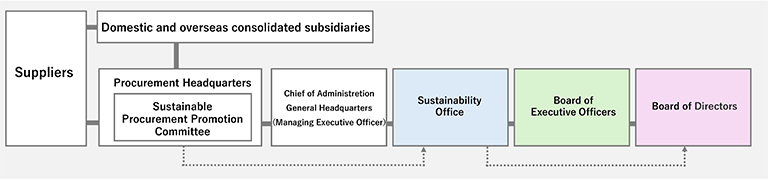
We established a supply chain management system headed by the Chief of Administration General Headquarters (Managing Executive Officer) and overseen by the Procurement Headquarters. Measures related to sustainable procurement are reported and discussed at the Sustainable Procurement Promotion Committee under the Procurement Headquarters, along with other committees, and progress on their activities is reviewed.
The Sustainability Office reports on important issues, targets, progress, and other items to the Board of Directors on a quarterly basis, which then provides direction and instruction.
Supply chain overview
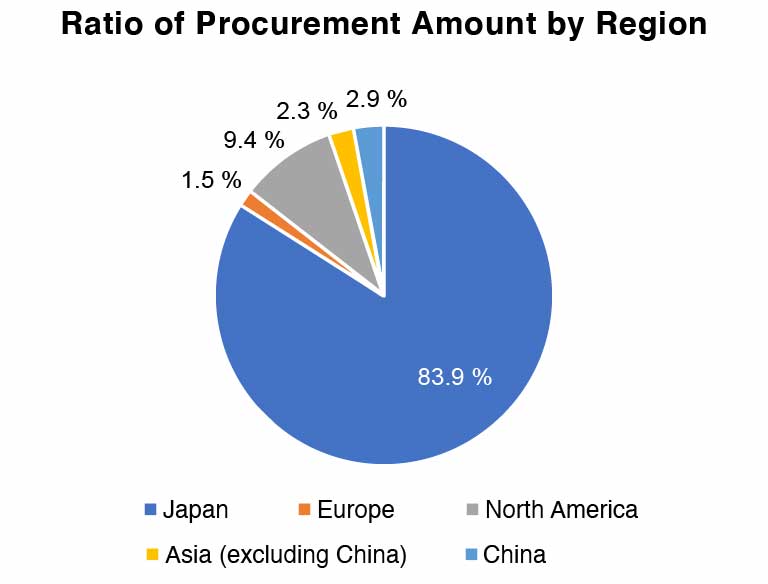
In FY2025 (ended September 30 2025), in terms of the amount spent on materials used in products by region, Japanese suppliers account for 83.9 % of the total, followed by North America (9.4 %) and China (2.9 %).
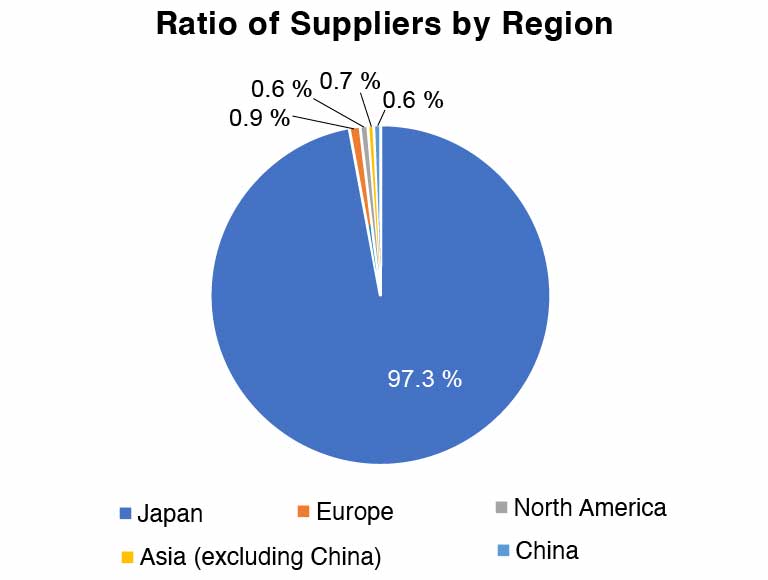
In terms of the number of suppliers by region, Japanese suppliers account for 97.3 % of the total.
Identification of significant suppliers
We identify significant suppliers by considering factors such as “procurement amount”, “ESG risks” and “availability of critical materials that are difficult to replace.”
In the current fiscal year (ended September 30 2026) , there are 253 significant suppliers of materials used in our products. These significant suppliers account for 69.4 % of the procurement amount for materials used in our products (excluding the consolidated subsidiaries).
| Item | FY2025 | FY2026 |
|---|---|---|
| Total number of Tier 1 suppliers | 1,948 companies |
1,922 companies |
Total number of significant suppliers |
229 companies | 253 companies |
| Ratio of total procurement amount for materials | 90 % | 69.4 % |
We also conduct regular Sustainable Procurement Surveys for our significant suppliers, with the aim of covering all significant suppliers within a three-year cycle in principle. In addition, suppliers with high ESG risks are addressed with priority, regardless of the above frequency.
For the identified significant suppliers, we maintain and manage their validity through the Evaluation Process outlined below.
<Evaluation Process>
1. Dissemination of Supply chain Policy and Code of Conduct, and agreement
2. Identification of target suppliers (Selected based on risks and other factors to ensure that all suppliers are assessed within a three-year cycle.)
3. Analysis/Result of Sustainable Procurement Survey
4. ESG Audit (Conduct on suppliers deemed to require corrective action based on the result.)
5. Request for development and validation of corrective plans
6. Reverified in the Sustainable Procurement Survey conducted in the following year
Click here for details on the Sustainable Procurement Survey.
Basic sales & purchase agreement
(Applicable to domestic supplier only)
We conclude basic sales & purchase agreements with suppliers, stipulating sustainable procurement requirements, including compliance with laws and regulations, respect for human rights, and environmental protection, and require them to comply with these items.
Percentage of significant suppliers that have signed the basic sales & purchase agreement:91 % (As of July 1, 2026)
The key articles of Basic Sales & Purchase Agreement
Article 36 Compliance with Supply chain Code of Conduct
Article 37 Environmental regulations
Article 38 Legal compliance
Article 39 Respect for Human rights
Article 40 Fair trading
Supply chain code of conduct
In October 2024, based on the Hamamatsu Photonics Group Code of Conduct, we have prepared the “Hamamatsu Photonics Supply Chain Code of Conduct” to include more articles related to respect for human rights, referring to the “Guidelines for Responsible Corporate Behavior” published by the Japan Electronics and Information Technology Industries Association (JEITA), to which we are involved.
We are requesting our significant suppliers to understand and sign the Code of Conduct that includes our corporate’s various policies on the environment, human rights, labor and other related matters and submit a letter of agreement.
Part I. Code of conduct
1. Compliance with Laws and Regulations and Respect for International norms
2. Human Rights and Labor
3. Health and safety
4. Environment
5. Fair trading and ethics
6. Quality and safety
7. Information security
8. Business continuity plan
9. Other
Part 2: Establishment of management system
A. Establishing a management system
B. Supplier management
C. Proper import/export control
D. Establishing a grievance mechanism
E. Disclosing the activities
We review the guidelines on a regular basis to keep them up-to-date with current conditions.
When any change is made to the guidelines, we disclose our suppliers and make them aware of the change.
<Supplier agreement rate for the Hamamatsu Photonics Group Code of Conduct>
| Target | Result (FY2025) | Result (FY2026) |
|---|---|---|
| 80 % supplier’s agreement rate for the Supply Chain Code of Conduct | 97.4 % (223 companies/ 229 companies) | 95.6 % (242 companies/ 253 companies) |
Sustainable procurement survey
We regularly conduct sustainable procurement surveys to assess the status of sustainable procurement initiatives among our significant suppliers and to confirm their compliance with the “Hamamatsu Photonics Supply Chain Code of Conduct”.
The survey items are based on the code of conduct and management system, with a particular focus on important issues such as human rights and labor ,and health and safety.
The results of the sustainable procurement survey are shared with each supplier to promote their voluntary improvement efforts.
This Sustainable Procurement Survey is designed to ensure that all of our significant suppliers, including newly designated significant suppliers, are assessed within a three‑year cycle in principle.
<Current results of Sustainable Procurement Survey>
| Item | FY2025 | FY2026 |
|---|---|---|
| Survey target | 229 companies | 253 companies |
| Responding suppliers | 222 companies | 242 companies |
| Response rate | 96.9 % | 95.6 % |
| Rank | Result (FY2025) | Result (FY2026) | Definition/Note | Risk Level |
|---|---|---|---|---|
| A | 91 companies (40 %) | 109 companies (43 %) | Compliant with required items of the ESG standards in the Code of Conduct and consistently maintains a high level of performance. | Low |
| B | 59 companies (26 %) | 71 companies (28 %) | Almost compliant with the required items of the ESG standards in the Code of Conduct . There is scope for improvement, with expectations for voluntary actions to address them. |
|
| C | 40 companies (17 %) | 44 companies (17 %) | Some of the ESG standards in the Code of Conduct aren’t met, and further improvements are desirable. Check the status of improvement at the next SAQ evaluation and provide support as needed. |
Moderate |
| D | 39 companies (17 %) | 29 companies (12 %) | Many of the ESG standards in the Code of Conduct aren’t met, and the response to key issues is inadequate. Conduct ESG audits as necessary, request submission of improvement plans, and conduct ongoing monitoring. |
High |
Note: A and B are defined as “excellent suppliers” and are subject to active operation as a source of direct and critical materials for standard products.
<Analysis of Sustainable Procurement Survey>
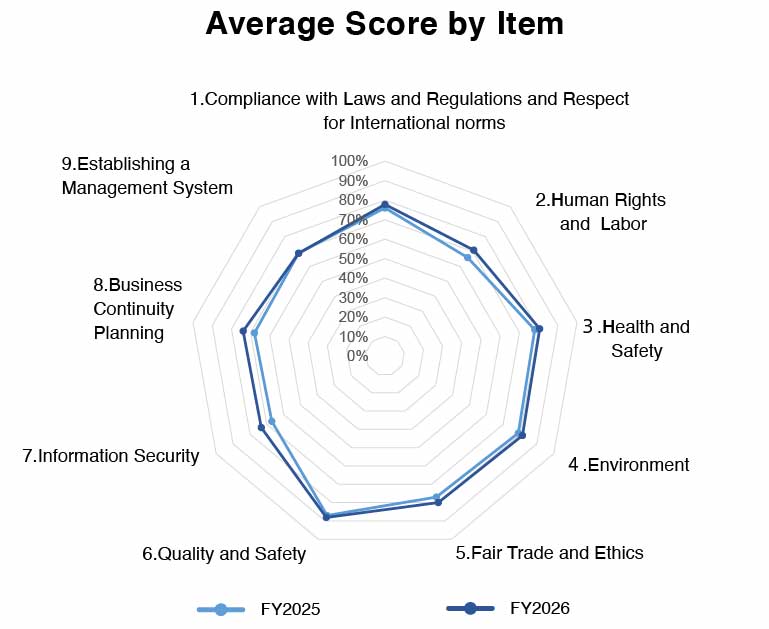
The items with high scores are “Quality and Safety”, “Environment” and “Health and Safety,” while “Establish a Management System”, “Human Rights and Labor” and “Information Security” show room for improvement.
No significant risks related to compliance violations were detected.
In FY2026 (ended September 30, 2026) 29 companies (12 %) were rated as Rank D. For suppliers that received a Rank D rating in the current survey, we request a follow-up survey in the following year using SAQ (Self-Assessment Questionnaire)to monitor their improvement status.
| Item | Average score rate | |
|---|---|---|
| FY2025 | FY2026 | |
| 1.Compliance with Laws and Regulations and Respect for International norms | 76.0 % | 77.8 % |
| 2.Human Rights and Labor | 66.1 % | 70.9 % |
| 3.Health and Safety | 78.2 % | 80.6 % |
| 4.Environment | 79.4 % | 81.4 % |
| 5.Fair Trade and Ethics | 76.7 % | 80.0 % |
| 6.Quality and Safety | 86.9 % | 88.1 % |
| 7.Information Security | 67.3 % | 73.3 % |
| 8.Business Continuity Planning | 68.0 % | 73.9 % |
| Establishing a Management System | 68.8 % | 68.9 % |
| Total | 72.4 % | 75.9 % |
<Conducting ESG audits>
In FY2026 (ended September 30, 2026) , suppliers assessed as high risk with a D Rank in the Sustainable Procurement Survey were designated as audit targets. Among them, we conducted onsite audits for suppliers determined to require particular attention. For the risks identified through the ESG audits, we requested each supplier to formulate an improvement plan and carried out follow up assessments using the SAQ (Self-Assessment Questionnaire) . We continue to work collaboratively with suppliers to reduce these risks.
Audit results (As of March 1, 2026)
We conducted on-site audits for 4 companies selected for audit.
We issued improvement plan requests to all 4 companies and continue to provide ongoing support for their corrective action.
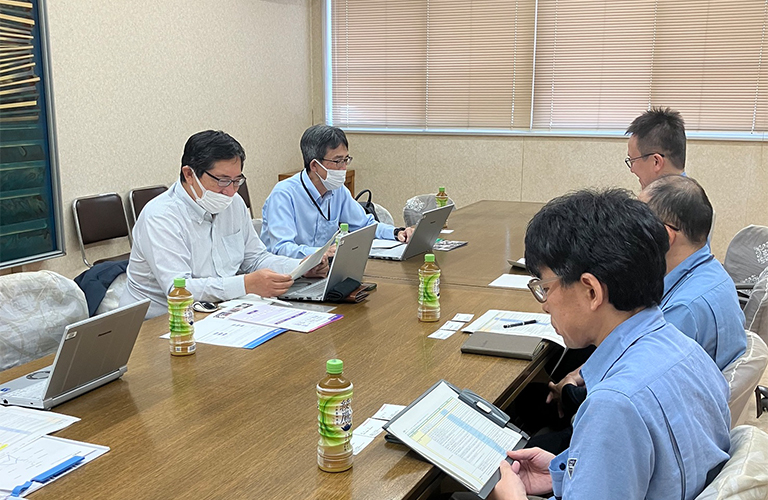
Audit scene at the supplier’s factory
Education and raising awareness
In-house education
In FY2025 (ended September 30, 2025) , we provided in-house education for 703 procurement officers and related personnel regarding “promotion of sustainable procurement (including various policies such as the Basic Policy of Sustainability) ” and “procurement-related laws and regulations (e.g., Subcontract laws) ”.
| Educational Contents | Number of Participants (FY2025) |
|---|---|
Promotion of sustainable procurement (including various policies such as the Basic Policy of Sustainability) |
511 |
| Procurement-related laws and regulations (e.g., Subcontract laws) |
192 |
| Total number of participants | 703 |
Training and Exchange with Suppliers
We hold Hamamatsu Photonics Cooperation Meetings (Suppliers Meetings) three times a year to share information and deepen mutual understanding with significant suppliers.
| Month and Year | Theme | Number of Participating Companies / Participants |
|---|---|---|
| July 2025 | Health Management |
38 Companies / 61Participants |
| November 2025 | Sustainability | 37 Companies / 56 Participants |
| March 2026 | Information Security | 38 Companies / 61 Participants |
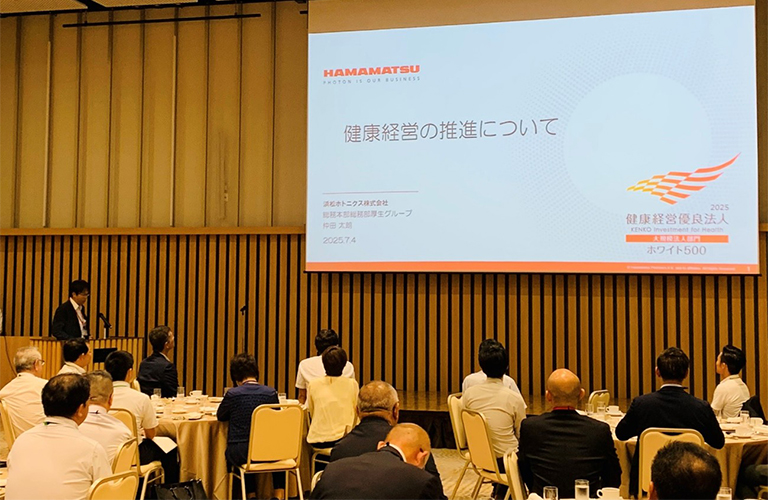
Picture from Suppliers Meeting 1
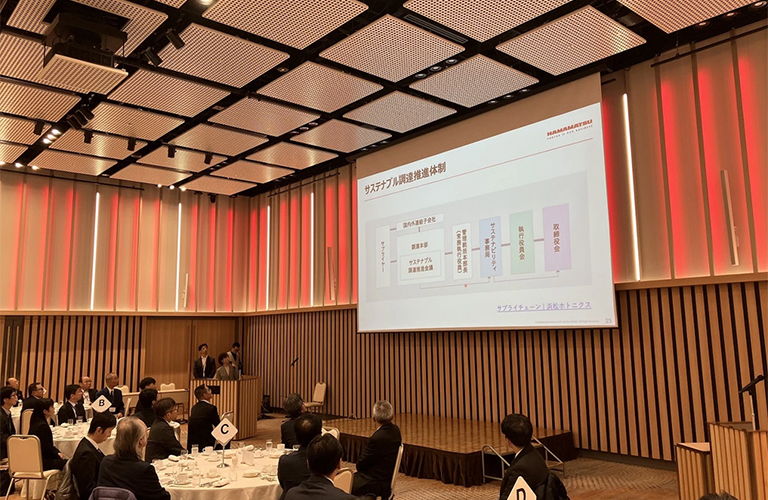
Picture from Suppliers Meeting 2
The educational and awareness activities mentioned above will be held annually with different themes and educational participants.
External Collaboration
Our company participants in the activities of the Global Compact Network Japan (GCNJ) , the local network of the United Nations Global Compact in Japan, as well as the Japan Electronics and information Technology Industries Association (JEITA) , an industry association for electronics, electronic components, and information technology in Japan.
Through these engagements, we deepen our understanding of sustainable procurement, promote related initiatives, and incorporate the lessons learned into our engagement activities with suppliers.
Reporting system
We practice sustainable procurement in accordance with our "Hamamatsu Photonics Group Basic Policy of Sustainability". As part of these efforts, we have set up “Contact point for whistleblowing and reporting” for our suppliers.
Please contact us if you are aware of or have questions about misconduct or legal violations, ethical violations or similar conduct which may involve our business or employees.
- Confirmation
-
It looks like you're in the . If this is not your location, please select the correct region or country below.
You're headed to Hamamatsu Photonics website for US (English). If you want to view an other country's site, the optimized information will be provided by selecting options below.
In order to use this website comfortably, we use cookies. For cookie details please see our cookie policy.
- Cookie Policy
-
This website or its third-party tools use cookies, which are necessary to its functioning and required to achieve the purposes illustrated in this cookie policy. By closing the cookie warning banner, scrolling the page, clicking a link or continuing to browse otherwise, you agree to the use of cookies.
Hamamatsu uses cookies in order to enhance your experience on our website and ensure that our website functions.
You can visit this page at any time to learn more about cookies, get the most up to date information on how we use cookies and manage your cookie settings. We will not use cookies for any purpose other than the ones stated, but please note that we reserve the right to update our cookies.
1. What are cookies?
For modern websites to work according to visitor’s expectations, they need to collect certain basic information about visitors. To do this, a site will create small text files which are placed on visitor’s devices (computer or mobile) - these files are known as cookies when you access a website. Cookies are used in order to make websites function and work efficiently. Cookies are uniquely assigned to each visitor and can only be read by a web server in the domain that issued the cookie to the visitor. Cookies cannot be used to run programs or deliver viruses to a visitor’s device.
Cookies do various jobs which make the visitor’s experience of the internet much smoother and more interactive. For instance, cookies are used to remember the visitor’s preferences on sites they visit often, to remember language preference and to help navigate between pages more efficiently. Much, though not all, of the data collected is anonymous, though some of it is designed to detect browsing patterns and approximate geographical location to improve the visitor experience.
Certain type of cookies may require the data subject’s consent before storing them on the computer.
2. What are the different types of cookies?
This website uses two types of cookies:
- First party cookies. For our website, the first party cookies are controlled and maintained by Hamamatsu. No other parties have access to these cookies.
- Third party cookies. These cookies are implemented by organizations outside Hamamatsu. We do not have access to the data in these cookies, but we use these cookies to improve the overall website experience.
3. How do we use cookies?
This website uses cookies for following purposes:
- Certain cookies are necessary for our website to function. These are strictly necessary cookies and are required to enable website access, support navigation or provide relevant content. These cookies direct you to the correct region or country, and support security and ecommerce. Strictly necessary cookies also enforce your privacy preferences. Without these strictly necessary cookies, much of our website will not function.
- Analytics cookies are used to track website usage. This data enables us to improve our website usability, performance and website administration. In our analytics cookies, we do not store any personal identifying information.
- Functionality cookies. These are used to recognize you when you return to our website. This enables us to personalize our content for you, greet you by name and remember your preferences (for example, your choice of language or region).
- These cookies record your visit to our website, the pages you have visited and the links you have followed. We will use this information to make our website and the advertising displayed on it more relevant to your interests. We may also share this information with third parties for this purpose.
Cookies help us help you. Through the use of cookies, we learn what is important to our visitors and we develop and enhance website content and functionality to support your experience. Much of our website can be accessed if cookies are disabled, however certain website functions may not work. And, we believe your current and future visits will be enhanced if cookies are enabled.
4. Which cookies do we use?
There are two ways to manage cookie preferences.
- You can set your cookie preferences on your device or in your browser.
- You can set your cookie preferences at the website level.
If you don’t want to receive cookies, you can modify your browser so that it notifies you when cookies are sent to it or you can refuse cookies altogether. You can also delete cookies that have already been set.
If you wish to restrict or block web browser cookies which are set on your device then you can do this through your browser settings; the Help function within your browser should tell you how. Alternatively, you may wish to visit www.aboutcookies.org, which contains comprehensive information on how to do this on a wide variety of desktop browsers.
5. What are Internet tags and how do we use them with cookies?
Occasionally, we may use internet tags (also known as action tags, single-pixel GIFs, clear GIFs, invisible GIFs and 1-by-1 GIFs) at this site and may deploy these tags/cookies through a third-party advertising partner or a web analytical service partner which may be located and store the respective information (including your IP-address) in a foreign country. These tags/cookies are placed on both online advertisements that bring users to this site and on different pages of this site. We use this technology to measure the visitors' responses to our sites and the effectiveness of our advertising campaigns (including how many times a page is opened and which information is consulted) as well as to evaluate your use of this website. The third-party partner or the web analytical service partner may be able to collect data about visitors to our and other sites because of these internet tags/cookies, may compose reports regarding the website’s activity for us and may provide further services which are related to the use of the website and the internet. They may provide such information to other parties if there is a legal requirement that they do so, or if they hire the other parties to process information on their behalf.
If you would like more information about web tags and cookies associated with on-line advertising or to opt-out of third-party collection of this information, please visit the Network Advertising Initiative website http://www.networkadvertising.org.
6. Analytics and Advertisement Cookies
We use third-party cookies (such as Google Analytics) to track visitors on our website, to get reports about how visitors use the website and to inform, optimize and serve ads based on someone's past visits to our website.
You may opt-out of Google Analytics cookies by the websites provided by Google:
https://tools.google.com/dlpage/gaoptout?hl=en
As provided in this Privacy Policy (Article 5), you can learn more about opt-out cookies by the website provided by Network Advertising Initiative:
http://www.networkadvertising.org
We inform you that in such case you will not be able to wholly use all functions of our website.
Close