
Products










We are actively taking measures to improve product quality levels.
Applications














Why Hamamatsu?
Resources





Support




Our company







Investors








United Kingdom (EN)
Select your region or country.


Frequently Asked Questions
Answers to common questions from our recent webinar on industrial X-ray inspection, detector selection and AI-powered image denoising.
X-ray inspection fundamentals
This section introduces the key principles that influence inspection performance, including X-ray penetration, energy selection, material properties and image quality considerations.
1. How deep can X-rays penetrate during inspection?
There is no single maximum penetration depth for X-rays. X-ray penetration depends on the material density, thickness, and the X-ray energy used. In general, higher X-ray energies provide greater penetration, while lower energies are preferred when inspecting less dense materials and when higher image contrast is required.
The table below shows typical energy ranges used for different materials and inspection targets:
| Material / Product | Typical X-ray energy |
| Food products, packaged food, organic materials | 20 - 100 kV |
| Plastics, polymers, rubber parts | 20 - 80 kV |
| PCB assemblies, solder joints, electronic components | 60 - 130 kV |
| Semiconductor packages | 80 - 160 kV |
| Lithium-ion batteries | 100 - 180 kV |
| Aluminum castings and light alloys | 100 - 225 kV |
| Steel components and welded assemblies | 180 - 320 kV |
| High-density metal parts and large industrial components | 225 - 450 kV+ |
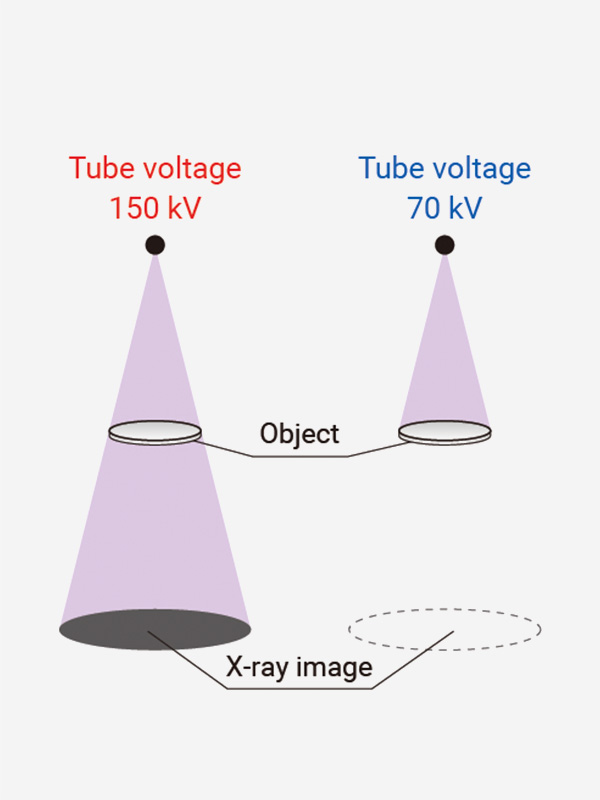
Tube voltage X-ray transmission
Fig.1: As the X-ray energy increases with the increase in tube voltage, the X-ray transmission to the object also increases. A high-contrast X-ray image can be obtained by setting a tube voltage value suitable for the object.
Focal spot size X-ray image transition
For application-specific recommendations, representative sample testing under real inspection conditions is always recommended. We can carry out tests for you in our demo facilities.
AI denoising models, applications and validation
Learn how AI denoising is applied to X-ray inspection, the neural network technology behind it, and the methods used to verify performance and reliability.
2. Can AI denoising be applied to PCB inspection applications?
Yes, AI denoising can be applied to PCB inspection applications, particularly to improve the visibility of small defects or low-contrast features when images are acquired under noisy conditions. The effectiveness of AI denoising depends on several factors, including X-ray energy, dose, object structure, defect size, defect contrast, and inspection speed.
The commercially available AI denoising dynamic-link library (DLL) is currently compatible with the Hamamatsu C14300 series X-ray line scan cameras. At present, it is not commercially available for TDI-CCD camera platforms. We are considering expanding it for flat panel detectors.
Before deployment in a production environment, we recommend validating performance using representative samples and real inspection conditions.
3. What type of AI model is used for image denoising?
Hamamatsu uses proprietary convolutional neural network (CNN) architectures specifically developed for X-ray image denoising.
These models have been optimized to reduce image noise while preserving fine structural details that are critical for inspection applications. In addition to the network architecture itself, particular attention is given to the training process and data generation methods.
The models are trained using data that accurately reproduces the physical behavior of X-ray imaging systems and their associated noise characteristics. Detailed information regarding the network architecture and training conditions remains proprietary.
4. Can AI denoising create false defects or hide existing defects?
As with any AI-based image processing technology, the possibility of image alterations cannot be eliminated, particularly when operating outside the conditions used during training.
To minimize this risk, Hamamatsu trains its AI denoising models using simulations based on the physical characteristics of X-ray imaging systems and validates performance using standard image quality metrics such as Signal-to-Noise Ratio (SNR), Photon Transfer Curve (PTC) analysis and spatial resolution.
Since inspection performance depends on the application, defect type, imaging conditions and inspection algorithms, we recommend validating AI denoising with representative samples and real production conditions before deployment.
System investment and detector compatibility
Explore the factors that influence return on investment and understand how detector operating limits affect system selection.
5. When does X-ray inspection make economic sense for low-cost products?
The decision to implement X-ray inspection should be based on the overall cost of quality rather than product cost alone.
X-ray inspection may make economic sense when the potential cost of defects, contamination, field failures, or product recalls exceeds the cost of inspection. For high-volume production, even low-cost products can justify inspection where defects create significant downstream costs.
Cost and performance can be optimized by considering the complete imaging chain, including the X-ray source, detector and image processing.
6. What are the X-ray energy compatibility limits of Hamamatsu detectors?
Hamamatsu detector platforms currently support maximum X-ray energies from 160 kV to 180 kV, depending on the detector technology and sensor design. The table below lists the maximum supported X-ray energy for each platform.
| Detector | Maximum X-ray energy |
| CCD-TDI (C12300 series) | Up to 180 kV |
| Single-line line scan cameras (C14300 / C14960 series) | Up to 160 kV |
| TDI-CMOS detectors | Up to 160 kV |
| Flat panel sensor C16401SK-51 (12 cm × 14 cm) | Up to 160 kV |
These energy ratings are intended as general compatibility guidelines. The optimum detector choice also depends on factors such as material density, thickness, required image quality, and inspection speed. Hamamatsu is continuously expanding its X-ray detector portfolio, and detector solutions compatible with 225 kV systems are currently under development.
Real-time inspection and system performance
Discover how acquisition speed, detector technology and image processing work together to achieve reliable inspection results in production environments.
7. Does AI denoising work in real time, or only on acquired images?
The AI denoising dynamic-link library (DLL) can process both acquired images offline and images inline within an inspection system. Whether inline processing operates in real time depends on multiple factors, including image size, acquisition rate, PC configuration, GPU performance, and application requirements. As a result, processing time cannot be defined as a single fixed value.
For real-time inspection applications, it is important to verify that the AI denoising process can keep pace with the camera acquisition rate within the target hardware environment. Performance validation should therefore be carried out using the intended system configuration.
8. Which matters most in an X-ray NDT system: the source, detector, or image processing?
No single element matters most in isolation. Inspection performance depends on how well the entire imaging chain is matched to the application.
The source influences penetration and image sharpness, the detector affects sensitivity, resolution and speed, while image processing helps maximize the value of the acquired data. The best results are achieved when all three are selected together based on the inspection objective.
9. How do you choose the right resolution for an inspection?
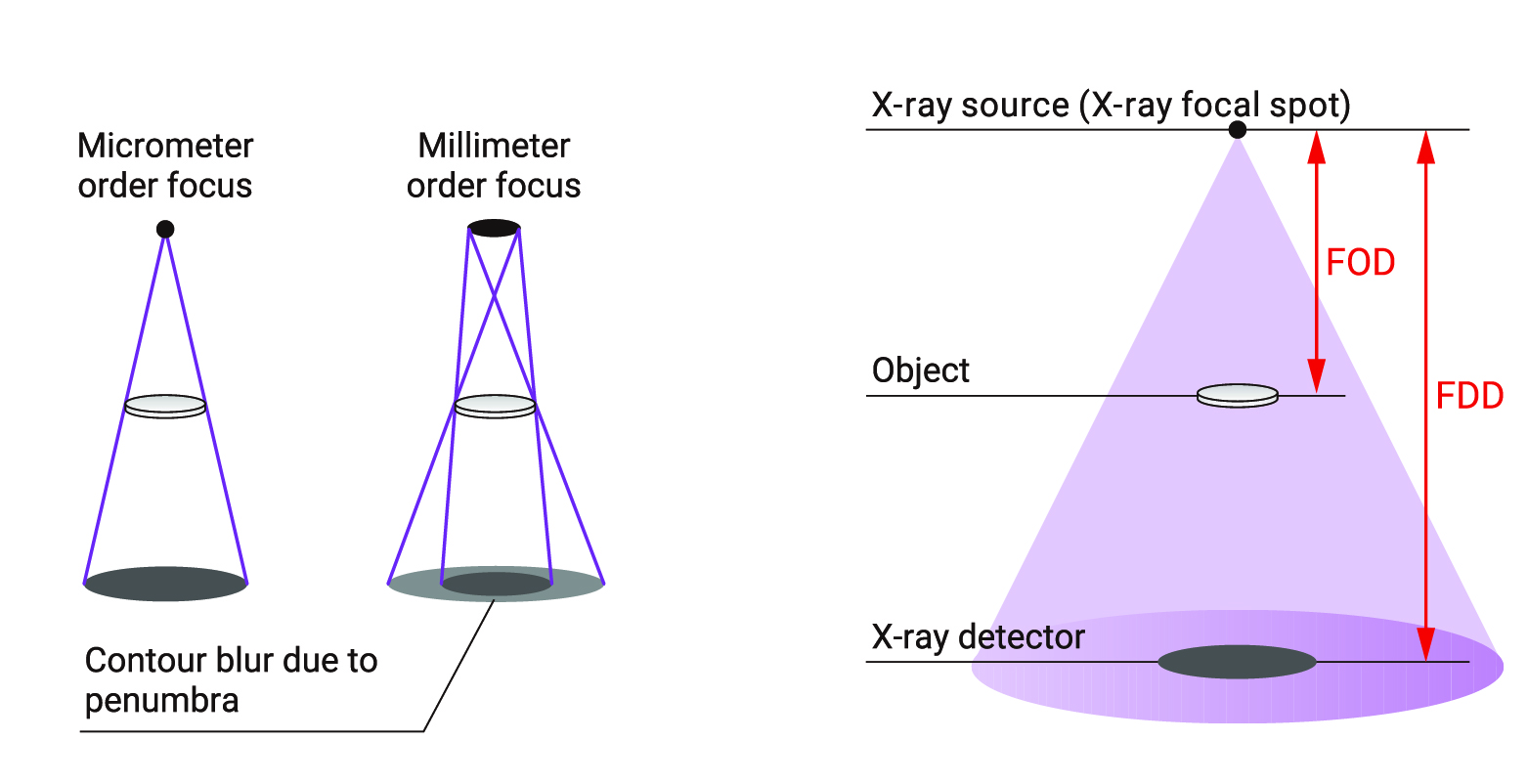
Choose the resolution needed to reliably detect the target feature or defect. Higher resolution is not always better: focal spot size, detector pixel size, magnification, field of view and inspection speed must be considered together to achieve the required detectability while maintaining a practical and repeatable inspection process.
Fig. 2: This focal-spot-size and magnification image can illustrate how these factors affect the resolution available for inspection.
10. Why choose TDI-CMOS over a standard line-scan detector for high-speed inspection?
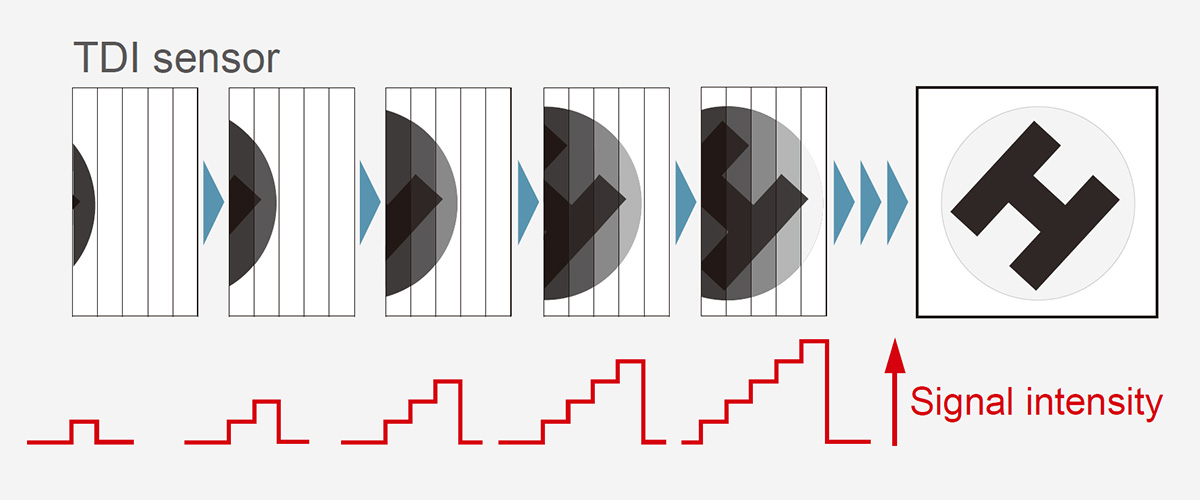
TDI-CMOS is particularly beneficial for high-speed inspection of moving objects when the available x-ray signal is limited.
Time delay integration (TDI) accumulates the signal over multiple synchronized stages, improving the signal-to-noise ratio without reducing throughput. It is often the preferred choice when higher image quality is required under demanding production-line conditions.
Fig. 3: This focal-spot-size and magnification image can illustrate how these factors affect the resolution available for inspection.
Future developments in X-ray inspection
An overview of emerging technologies and industry trends that are expected to shape the next generation of inspection systems.
11. Which area will advance most in the next five years: sources, detectors, or AI?
Rather than one technology outpacing the others, the most significant advances are likely to come from the combined evolution of X-ray sources, detectors and AI-based image processing. As these technologies become increasingly integrated, they will enable more optimized and application-specific inspection solutions. Hamamatsu continues to invest in innovation across its portfolio, and several developments are currently underway.
If you have a question that’s not covered here, our NDT specialists can help.
- Confirmation
-
It looks like you're in the . If this is not your location, please select the correct region or country below.
You're headed to Hamamatsu Photonics website for GB (English). If you want to view an other country's site, the optimized information will be provided by selecting options below.
In order to use this website comfortably, we use cookies. For cookie details please see our cookie policy.
- Cookie Policy
-
This website or its third-party tools use cookies, which are necessary to its functioning and required to achieve the purposes illustrated in this cookie policy. By closing the cookie warning banner, scrolling the page, clicking a link or continuing to browse otherwise, you agree to the use of cookies.
Hamamatsu uses cookies in order to enhance your experience on our website and ensure that our website functions.
You can visit this page at any time to learn more about cookies, get the most up to date information on how we use cookies and manage your cookie settings. We will not use cookies for any purpose other than the ones stated, but please note that we reserve the right to update our cookies.
1. What are cookies?
For modern websites to work according to visitor’s expectations, they need to collect certain basic information about visitors. To do this, a site will create small text files which are placed on visitor’s devices (computer or mobile) - these files are known as cookies when you access a website. Cookies are used in order to make websites function and work efficiently. Cookies are uniquely assigned to each visitor and can only be read by a web server in the domain that issued the cookie to the visitor. Cookies cannot be used to run programs or deliver viruses to a visitor’s device.
Cookies do various jobs which make the visitor’s experience of the internet much smoother and more interactive. For instance, cookies are used to remember the visitor’s preferences on sites they visit often, to remember language preference and to help navigate between pages more efficiently. Much, though not all, of the data collected is anonymous, though some of it is designed to detect browsing patterns and approximate geographical location to improve the visitor experience.
Certain type of cookies may require the data subject’s consent before storing them on the computer.
2. What are the different types of cookies?
This website uses two types of cookies:
- First party cookies. For our website, the first party cookies are controlled and maintained by Hamamatsu. No other parties have access to these cookies.
- Third party cookies. These cookies are implemented by organizations outside Hamamatsu. We do not have access to the data in these cookies, but we use these cookies to improve the overall website experience.
3. How do we use cookies?
This website uses cookies for following purposes:
- Certain cookies are necessary for our website to function. These are strictly necessary cookies and are required to enable website access, support navigation or provide relevant content. These cookies direct you to the correct region or country, and support security and ecommerce. Strictly necessary cookies also enforce your privacy preferences. Without these strictly necessary cookies, much of our website will not function.
- Analytics cookies are used to track website usage. This data enables us to improve our website usability, performance and website administration. In our analytics cookies, we do not store any personal identifying information.
- Functionality cookies. These are used to recognize you when you return to our website. This enables us to personalize our content for you, greet you by name and remember your preferences (for example, your choice of language or region).
- These cookies record your visit to our website, the pages you have visited and the links you have followed. We will use this information to make our website and the advertising displayed on it more relevant to your interests. We may also share this information with third parties for this purpose.
Cookies help us help you. Through the use of cookies, we learn what is important to our visitors and we develop and enhance website content and functionality to support your experience. Much of our website can be accessed if cookies are disabled, however certain website functions may not work. And, we believe your current and future visits will be enhanced if cookies are enabled.
4. Which cookies do we use?
There are two ways to manage cookie preferences.
- You can set your cookie preferences on your device or in your browser.
- You can set your cookie preferences at the website level.
If you don’t want to receive cookies, you can modify your browser so that it notifies you when cookies are sent to it or you can refuse cookies altogether. You can also delete cookies that have already been set.
If you wish to restrict or block web browser cookies which are set on your device then you can do this through your browser settings; the Help function within your browser should tell you how. Alternatively, you may wish to visit www.aboutcookies.org, which contains comprehensive information on how to do this on a wide variety of desktop browsers.
5. What are Internet tags and how do we use them with cookies?
Occasionally, we may use internet tags (also known as action tags, single-pixel GIFs, clear GIFs, invisible GIFs and 1-by-1 GIFs) at this site and may deploy these tags/cookies through a third-party advertising partner or a web analytical service partner which may be located and store the respective information (including your IP-address) in a foreign country. These tags/cookies are placed on both online advertisements that bring users to this site and on different pages of this site. We use this technology to measure the visitors' responses to our sites and the effectiveness of our advertising campaigns (including how many times a page is opened and which information is consulted) as well as to evaluate your use of this website. The third-party partner or the web analytical service partner may be able to collect data about visitors to our and other sites because of these internet tags/cookies, may compose reports regarding the website’s activity for us and may provide further services which are related to the use of the website and the internet. They may provide such information to other parties if there is a legal requirement that they do so, or if they hire the other parties to process information on their behalf.
If you would like more information about web tags and cookies associated with on-line advertising or to opt-out of third-party collection of this information, please visit the Network Advertising Initiative website http://www.networkadvertising.org.
6. Analytics and Advertisement Cookies
We use third-party cookies (such as Google Analytics) to track visitors on our website, to get reports about how visitors use the website and to inform, optimize and serve ads based on someone's past visits to our website.
You may opt-out of Google Analytics cookies by the websites provided by Google:
https://tools.google.com/dlpage/gaoptout?hl=en
As provided in this Privacy Policy (Article 5), you can learn more about opt-out cookies by the website provided by Network Advertising Initiative:
http://www.networkadvertising.org
We inform you that in such case you will not be able to wholly use all functions of our website.
Close