
Products










We are actively taking measures to improve product quality levels.
Applications













Why Hamamatsu?
Resources





Support




Our company







Investors








United Kingdom (EN)
Select your region or country.


Achieving more with less.
Reveal weak signals through system-level optimization
A sensitive detector is only part of the solution. Noise and background elsewhere in the measurement system can obscure weak signals. Making the most of Hypereon means understanding how the optics, readout electronics, and signal processing work together.
Resolving weaker signals
The optimized configuration resolves distinct peaks down to the low-photon-number region.
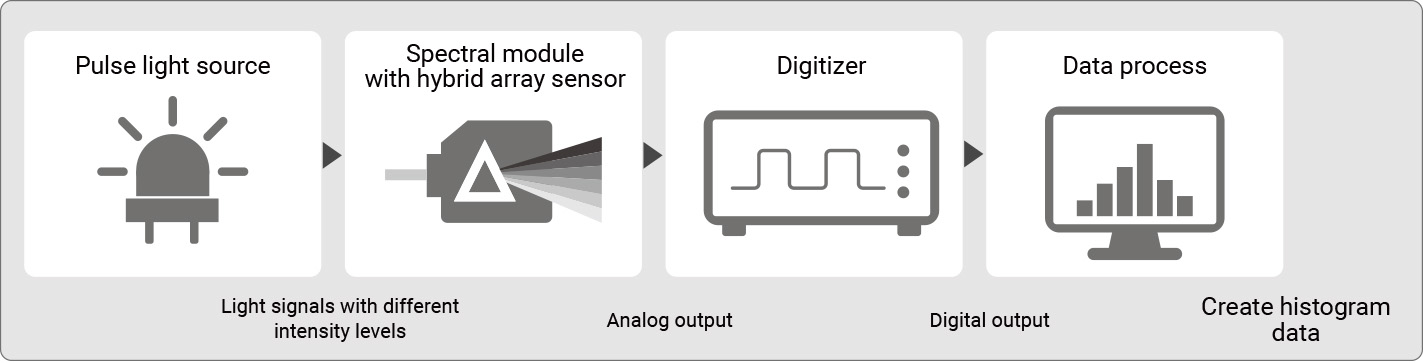
Experimental setup
Pulsed light was delivered to the Hypereon module, and its output was acquired with an external digitizer. The recorded waveforms were processed to generate the histogram in this section.
This bench evaluation used pulsed light at controlled intensity levels and is not a flow cytometry sample measurement. The horizontal axis of the histogram (Photon number) shows the number of incident photons per pulse.

More measurement examples
Measurement of four mixed samples with one laser and one gain operation
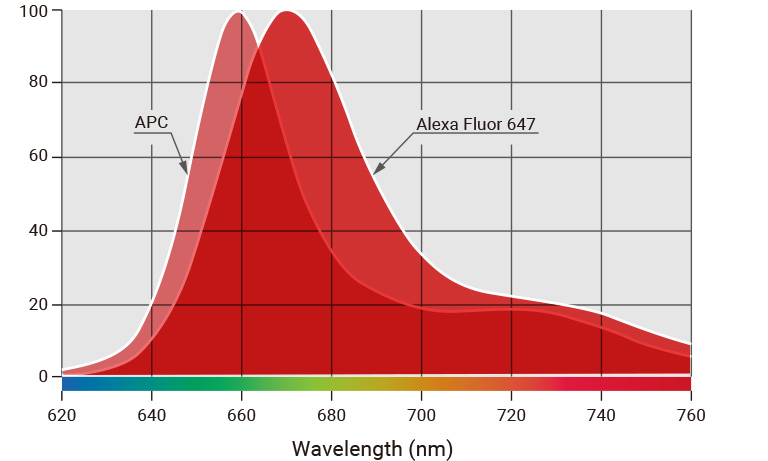
4 mixed samples
| Sample | 1 | 2 | 3 | 4 |
|---|---|---|---|---|
| APC 657 nm (ng) | 30 | 0 | 30 | 15 |
| AF647 684 nm (ng) | 0 | 30 | 15 | 30 |
Compensation Bead; BD™ Anti-Rat Ig, κ/Negative Control (BSA) Compensation Plus (7.5 µm) Particles Set [Cat. No. 560499]
Fluorescence Antibody Reagent; APC anti-mouse CD62L Antibody [Cat. No. 161217]
Alexa Fluor 647® anti-mouse CD197 (CCR7) Antibody [Cat. No. 120111]
Buffer; BD Pharmingen™ Stain Buffer (FBS) [Cat. No. 554656]
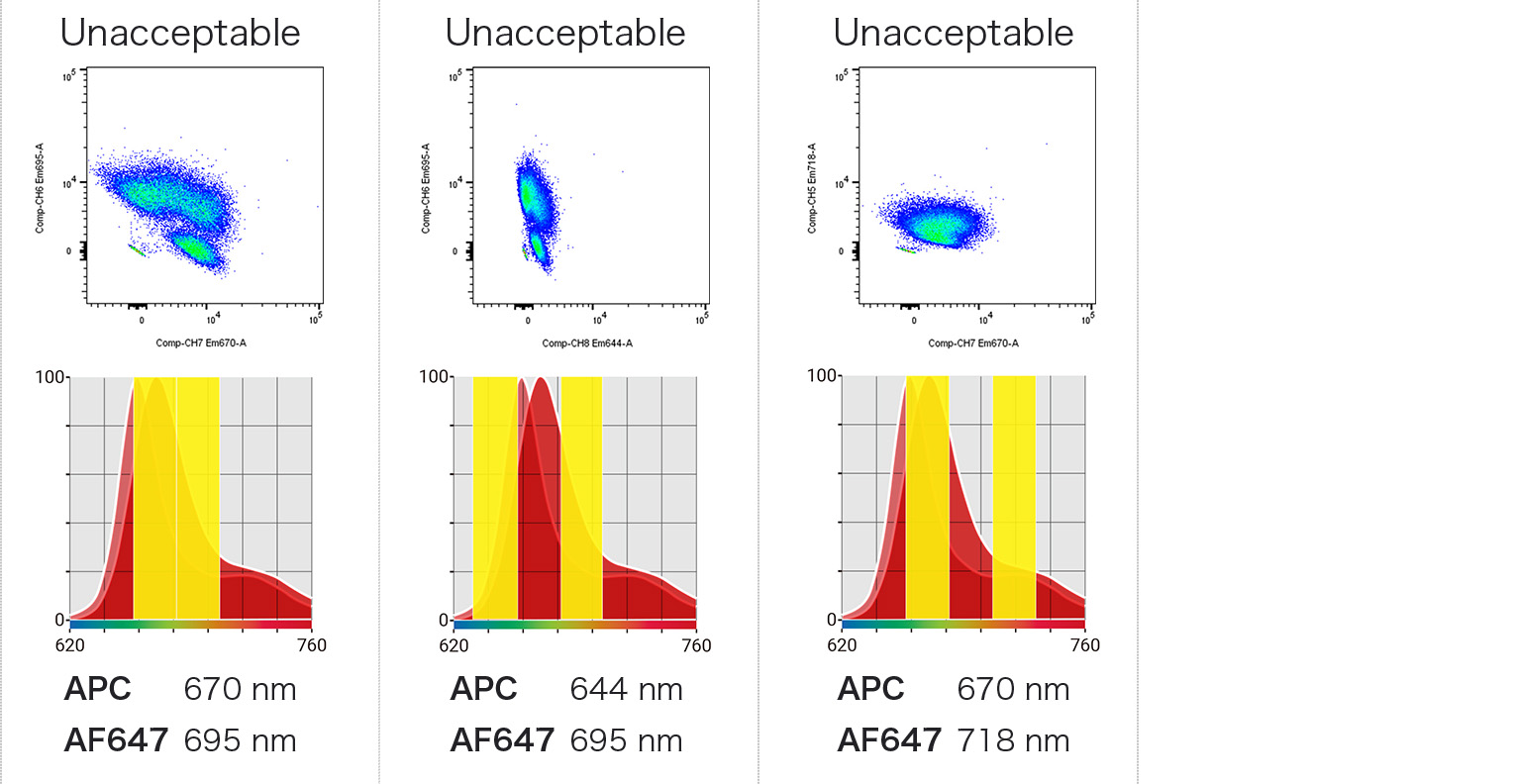
The Hypereon and PMT measurements used different channel configurations: 32 channels for Hypereon and 16 channels for the PMT. The measurement conditions were not identical.
Hypereon
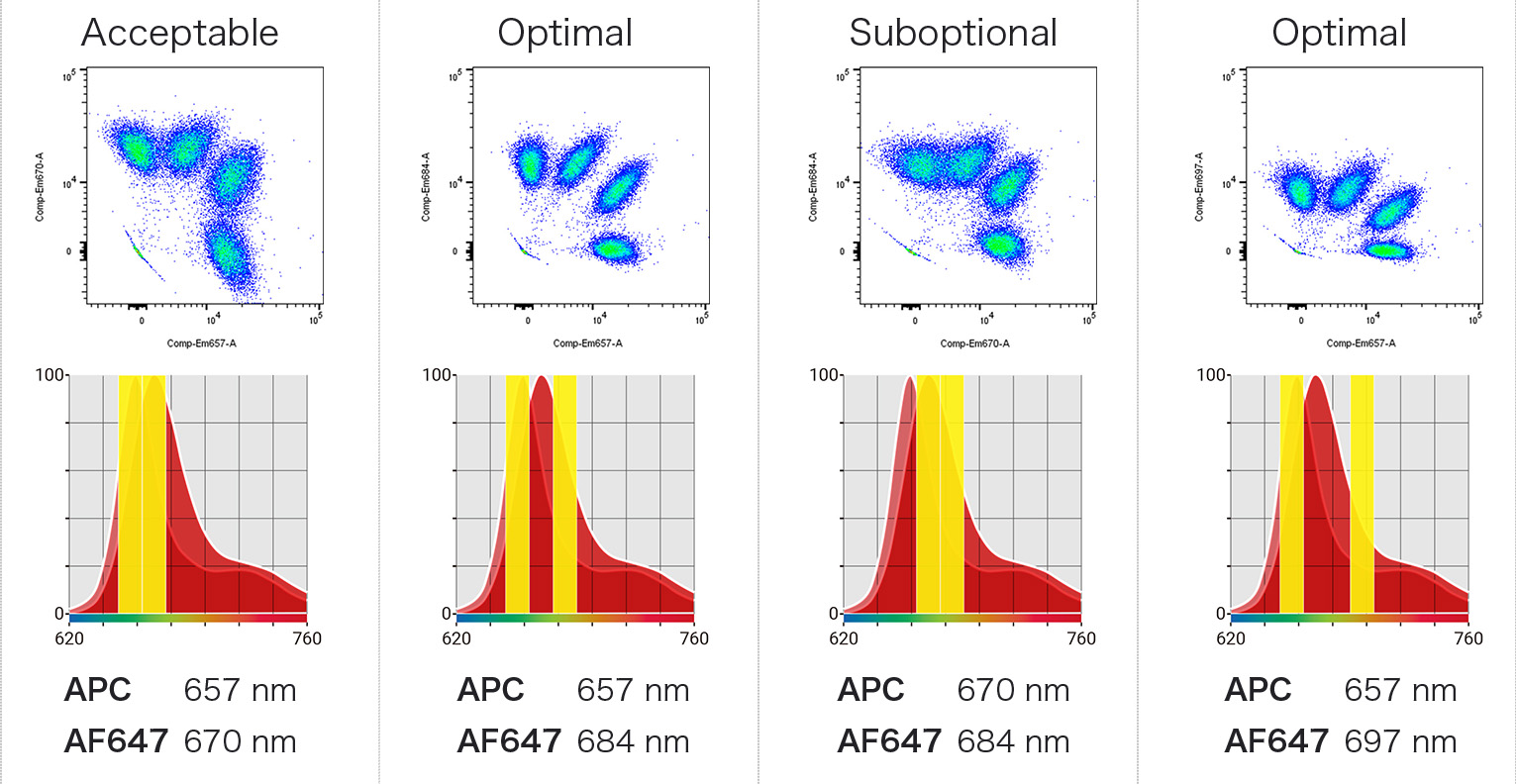
PMT
Measurement of 13 mixed samples with one laser and one gain operation
Thirteen mixed samples containing APC and Alexa Fluor 647 were measured with Hypereon at a fixed sensor gain. The plots below show the resulting signal distributions across the sample set.
Detection channels: APC 657 nm, AF647 684 nm

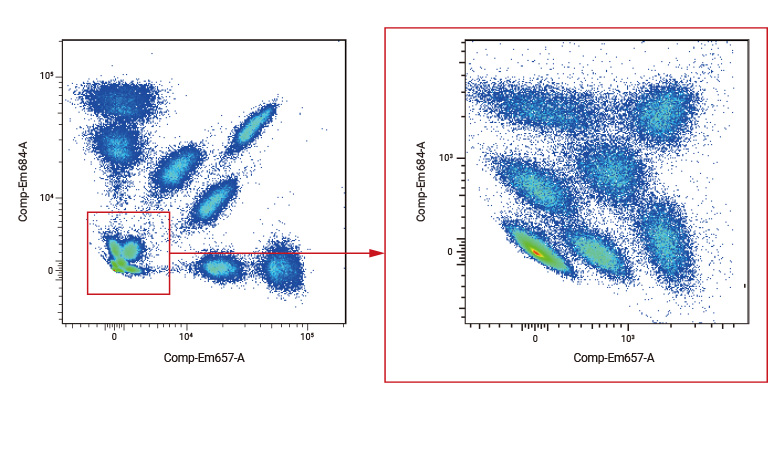
13 mixed samples
| Sample | 1 | 2 | 3 | 4 | 5 | 6 | 7 | 8 | 9 | 10 | 11 | 12 | 13 |
|---|---|---|---|---|---|---|---|---|---|---|---|---|---|
| Sample ratio | APC Single stain | Alexa Fluor 647 Single stain | APC+Alexa Fluor 647 | ||||||||||
| APC (ng) | 160 | 40 | 3.2 | 0.8 | 0 | 0 | 0 | 0 | 160 | 40 | 20 | 3.2 | 1.2 |
| Alexa Fluor 647 (ng) | 0 | 0 | 0 | 0 | 160 | 40 | 3.2 | 0.8 | 160 | 20 | 40 | 3.2 | 1.2 |
Compensation Bead; BD™ Anti-Rat Ig, κ/Negative Control (BSA) Compensation Plus (7.5 µm) Particles Set [Cat. No. 560499]
Fluorescence Antibody Reagent; APC anti-mouse CD62L Antibody [Cat. No. 161217]
Alexa Fluor 647® anti-mouse CD197 (CCR7) Antibody [Cat. No. 120111]
Buffer; BD Pharmingen™ Stain Buffer (FBS) [Cat. No. 554656]
Measurement examples for nano particle: EV measurement
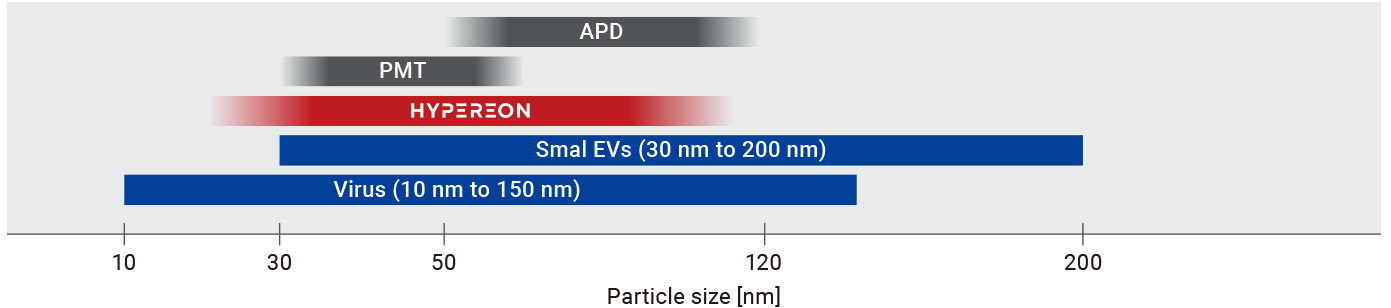
Estimation of detectable Particle diameter
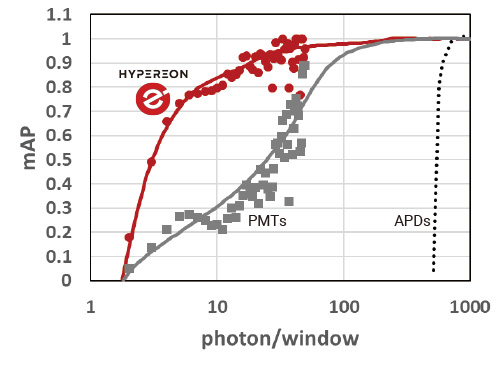
Hypereon enables “good” detection of <10 photons
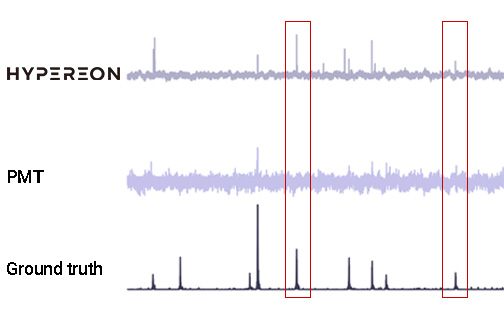
Raw data from Hypereon, PMT and ground truth
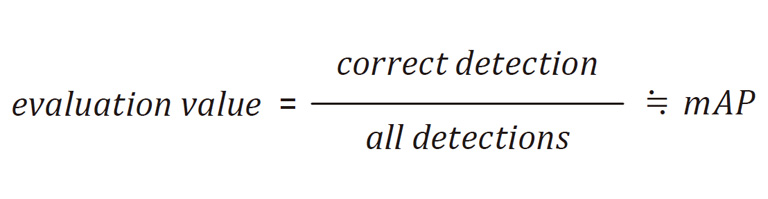
- Detect events and count photons using ground truth
- Judge detection by PMT and HYPEREON for each event
- Calculate accuracy as mAP (mean Average Precision)
- Plot mAP vs. photon count for each detector
Optics for comparison of Hypereon and PMT

Data provision and cooperation
Yuichiro Iwamoto
Postdoctoral Researcher, Ota Lab, The University of Tokyo
Specialized in high-throughput, single-particle analysis by integrating optics, fluidics, and data science.
Archive of CYTO commercial tutorial
Commercial Tutorials are educational sessions held as part of the CYTO conference program, where companies and industry experts introduce new technologies, measurement approaches, and application possibilities in flow cytometry.
Unlike a general product introduction, these sessions provide an opportunity to explore the technical background of emerging solutions, examine experimental data, and discuss how new technologies may address challenges in current flow cytometry workflows.
CYTO2024
Introducing a New Hybrid Sensor for Flow Cytometry
This tutorial introduces HYPEREON, a hybrid photosensor developed for flow cytometry. It explains how HYPEREON combines electron-tube and solid-state technologies and explores its potential through data analysis, simulations, and application examples.
CYTO2025
Exploring the Value of HYPEREON in Flow Cytometry
Building on the CYTO 2024 tutorial, this presentation explores the value of HYPEREON in flow cytometry. Experimental results and application examples illustrate its potential for spectral analysis, instrument standardization, and nanoscale particle measurement.
The information in this archived presentation reflects the status at the time and may differ from the latest specifications or development status.
- Confirmation
-
It looks like you're in the . If this is not your location, please select the correct region or country below.
You're headed to Hamamatsu Photonics website for GB (English). If you want to view an other country's site, the optimized information will be provided by selecting options below.
In order to use this website comfortably, we use cookies. For cookie details please see our cookie policy.
- Cookie Policy
-
This website or its third-party tools use cookies, which are necessary to its functioning and required to achieve the purposes illustrated in this cookie policy. By closing the cookie warning banner, scrolling the page, clicking a link or continuing to browse otherwise, you agree to the use of cookies.
Hamamatsu uses cookies in order to enhance your experience on our website and ensure that our website functions.
You can visit this page at any time to learn more about cookies, get the most up to date information on how we use cookies and manage your cookie settings. We will not use cookies for any purpose other than the ones stated, but please note that we reserve the right to update our cookies.
1. What are cookies?
For modern websites to work according to visitor’s expectations, they need to collect certain basic information about visitors. To do this, a site will create small text files which are placed on visitor’s devices (computer or mobile) - these files are known as cookies when you access a website. Cookies are used in order to make websites function and work efficiently. Cookies are uniquely assigned to each visitor and can only be read by a web server in the domain that issued the cookie to the visitor. Cookies cannot be used to run programs or deliver viruses to a visitor’s device.
Cookies do various jobs which make the visitor’s experience of the internet much smoother and more interactive. For instance, cookies are used to remember the visitor’s preferences on sites they visit often, to remember language preference and to help navigate between pages more efficiently. Much, though not all, of the data collected is anonymous, though some of it is designed to detect browsing patterns and approximate geographical location to improve the visitor experience.
Certain type of cookies may require the data subject’s consent before storing them on the computer.
2. What are the different types of cookies?
This website uses two types of cookies:
- First party cookies. For our website, the first party cookies are controlled and maintained by Hamamatsu. No other parties have access to these cookies.
- Third party cookies. These cookies are implemented by organizations outside Hamamatsu. We do not have access to the data in these cookies, but we use these cookies to improve the overall website experience.
3. How do we use cookies?
This website uses cookies for following purposes:
- Certain cookies are necessary for our website to function. These are strictly necessary cookies and are required to enable website access, support navigation or provide relevant content. These cookies direct you to the correct region or country, and support security and ecommerce. Strictly necessary cookies also enforce your privacy preferences. Without these strictly necessary cookies, much of our website will not function.
- Analytics cookies are used to track website usage. This data enables us to improve our website usability, performance and website administration. In our analytics cookies, we do not store any personal identifying information.
- Functionality cookies. These are used to recognize you when you return to our website. This enables us to personalize our content for you, greet you by name and remember your preferences (for example, your choice of language or region).
- These cookies record your visit to our website, the pages you have visited and the links you have followed. We will use this information to make our website and the advertising displayed on it more relevant to your interests. We may also share this information with third parties for this purpose.
Cookies help us help you. Through the use of cookies, we learn what is important to our visitors and we develop and enhance website content and functionality to support your experience. Much of our website can be accessed if cookies are disabled, however certain website functions may not work. And, we believe your current and future visits will be enhanced if cookies are enabled.
4. Which cookies do we use?
There are two ways to manage cookie preferences.
- You can set your cookie preferences on your device or in your browser.
- You can set your cookie preferences at the website level.
If you don’t want to receive cookies, you can modify your browser so that it notifies you when cookies are sent to it or you can refuse cookies altogether. You can also delete cookies that have already been set.
If you wish to restrict or block web browser cookies which are set on your device then you can do this through your browser settings; the Help function within your browser should tell you how. Alternatively, you may wish to visit www.aboutcookies.org, which contains comprehensive information on how to do this on a wide variety of desktop browsers.
5. What are Internet tags and how do we use them with cookies?
Occasionally, we may use internet tags (also known as action tags, single-pixel GIFs, clear GIFs, invisible GIFs and 1-by-1 GIFs) at this site and may deploy these tags/cookies through a third-party advertising partner or a web analytical service partner which may be located and store the respective information (including your IP-address) in a foreign country. These tags/cookies are placed on both online advertisements that bring users to this site and on different pages of this site. We use this technology to measure the visitors' responses to our sites and the effectiveness of our advertising campaigns (including how many times a page is opened and which information is consulted) as well as to evaluate your use of this website. The third-party partner or the web analytical service partner may be able to collect data about visitors to our and other sites because of these internet tags/cookies, may compose reports regarding the website’s activity for us and may provide further services which are related to the use of the website and the internet. They may provide such information to other parties if there is a legal requirement that they do so, or if they hire the other parties to process information on their behalf.
If you would like more information about web tags and cookies associated with on-line advertising or to opt-out of third-party collection of this information, please visit the Network Advertising Initiative website http://www.networkadvertising.org.
6. Analytics and Advertisement Cookies
We use third-party cookies (such as Google Analytics) to track visitors on our website, to get reports about how visitors use the website and to inform, optimize and serve ads based on someone's past visits to our website.
You may opt-out of Google Analytics cookies by the websites provided by Google:
https://tools.google.com/dlpage/gaoptout?hl=en
As provided in this Privacy Policy (Article 5), you can learn more about opt-out cookies by the website provided by Network Advertising Initiative:
http://www.networkadvertising.org
We inform you that in such case you will not be able to wholly use all functions of our website.
Close