
Products












We are actively taking measures to improve product quality levels.
Applications

















Why Hamamatsu?
Resources





Support




Our company








Investors








United Kingdom (EN)
Select your region or country.


Fundamentals of Inline High-Resolution X-ray Inspection Webinar Q&A
hosted by Simon Whitbread, X-ray Technology Specialist
Welcome to our Q&A page, where we address the key questions from our “Fundamentals of Inline High-Resolution X-ray Inspection” webinar. Explore answers on technology, safety, integration, and practical deployment of advanced NDT X-ray and CT (Computed Tomography) systems.
If you haven’t seen the webinar yet, we encourage you to watch it first here.
Can microfocus tubes be used 24 hours a day?
Yes, sealed-type microfocus (MFX) tubes can typically be operated continuously 24 hours a day without issues. Hamamatsu offers specific models for continuous usage like the L9181-05 reflection type or the L15851 transmission type. Both models are 130 kV. Follow the link on each model number for their technical datasheets.
Do safety concerns and shielding make the implementation of X-ray inspection complex?
Safety standards and worker protection are important considerations for implementing X-ray inspection systems. It is crucial to adhere to common regulations across Europe, and always advisable to check with your local safety regulator for specific guidelines.
Do you see advantages to using multi-energy detectors? Do you intend to develop them in the future?
Multi-energy (dual-energy) X-ray detectors offer significant advantages, such as improved detection of low-density contaminants and better material discrimination in inspection applications. Hamamatsu is actively developing and expanding these technologies for future advancements in X-ray imaging. Download our dual-energy X-ray line scan camera catalog for more details.
Further information on the dual-energy principle can also be discovered at timestamp 22:11 of our webinar, "Assessing food quality and safety with SWIR and X-ray inspection techniques".
Can you compare sealed and open types?
Sealed Types are compact, easy to integrate, require minimal maintenance, and are well-suited for small footprint applications and straightforward installations. Open Types offer high tube voltage and high-resolution applications but require additional equipment and periodic maintenance.
For a detailed comparison, please refer to page 3 of the MFX Microfocus X-ray Sources Catalog.

MFX Open type

MFX Sealed type
What is the fastest speed at which X-rays can inspect products?
X-ray inspection systems can achieve speeds up to 200 meters per minute when using minimum geometric magnification. Find out more in our X-ray line scan camera series catalog.
Focal Spot Size
X-ray image transition
The focal spot size is directly related to the resolution of images. The larger the focal spot size is, the larger the blurry area in images (penumbra) becomes at high magnification imaging. In contrast, the smaller focal spot size enables less blurry X-ray images.
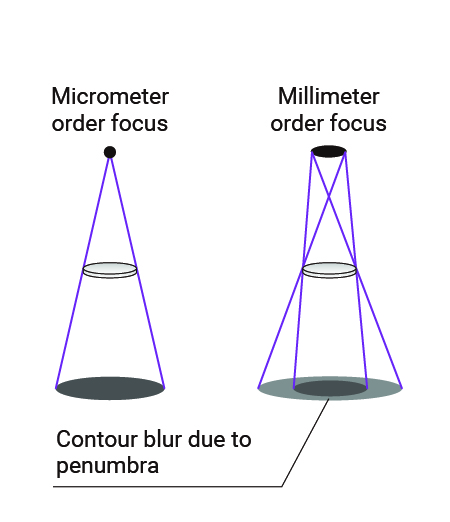
Fig. 1: Focal Spot Size
Geometric magnification
X-ray image magnification
When FDD1 is set to a constant value, the shorter the FOD2 is, the higher the geometric magnification calculated by FDD/FOD becomes.
1 FDD focus to detector distance: Distance from X-ray focal spot to X-ray detector.
2 FOD focus to object distance: Distance from X-ray focal spot to object.
Learn more about geometric magnification on page 4 of our MFX brochure.
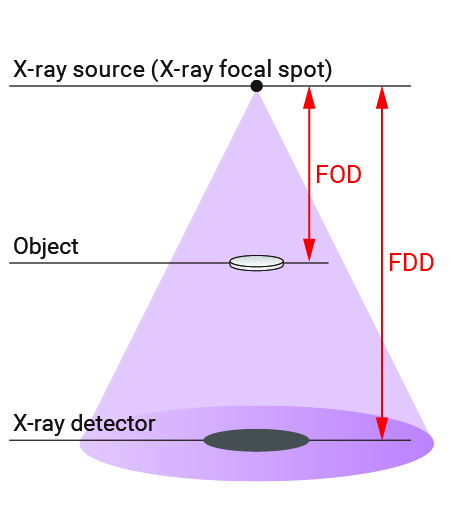
Fig. 2: Geometric magnification
Which type of X-ray detector is suitable for the detection of a 0.5 mm gap?
Our C14300/C14960 X-ray line scan camera series features a pixel size of 0.4 mm, although suitability can vary based on the geometry of the object and the position of the gap.
For more details, see the C14300/C14960 series cameras catalog.
Is the resolution limited by the source or the detector?
Resolution depends on both the focal spot size of the source and the resolution of the detector, as well as geometric magnification factors, as seen in Fig. 1 and Fig. 2 above.
For more details, see page 4 of the MFX brochure.
Is the resolution of the detector dependent on X-ray energies?
No, detector resolution does not depend on X-ray energy. Focal spot size, which is a key parameter influencing resolution, depends on X-ray tube power and can increase with tube voltage.
See our Microfocus X-ray Source brochure for more information.
What's the largest product you can support?
Standard single-energy line scan cameras with 0.4 mm pixel size support detection widths up to 921.6 mm. The maximum width of the object detectable with such a camera depends on the geometric magnification. For example, if a geometric magnification factor of 2 is used, an object of roughly 460 mm wide can be detected.
The length of the object is not a limit, as line scan cameras can measure continuously. Customization to achieve larger inspection width is possible, please contact your local sales team to explore this possibility. Alternatively, with photodiode arrays (PDA), you can tailor the detection width to your needs.
View more details in our C14300/C14960 Line Scan camera brochure and on our silicon photodiode arrays with amplifiers webpage.
Are X-ray inspection systems difficult to maintain?
They are not difficult to maintain, however, preventive maintenance is important due to potential radiation damage to both the X-ray source and detector. Regular checks and servicing help ensure reliable operation. Hamamatsu’s X-ray products are renowned for their resistance to radiation damage, resulting in minimal maintenance.
Why are X-rays so great?
X-rays are fantastic because they provide high-quality imaging capabilities essential for a wide range of applications. It's a deeper look than just what meets the eye. In these images of our beloved mascots, ORCA and HamaCATsu. you are getting a 'ray of insight' into their internal intricacies.
There is more to our ORCA than it ‘seams’!
If you examine the Orca X-ray image carefully, you'll notice finer details such as the plush seams that make up its fur, clearly demonstrating the high quality of the X-ray imaging produced by our MFX and TDI camera and the level of quality control this gives.
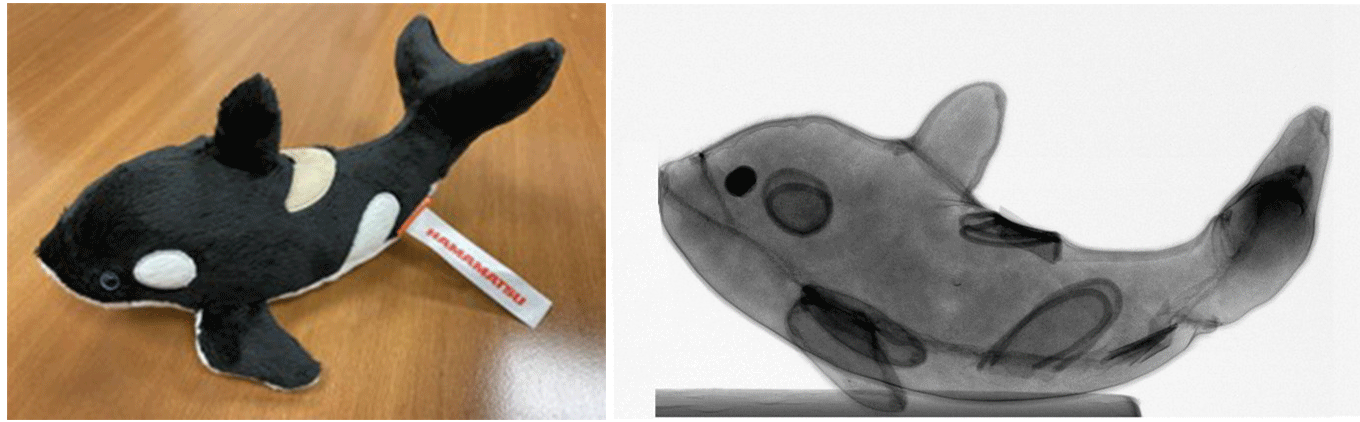
X-ray scan of the ORCA mascot at 60 kV / 650 µA using an L9631 MFX with a C12300-321 TDI camera.
Acquired at 1.21× geometric magnification with an object speed of 40 mm/s.
Our HamaCATsu X-ray image purr-fectly illustrates that there is more to our lucky friend than just fur. Thanks to the detailed insights provided by our MFX and TDI cameras, we can see the internal ‘tail’ of this little HamaCATsu, featuring various-sized belly pellets, some of which have wandered up to its head.
To find out how our X-ray solutions can help you see beneath the surface, contact your local X-ray specialists.
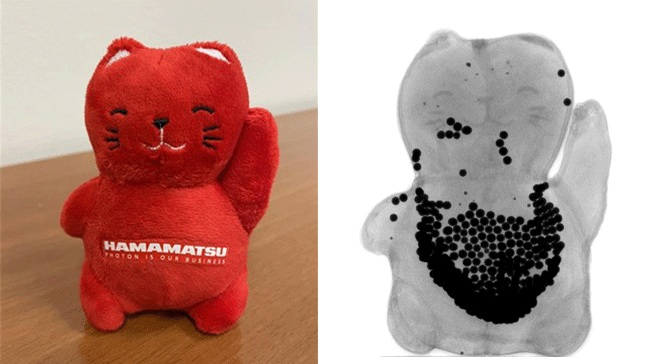
X-ray scan of the HamaCATsu mascot at 60 kV / 650 µA using an L9631 MFX with a C12300-321 TDI camera.
Acquired at 1.25× geometric magnification with an object speed of 40 mm/s.
- Confirmation
-
It looks like you're in the . If this is not your location, please select the correct region or country below.
You're headed to Hamamatsu Photonics website for GB (English). If you want to view an other country's site, the optimized information will be provided by selecting options below.
In order to use this website comfortably, we use cookies. For cookie details please see our cookie policy.
- Cookie Policy
-
This website or its third-party tools use cookies, which are necessary to its functioning and required to achieve the purposes illustrated in this cookie policy. By closing the cookie warning banner, scrolling the page, clicking a link or continuing to browse otherwise, you agree to the use of cookies.
Hamamatsu uses cookies in order to enhance your experience on our website and ensure that our website functions.
You can visit this page at any time to learn more about cookies, get the most up to date information on how we use cookies and manage your cookie settings. We will not use cookies for any purpose other than the ones stated, but please note that we reserve the right to update our cookies.
1. What are cookies?
For modern websites to work according to visitor’s expectations, they need to collect certain basic information about visitors. To do this, a site will create small text files which are placed on visitor’s devices (computer or mobile) - these files are known as cookies when you access a website. Cookies are used in order to make websites function and work efficiently. Cookies are uniquely assigned to each visitor and can only be read by a web server in the domain that issued the cookie to the visitor. Cookies cannot be used to run programs or deliver viruses to a visitor’s device.
Cookies do various jobs which make the visitor’s experience of the internet much smoother and more interactive. For instance, cookies are used to remember the visitor’s preferences on sites they visit often, to remember language preference and to help navigate between pages more efficiently. Much, though not all, of the data collected is anonymous, though some of it is designed to detect browsing patterns and approximate geographical location to improve the visitor experience.
Certain type of cookies may require the data subject’s consent before storing them on the computer.
2. What are the different types of cookies?
This website uses two types of cookies:
- First party cookies. For our website, the first party cookies are controlled and maintained by Hamamatsu. No other parties have access to these cookies.
- Third party cookies. These cookies are implemented by organizations outside Hamamatsu. We do not have access to the data in these cookies, but we use these cookies to improve the overall website experience.
3. How do we use cookies?
This website uses cookies for following purposes:
- Certain cookies are necessary for our website to function. These are strictly necessary cookies and are required to enable website access, support navigation or provide relevant content. These cookies direct you to the correct region or country, and support security and ecommerce. Strictly necessary cookies also enforce your privacy preferences. Without these strictly necessary cookies, much of our website will not function.
- Analytics cookies are used to track website usage. This data enables us to improve our website usability, performance and website administration. In our analytics cookies, we do not store any personal identifying information.
- Functionality cookies. These are used to recognize you when you return to our website. This enables us to personalize our content for you, greet you by name and remember your preferences (for example, your choice of language or region).
- These cookies record your visit to our website, the pages you have visited and the links you have followed. We will use this information to make our website and the advertising displayed on it more relevant to your interests. We may also share this information with third parties for this purpose.
Cookies help us help you. Through the use of cookies, we learn what is important to our visitors and we develop and enhance website content and functionality to support your experience. Much of our website can be accessed if cookies are disabled, however certain website functions may not work. And, we believe your current and future visits will be enhanced if cookies are enabled.
4. Which cookies do we use?
There are two ways to manage cookie preferences.
- You can set your cookie preferences on your device or in your browser.
- You can set your cookie preferences at the website level.
If you don’t want to receive cookies, you can modify your browser so that it notifies you when cookies are sent to it or you can refuse cookies altogether. You can also delete cookies that have already been set.
If you wish to restrict or block web browser cookies which are set on your device then you can do this through your browser settings; the Help function within your browser should tell you how. Alternatively, you may wish to visit www.aboutcookies.org, which contains comprehensive information on how to do this on a wide variety of desktop browsers.
5. What are Internet tags and how do we use them with cookies?
Occasionally, we may use internet tags (also known as action tags, single-pixel GIFs, clear GIFs, invisible GIFs and 1-by-1 GIFs) at this site and may deploy these tags/cookies through a third-party advertising partner or a web analytical service partner which may be located and store the respective information (including your IP-address) in a foreign country. These tags/cookies are placed on both online advertisements that bring users to this site and on different pages of this site. We use this technology to measure the visitors' responses to our sites and the effectiveness of our advertising campaigns (including how many times a page is opened and which information is consulted) as well as to evaluate your use of this website. The third-party partner or the web analytical service partner may be able to collect data about visitors to our and other sites because of these internet tags/cookies, may compose reports regarding the website’s activity for us and may provide further services which are related to the use of the website and the internet. They may provide such information to other parties if there is a legal requirement that they do so, or if they hire the other parties to process information on their behalf.
If you would like more information about web tags and cookies associated with on-line advertising or to opt-out of third-party collection of this information, please visit the Network Advertising Initiative website http://www.networkadvertising.org.
6. Analytics and Advertisement Cookies
We use third-party cookies (such as Google Analytics) to track visitors on our website, to get reports about how visitors use the website and to inform, optimize and serve ads based on someone's past visits to our website.
You may opt-out of Google Analytics cookies by the websites provided by Google:
https://tools.google.com/dlpage/gaoptout?hl=en
As provided in this Privacy Policy (Article 5), you can learn more about opt-out cookies by the website provided by Network Advertising Initiative:
http://www.networkadvertising.org
We inform you that in such case you will not be able to wholly use all functions of our website.
Close